
Emma cricket
Teleogryllus emma
Description
How to identify
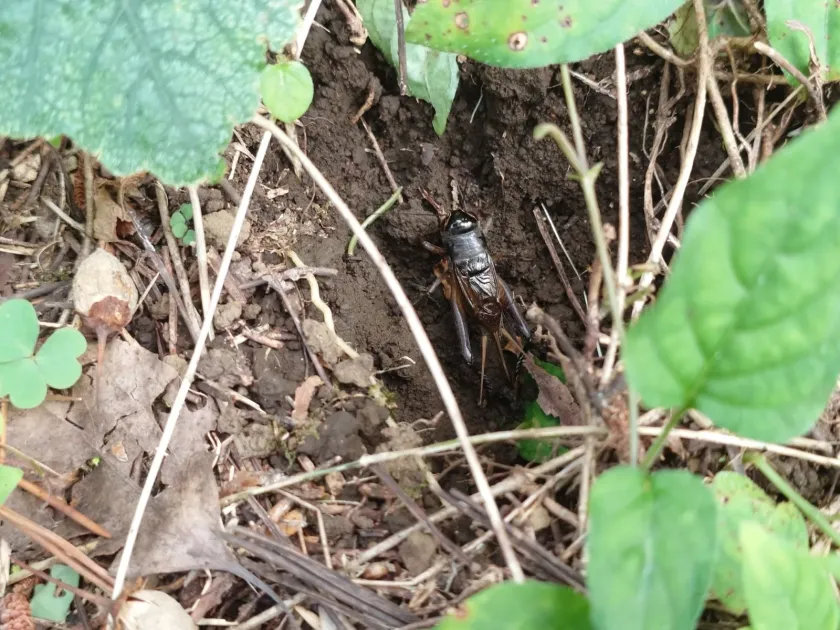
The Emma cricket (Teleogryllus emma) is a member of the Gryllidae family in the order Orthoptera. Adults typically measure between 20 and 28 millimeters in length.
They display a dark brown to black coloration. The head is robust and features long, thread-like antennae that are sensitive to environmental cues.
The forewings are hardened and thick, covering most of the abdomen. Females possess a prominent, needle-shaped ovipositor used for laying eggs deep in the soil.
Nymphs resemble smaller, wingless versions of the adults. They undergo several molting stages, gradually increasing in size and developing physiological maturity.
These insects are strictly nocturnal, spending their daylight hours hidden in burrows or beneath debris to avoid heat and predators.
What it damages
The Emma cricket is a significant polyphagous pest capable of attacking a wide variety of vegetable and cereal crops across agricultural landscapes.
Young seedlings of cucumbers, tomatoes, cabbage, corn, and soybeans are particularly susceptible to severe damage, often leading to total crop loss.
Equipped with powerful mandibles, these crickets can easily sever the stems of young plants at ground level, effectively destroying the plant's vascular system.
Beyond stem cutting, they feed on leaves and tender shoots, leaving behind ragged holes and necrotic tissue that inhibits the plant's ability to thrive.
The damage is most pronounced during dry seasons when the crickets migrate toward crops in search of moisture contained within the succulent plant tissues.
When it appears
Activity for the Emma cricket begins in late spring and persists through the summer months, largely dependent on soil temperature and humidity levels.
The species survives the winter primarily in the egg stage, with eggs buried deep enough in the soil to withstand freezing winter temperatures.
Mass hatching of nymphs typically occurs in June, coinciding with the rapid growth of many vegetable crops, providing an immediate food source for the nymphs.
Adults are present from July until early autumn, at which point mating and egg-laying cycles occur to ensure the survival of the next generation.
While there is generally only one generation per year, localized population explosions can occur if environmental conditions remain favorable.
Signs of infestation
The presence of Emma crickets is often signaled by small, circular entry holes in the soil located near the base of damaged or wilted plants.
Seedlings may appear to have been "pruned" or cleanly cut at the base, with the fallen tops often found nearby or dragged into the burrow.
Foliage damage appears as irregular, ragged edges or large holes in leaves, caused by the insects feeding on the soft tissue during the night.
Auditory identification is also possible, as males produce a loud, rhythmic chirping sound during the night to signal their location to potential mates.
- Excrement pellets found near plant stems.
- Wilting of plants without evidence of fungal or bacterial pathogens.
Control measures
Deep autumn plowing is a highly effective control measure, as it exposes the overwintering eggs to predators and freezing temperatures.
Sanitation practices, such as removing weeds and crop residues, deny these pests the shelter and daytime refuge they require for survival.
For chemical control, insecticidal baits applied to the soil surface are often more effective than standard spraying, as the pests are largely ground-dwelling.
Applying contact insecticides to the soil or around the perimeter of the field can help prevent migrations into high-value crop areas.
Implementing crop rotation is recommended to prevent the buildup of local cricket populations that can occur when the same host plants are grown repeatedly.
Taxonomy
- Latin name
- Teleogryllus emma
- Order
- Orthoptera (locusts)
- Family
- Gryllidae
- EPPO code
- GRYLEM
Discussion
No discussions yet — be the first.