
Tachystola acroxantha
Tachystola acroxantha
Description
How to identify
Tachystola acroxantha is a small moth belonging to the family Oecophoridae (concealer moths). Originating from Australia, this species has successfully spread across several European regions as an invasive insect.
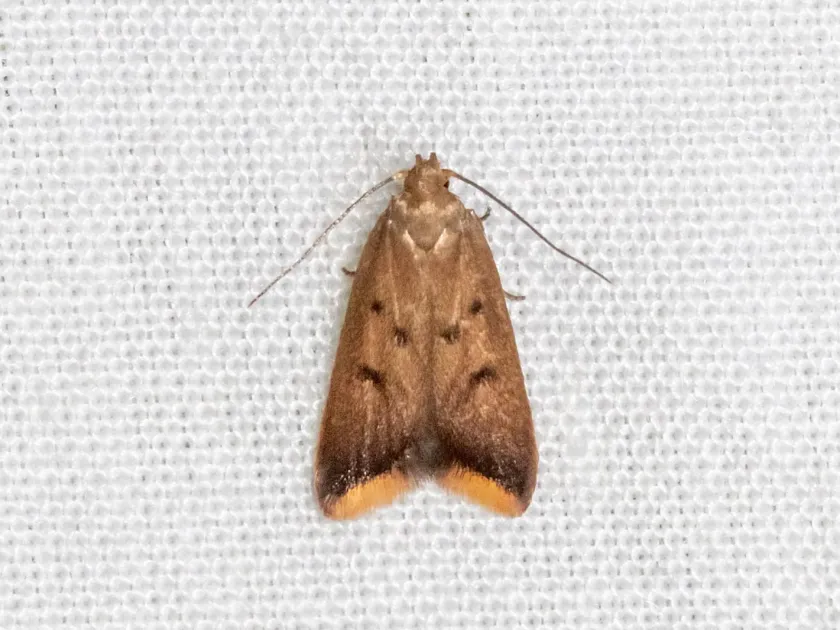
The adult moth typically has a wingspan of 12 to 16 mm. Its forewings are characterized by a yellowish-brown color with darker spots and a lighter apex, which serves as a key feature for identifying the species.
The larvae are small, cylindrical caterpillars with a light color and a prominent dark head capsule. They are known for their secretive nature, often spinning silk and hiding within debris or folded leaves.
Its life cycle includes egg, five larval instars, pupa, and adult stages. In warm climates, the species is capable of completing multiple generations within a single growing season.
While primarily a detritivore that feeds on decaying organic matter, high populations can shift to feeding on living plant tissues, posing a threat to various nursery and garden plants.
What it damages
The damage is primarily caused by the larvae, which feed on dry leaves, bark, and plant litter, but occasionally consume buds and young shoots when their primary food source is depleted.
Tachystola acroxantha can impact broad-leaved trees and ornamental shrubs. Caterpillars often congregate in branch forks where organic debris accumulates, expanding their feeding area to living tissue.
In nurseries, larval activity can be particularly damaging to young seedlings. By boring into the bark or consuming new growth, they can interfere with nutrient transport and weaken the plant.
Feeding damage to buds during the spring growth phase can lead to stunted development, leaf deformation, and poor structural growth of the plant.
Heavy infestations can lead to significant loss of aesthetic value in ornamental gardens and may predispose weakened trees to secondary infections by pathogens.
When it appears
Adult moth activity typically begins in late spring, with the peak flight period occurring throughout the summer months, particularly in June and July.
Larvae are active throughout the summer. Overwintering usually occurs in the larval stage or as pupae, hidden in sheltered areas like bark crevices, leaf litter, or the upper soil layer.
Early in the spring, once temperatures rise, the overwintered larvae resume feeding. This coincides with the bud break of many tree species, making this a critical window for monitoring.
The number of generations depends on local climate; in warmer regions, the species can build up large populations rapidly through continuous breeding cycles.
Activity gradually declines in the autumn, though larvae may continue to feed on bark and organic matter until the first hard frosts, if weather conditions remain mild.
Signs of infestation
One of the earliest signs of infestation is the presence of fine silk webbing between branches or on folded leaves, where caterpillars build their shelters.
Frass (larval excrement) is often visible as tiny dark granules trapped within the silken threads or gathered at the base of affected leaves.
Leaves showing signs of skeletonization or irregular holes, often accompanied by leaf curling, suggest the presence of active larvae.
Inspecting the bark of younger trees may reveal small tunnels or surface feeding tracks, which are clear indicators of caterpillar activity.
Using light traps in the evening can help gardeners and nursery managers detect the presence of adult moths, providing early warning to implement control measures.
Control measures
Sanitation is the most effective preventative measure. Regularly removing leaf litter, dead wood, and debris from the garden eliminates the primary habitat and food source for the larvae.
Pruning and destroying infected branches containing larval nests help to significantly reduce the local population of the moth.
Biological control using formulations based on Bacillus thuringiensis is highly effective against young larvae while remaining safe for beneficial insects and the environment.
In cases of high infestation, contact-stomach insecticides registered for use on the specific host plants can be applied during the larval emergence period.
Promoting a healthy garden ecosystem by protecting natural predators, such as insectivorous birds and parasitic wasps, assists in keeping populations of Tachystola acroxantha in check.
Taxonomy
- Latin name
- Tachystola acroxantha
- Order
- Lepidoptera (butterflies)
- Family
- Oecophoridae
- EPPO code
- TAHYAC
Discussion
No discussions yet — be the first.