
Brown house moth
Hofmannophila pseudospretella
Description
How to identify
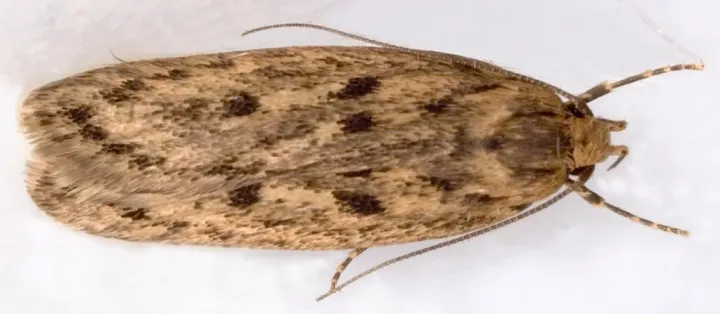
The Brown house moth (Hofmannophila pseudospretella) is a member of the Oecophoridae family. Adults are small moths with a wingspan ranging from 20 to 25 mm.
The forewings are typically mottled brownish-bronze with distinct dark spots, which provide excellent camouflage on warehouse surfaces and stored materials.
Larvae reach approximately 15–20 mm in length. They are characterized by a whitish to cream-colored body and a distinct, darker head capsule adapted for boring.
The pupae are enclosed in tough, silken cocoons often covered with debris, dust, or food particles, making them very difficult to detect during routine inspections.
This species is highly adapted to human environments, thriving in protected, stable indoor climates where they can complete their life cycle safely.
What it damages
This species is a generalist feeder and a significant pest of stored products, known for its ability to damage both plant-based seeds and organic matter.
In agricultural settings, it feeds on various grains, legumes, and cereals, causing direct losses by consuming the germ and ruining the viability of seeds.
Beyond agricultural produce, the larvae are notorious for damaging textiles, including wool, leather, and upholstery, as well as dried food products and stored botanical samples.
Larvae cause mechanical damage by boring into seeds, leaving behind hollowed-out husks that are structurally weak and nutritionally compromised.
Heavy infestations result in significant waste, as the larvae spin silken webbing that binds food together, creating contaminated clumps mixed with feces and molted skins.
When it appears
In temperature-controlled storage facilities and heated buildings, the Brown house moth breeds continuously throughout the year with no defined seasonal breaks.
The development time from egg to adult is highly temperature-dependent, typically taking three to four months under optimal room conditions.
In unheated granaries, the larvae enter a period of reduced activity in winter, surviving within their cocoons until warmer conditions stimulate further development.
Adult moth flight is most prominent during the warmer months when temperatures allow for rapid mating and dispersal throughout the facility.
Given the high reproductive potential of females, populations can increase rapidly in a matter of weeks if stored products are left undisturbed in warm, humid conditions.
Signs of infestation
The presence of adult moths resting on walls or ceilings, particularly at dusk, is often the first visual indicator of a breeding population.
Infested materials typically show signs of webbing or silk trails, which the larvae use to navigate and create protective tunnels within the food source.
Accumulations of small, dark granular frass (excrement) around or beneath stored bags suggest active larval feeding and development.
Visual inspection of seeds often reveals clear entry holes and hollow interiors, which are tell-tale signs of larval damage to the seed's embryo.
A musty or moldy odor may develop in long-term storage, as the webbing and debris trap moisture and promote the growth of secondary microorganisms.
Control measures
Effective management begins with rigorous warehouse hygiene, including the complete removal of spilled grain and dust from cracks and crevices between seasons.
Maintaining low humidity levels and cool temperatures is crucial for suppressing the reproductive success and metabolic rate of the moth population.
- Deployment of pheromone-based monitoring traps to track moth activity.
- Cold storage or freezing of high-value seeds to eliminate all life stages.
- Application of appropriate residual insecticides in empty storage areas.
- Use of airtight storage containers to isolate clean seed stocks from potential infestation.
Regular monitoring and rotation of stored stocks ensure that infestations are detected early, preventing widespread loss and the need for chemical intervention.
Taxonomy
- Latin name
- Hofmannophila pseudospretella
- Order
- Lepidoptera (butterflies)
- Family
- Oecophoridae
- EPPO code
- HOFMPS
Discussion
No discussions yet — be the first.