
White-shouldered house moth
Endrosis
Description
How to identify
The white-shouldered house moth, scientifically known as Endrosis sarcitrella, is a common member of the Oecophoridae family often found in food storage facilities.
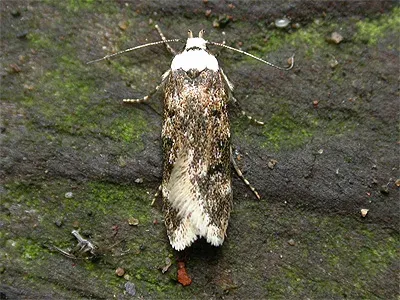
The adult moth is easily recognized by its distinctive appearance: it has white or greyish-white heads and thoracic segments, giving it a unique "white-shouldered" look.
The wingspan of this moth typically ranges from 15 to 22 mm, and the forewings are mottled with dark grey or brown patches.
The larvae are whitish with a brown head, usually reaching about 12 mm in length when they reach full development.
This species is highly adaptable and is found globally, thriving in indoor environments where organic debris is present.
What it damages
The larvae are the primary damaging stage, as they feed on a wide variety of dried plant materials and organic waste products.
They are frequently encountered in grain silos, flour mills, seed warehouses, and areas where dried fruits or animal feeds are kept.
Damage occurs when larvae consume the product and spin dense webbing, which causes clumping and contamination of the storage medium.
In addition to food sources, these moths can damage natural fibers, old nest materials, and even museum herbarium collections.
Economic impact is significant because infested batches of grain or food products must often be discarded due to contamination with silk and frass.
When it appears
In temperature-controlled storage environments, the white-shouldered house moth can continue its lifecycle throughout the entire year.
In unheated areas, adult moths are typically most active from late spring through the summer and early autumn months.
The life cycle duration is highly dependent on ambient temperature and humidity levels, with warmer conditions accelerating development.
Females are prolific egg-layers, depositing eggs in crevices or directly onto suitable food sources to ensure larval survival.
Multiple generations can occur annually if the climate inside the warehouse remains consistently moderate and moist.
Signs of infestation
Visible webbing on the surface of grain bags, walls, or shelving units is the most reliable indicator of an active infestation.
Inspection often reveals small, dark granular frass left behind by the larvae as they feed on the stored products.
- Adult moths resting on ceilings or dark wall surfaces.
- Silken tunnels created by larvae inside bags of flour or grain.
- Visible holes in kernels or seeds where larvae have bored inside.
- A characteristic musty odor emanating from infested stock.
Control measures
Sanitation is the most important preventive measure, including the regular removal of spilled grain, dust, and old debris from storage areas.
Managing the moisture content of grain is crucial, as damp conditions provide the optimal environment for the larvae to develop rapidly.
Surface treatments using approved residual insecticides can help manage adult moth populations within the warehouse structure.
Fumigation of the commodity is recommended when heavy infestations are detected to ensure the complete elimination of all life stages.
Regular monitoring using pheromone traps can help detect the presence of the moth early, allowing for timely intervention before populations explode.
Taxonomy
- Latin name
- Endrosis
- Order
- Lepidoptera (butterflies)
- Family
- Oecophoridae
- EPPO code
- ENDRSP
Discussion
No discussions yet — be the first.