
White-shouldered house moth
Endrosis sarcitrella
Description
How to identify
The white-shouldered house moth (Endrosis sarcitrella) belongs to the order Lepidoptera and the family Oecophoridae. Adult moths typically have a wingspan ranging from 15 to 20 millimeters.
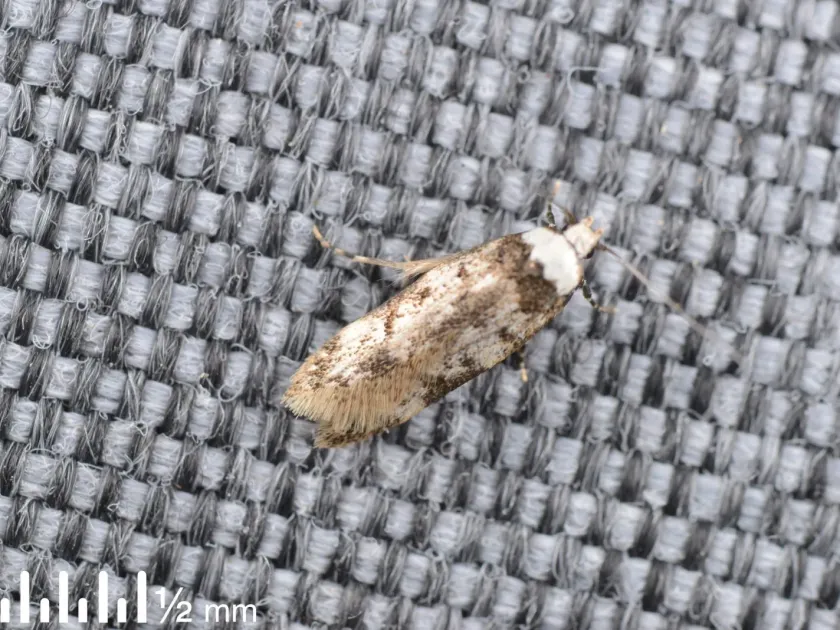
The moth is easily identified by its distinctive white head and thorax, which stand out against the grayish-brown forewings. The wings often display obscure dark spots or mottling.
Larvae reach approximately 12-15 millimeters in length. Their bodies are whitish to yellowish with a darker, brownish head capsule, and they are sparsely covered with fine, pale hairs.
Pupation occurs within a loosely woven silk cocoon. These are frequently found in crevices of warehouse walls, floorboards, or hidden deep within the stored products themselves.
This species is a cosmopolitan pest, meaning it is found globally in homes, warehouses, barns, and mills, thriving wherever organic debris or stored grains accumulate.
What it damages
As a polyphagous insect, the white-shouldered house moth feeds on a wide variety of materials, including stored cereals, pulses, seeds, dried fruits, and even animal-based products.
Larvae are particularly damaging to stored food supplies. They feed on the grain endosperm, significantly reducing the weight, nutritional value, and germination potential of seeds.
Besides agricultural products, they consume plant dust, debris, and textile materials like burlap bags, making them persistent pests in poorly maintained storage facilities.
The presence of larvae leads to contamination of the entire batch of products with silk webbing, excrement, and cast skins, which promotes the growth of mold and bacteria.
In large-scale storage, this insect can remain unnoticed for long periods because it exploits inaccessible gaps and corners, creating a continuous source of re-infestation.
When it appears
In heated indoor environments like residential homes or temperature-controlled warehouses, the moth can breed throughout the entire year without a dormant phase.
The life cycle is highly temperature-dependent. Activity levels increase significantly when temperatures reach 20–25 degrees Celsius, which is optimal for rapid development.
In unheated granaries or barns, the larvae or pupae undergo a period of reduced activity during winter. Development resumes promptly once temperatures rise in the spring.
Depending on environmental conditions, the moth can produce multiple generations annually, which makes it challenging to eradicate once established in a building.
Adult moths are nocturnal and most active at twilight. They are strong fliers and can easily disperse throughout a facility to lay eggs on suitable food sources.
Signs of infestation
The primary indicator of an infestation is the presence of silky webbing on the surface of grain or within storage containers, created by larvae as they move and feed.
Sightings of adult moths flying near walls or ceilings in the evening are a definitive sign that a reproductive population is present in the storage area.
Accumulation of small, dark, granular frass (larval excrement) within the grain bulk is a strong diagnostic feature indicating that larvae are actively feeding inside.
Grain kernels showing hollowed-out centers or exit holes confirm that larvae have completed their development inside the seed, rendering it useless for processing or planting.
Damage to packaging materials, such as holes in sacks or cocoons stuck to the fabric, provides visual proof of the moth’s lifecycle progression within the warehouse.
Control measures
Sanitation is the most effective defense. Regularly cleaning storage areas to remove dust, spilled grain, and debris eliminates the moth's secondary food sources.
Maintaining grain moisture levels below 13-14 percent is crucial, as lower humidity levels inhibit the survival and developmental rate of the larvae.
In cases of heavy infestation, professional fumigation of the premises using approved insecticides is necessary to eliminate all life stages, including eggs and pupae.
Using pheromone traps helps monitor the moth population, allowing for precise timing of interventions and reducing the need for broad-spectrum chemical treatments.
- Deep clean all storage areas before adding new stock.
- Store grain in airtight, high-quality containers.
- Keep humidity levels low and ensure proper ventilation.
- Regularly inspect stocks for webbing and larval activity.
Taxonomy
- Latin name
- Endrosis sarcitrella
- Order
- Lepidoptera (butterflies)
- Family
- Oecophoridae
- EPPO code
- ENDRLA
Discussion
No discussions yet — be the first.