
Brown house moth
Hofmannophila
Description
How to identify
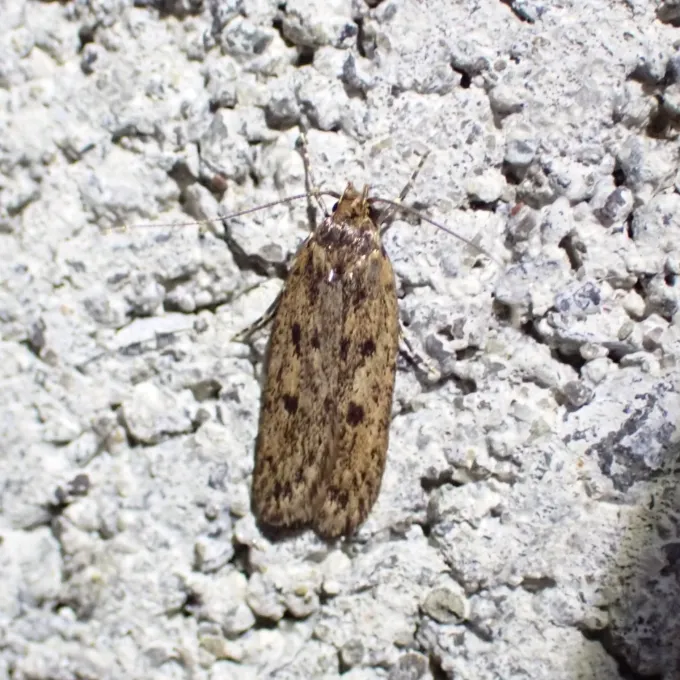
The Brown house moth (Hofmannophila pseudospretella) is a member of the Oecophoridae family within the Lepidoptera order. The adult moth has a wingspan ranging from 15 to 25 mm, with forewings that are brown to bronze in color, marked with dark, distinct spots that provide camouflage against wood and stored grain backgrounds.
The larvae, which are responsible for the damage, reach up to 20 mm in length. They have a cream-colored body and a brown head capsule. These larvae are known for their high mobility, allowing them to travel considerable distances from the initial infestation site in search of food sources.
Pupation occurs within a silken cocoon, often reinforced with particles of the food substrate or debris, which helps the pupa blend in with its environment. In centrally heated buildings, the life cycle is significantly shortened, allowing the moth to reproduce throughout the year.
Adult moths are primarily nocturnal and do not feed on solid food. Their lifespan is dedicated to mating and laying eggs. They possess sensitive organs that help them find suitable substrates for oviposition, which is why infestations often begin in cracks and crevices near food stocks.
Each female can lay several hundred eggs, usually deposited in small batches. The eggs are tiny, oval, and whitish, making them very difficult to spot with the naked eye. They are strategically placed in areas where the emerging larvae will have immediate access to nutrients.
What it damages
As polyphagous pests, Brown house moth larvae feed on a vast array of organic materials. In agricultural and commercial settings, they are frequent pests of stored grain, seeds, dried fruits, flour, cereals, and animal feeds, significantly lowering the market value of the goods.
Beyond agricultural produce, the larvae are notorious for damaging textiles, including wool, silk, carpets, and fur. They also infest organic materials found in museums and archives, such as natural history collections, dried plants, and book bindings containing organic adhesives.
Damage is characterized by larvae tunneling into seeds and grain kernels, leaving behind silk webbing, excrement (frass), and cast larval skins. This contamination renders the grain unfit for human consumption or for use as high-quality seed, as the germ is often destroyed.
High moisture levels in storage areas are a major catalyst for infestation. Larvae thrive in damp conditions, and the presence of moisture also encourages the growth of fungi on the infested product, which further accelerates the rate of decay and damage caused by the moth.
Economic loss is twofold: it involves the direct consumption and destruction of the product, and the costly requirement for professional decontamination or the complete disposal of heavily infested batches of grain and seeds that have been compromised by larvae activity.
Control measures
Sanitation is the most effective preventative measure. This includes the thorough removal of spillage and dust from storage areas, cleaning machinery and floors, and ensuring that no old or infested products remain in corners, under pallets, or in cracks where larvae can hide.
Monitoring using pheromone traps is highly recommended to detect the presence of adults early. By identifying the initial emergence of the moth, store managers can intervene with localized treatments before the infestation becomes widespread and difficult to manage.
Temperature control is a key tool for suppression. Keeping storage temperatures below 10°C drastically slows the growth rate of the larvae and disrupts the reproductive cycle of the moths. Regular ventilation and cooling of grain bulks are essential practices for long-term storage.
For large-scale infestations, chemical control via fumigation is necessary. Phosphine-based fumigants are commonly used to penetrate stored grain and eliminate larvae deep within the bulks. This process requires expert application to ensure both safety and efficacy within a sealed environment.
Finally, exclusion tactics should be employed to protect new stocks. This includes using insect-proof packaging, sealing cracks in warehouse structures, and performing rigorous inspections of all incoming deliveries to prevent the introduction of eggs or larvae into clean storage facilities.
Taxonomy
- Latin name
- Hofmannophila
- Order
- Lepidoptera (butterflies)
- Family
- Oecophoridae
- EPPO code
- HOFMSP
Discussion
No discussions yet — be the first.