
Syntormon pallipes
Syntormon pallipes
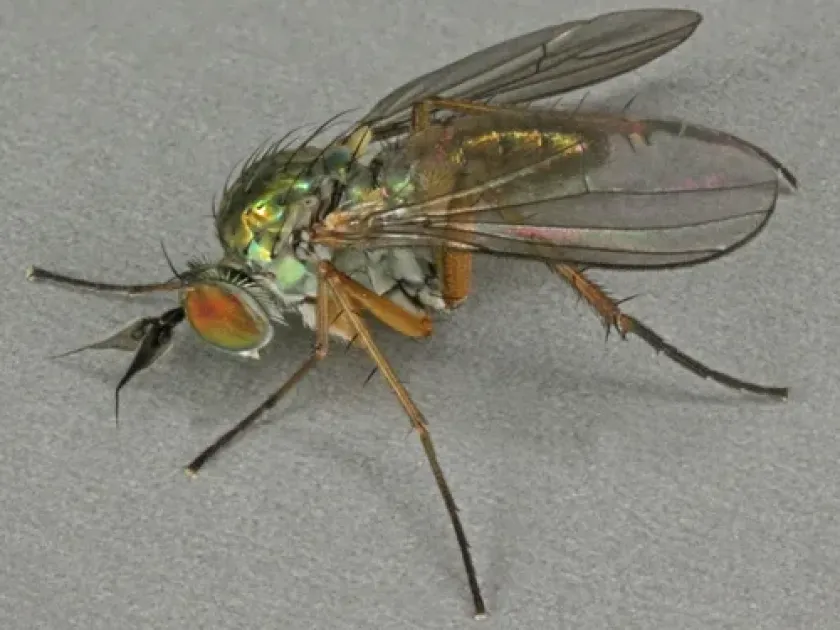
Description
How to identify
Syntormon pallipes belongs to the Dolichopodidae family, commonly known as long-legged flies. These are small, metallic-colored flies that are frequently found in moist environments and are common across various agricultural landscapes.
Adult flies typically measure between 2 to 4 mm in length. Their appearance is defined by a shiny, often greenish or coppery body and relatively pale legs, which is a diagnostic feature used by entomologists for classification.
The life cycle involves larval stages that reside in the soil. These larvae are vermiform, translucent, and lack a distinct head capsule, allowing them to navigate easily through soil organic matter.
Identification often requires careful inspection of the micro-habitat. They are most frequently observed near irrigation drips, drainage areas, or places where organic debris is decomposing.
While often considered beneficial in some ecological contexts due to predation by adults, the larval stages can become problematic in intensive horticultural systems where they feed on young plant roots.
What it damages
The primary agricultural concern stems from the larval activity in the rhizosphere. Larvae feed on the delicate root hairs and epidermal layers of young transplants, causing significant stress to the host plant.
These root injuries serve as entry points for secondary soil-borne pathogens, including Pythium and Rhizoctonia species, which lead to root rot and eventual plant collapse.
In greenhouse settings, high densities of larvae can stunt crop development, resulting in uneven stands and reduced yield quality. Affected plants exhibit signs of nutrient deficiency despite adequate fertilization.
Vegetable crops such as lettuce, peppers, and cucumbers are particularly susceptible during their early growth stages when the root system is not yet fully developed and resilient.
Management of the pest is crucial because the concealed nature of the damage often leads to delayed treatment, by which time the plants have already suffered significant loss of vigor.
When it appears
The fly's activity is highly dependent on humidity and temperature. In temperate regions, adults emerge in spring when soil temperatures allow for the completion of pupal development.
Peak population levels are typically recorded during mid-summer months when irrigation regimes provide consistent moisture in the upper soil layers, favoring larval survival and growth.
During the autumn, the population gradually declines as temperatures drop. The insect enters overwintering stages, usually remaining in the soil or protected organic debris until the following season.
In greenhouses, where environmental conditions are optimized for year-round production, Syntormon pallipes can produce multiple overlapping generations, necessitating constant vigilance.
Monitoring programs should be initiated early in the season, focusing on high-moisture zones, as these are the primary colonization sites for the pest.
Signs of infestation
The first noticeable symptom of an infestation is the sudden drooping or wilting of seedlings during the brightest part of the day, which does not necessarily correlate with soil moisture levels.
Upon closer inspection, the roots will show brown discoloration and eroded tissues. The presence of tiny, translucent larvae within the root ball confirms the infestation.
Gardeners and farmers might observe adult flies flying low over the soil surface, particularly after disturbing the mulch or the top layer of the substrate.
Reduced vigor and chlorotic (yellowing) leaves often indicate that the plant is struggling to uptake water due to impaired root function caused by larval feeding.
- Wilting in morning hours.
- Root decay and necrotic tissue.
- Presence of flies near irrigation lines.
Control measures
The most effective management strategy is the optimization of irrigation to avoid waterlogged conditions, which are highly conducive to larval development.
Soil sanitation is paramount. Steaming or solarization of the growing medium before planting can significantly reduce the overwintering population of larvae.
Biological control using entomopathogenic nematodes (such as Steinernema species) has proven effective in suppressing larval populations within the soil profile without chemical residues.
Regular monitoring using yellow sticky cards helps track adult activity and informs the timing of preventive measures to avoid large-scale infestations.
If chemical control is deemed necessary, insecticides should be applied as soil drenches in compliance with local regulations and pre-harvest intervals to ensure food safety.
Taxonomy
- Latin name
- Syntormon pallipes
- Order
- Diptera (flies)
- Family
- Dolichopodidae
- EPPO code
- SYTOPA
Discussion
No discussions yet — be the first.