
Long-legged fly
Campsicnemus scambus
Description
How to identify
The long-legged fly, scientifically known as Campsicnemus scambus, belongs to the Dolichopodidae family, order Diptera. These are small, often shiny insects typically displaying a metallic green or bronze sheen.
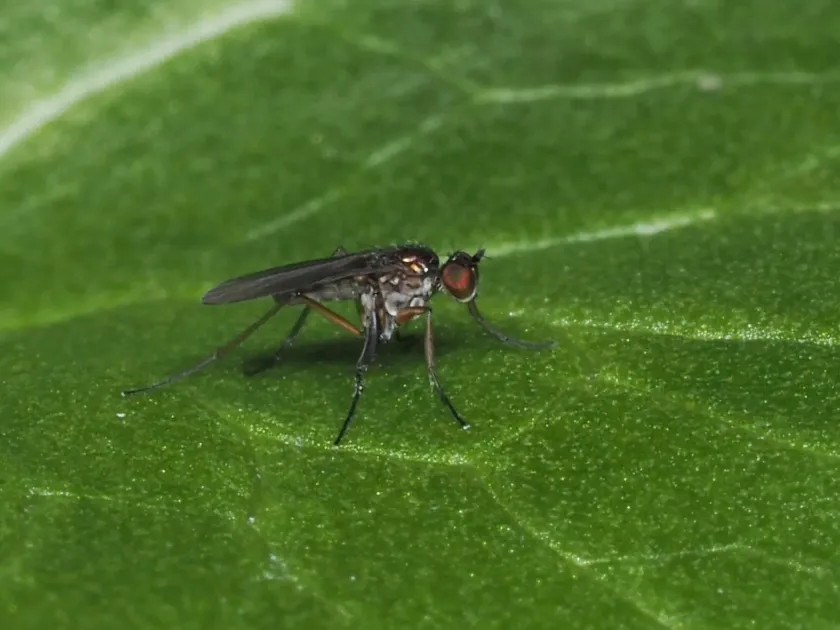
Adults possess elongated legs, enabling them to move rapidly across soil surfaces and damp foliage. The head is relatively large with prominent compound eyes, and their mouthparts are adapted for feeding on liquid nourishment.
Larvae of this species have the typical vermiform shape of fly maggots, lack limbs, and are whitish or cream-colored. They develop primarily in moisture-rich environments containing high levels of organic matter, which defines their distribution.
A distinctive feature of the adults is the specific behavior of males during mating, which involves energetic movements and "dances" on the substrate. In agricultural settings, they are often overlooked due to their diminutive size.
The species is widespread in temperate latitudes, favoring habitats with high humidity levels, including the edges of irrigated fields, wetlands, and areas adjacent to water bodies that border agricultural plots.
What it damages
While many Dolichopodidae are predatory, some species, including Campsicnemus scambus, may exhibit phytophagous or saprophagous tendencies in their larval stage. In agriculture, the damage is primarily caused by the larvae.
The main crops at risk include moisture-loving vegetables and cereals grown in waterlogged soils. The pest concentrates in the root zone, where the soil is most saturated with moisture.
Larvae damage the root systems of young plants by chewing tunnels through tender root tissues. This weakens the plant's overall immunity and makes it susceptible to secondary fungal and bacterial infections.
In cases of high pest density, mass mortality of seedlings can occur, especially during early growth stages. Infested plants show stunted growth, yellowing leaves, and distorted root systems.
Economic damage manifests as a reduction in crop stand density and loss of market quality. Periods of heavy rainfall are particularly dangerous as they stimulate the reproduction of this insect within the soil profile.
When it appears
Adult activity of Campsicnemus scambus is observed throughout the growing season, starting from late spring and continuing through early autumn. Population peaks often coincide with periods of high humidity.
The development of the insect is directly dependent on soil temperature regimes. Optimal conditions for reproduction are achieved at moderate temperatures, characteristic of early and late summer.
Larvae reside in the soil almost constantly, and their activity increases with rising groundwater levels. During the winter, the pest is capable of overwintering as larvae or pupae in deeper soil layers.
Migration of adult flies occurs on warm, calm days. During this time, they actively colonize new areas, preferring damp, shaded sites with abundant plant debris for oviposition.
A second generation of flies usually emerges by mid-August, posing a threat to winter crops or late-season vegetable plantings. Monitoring the population during these periods is critical for agronomists.
Signs of infestation
Signs of infestation include the sudden wilting of seedlings or young plants despite adequate soil moisture. Upon excavating such plants, one may observe damaged tissues near the root collar.
On the soil surface in areas of high fly concentration, tiny exit holes made by emerging insects may occasionally be spotted. These holes often remain undetected due to their extremely small diameter.
An indirect sign is the presence of patches of "missing" plants in the field where seedlings died early on. Often, adult flies can be seen hovering above the moist soil in these areas.
Root damage caused by larvae is accompanied by characteristic darkening of the tissues at the entry points. Pathogenic fungi often invade these wounds, leading to root rot of various etiologies.
Soil sample analysis is the most reliable diagnostic method. The detection of larvae within the top 10-15 cm of the soil confirms the presence of this pest on the field.
Control measures
The primary control measure is strict adherence to crop rotation and avoiding the cultivation of moisture-loving plants on waterlogged areas without proper drainage. Soil drainage is an effective preventive method.
Mechanical soil cultivation, including deep autumn plowing, helps destroy overwintering sites and reduce larval populations by exposing them to the surface, where they succumb to cold weather.
Applying agronomic practices, such as choosing optimal sowing dates, allows plants to pass the critical stage where they are most vulnerable to larval root damage.
In cases of high risk to valuable crops, the use of soil-applied insecticides is permissible. Products based on organophosphates or neonicotinoids demonstrate high efficacy against soil-borne pests.
Biological control involves the use of entomopathogenic fungi and nematodes, which are natural enemies of Campsicnemus scambus larvae, helping to reduce the overall pesticide burden on the agroecosystem.
Taxonomy
- Latin name
- Campsicnemus scambus
- Order
- Diptera (flies)
- Family
- Dolichopodidae
- EPPO code
- CMPSSC
Discussion
No discussions yet — be the first.