
Long-legged fly
Dolichopus popularis
Description
How to identify
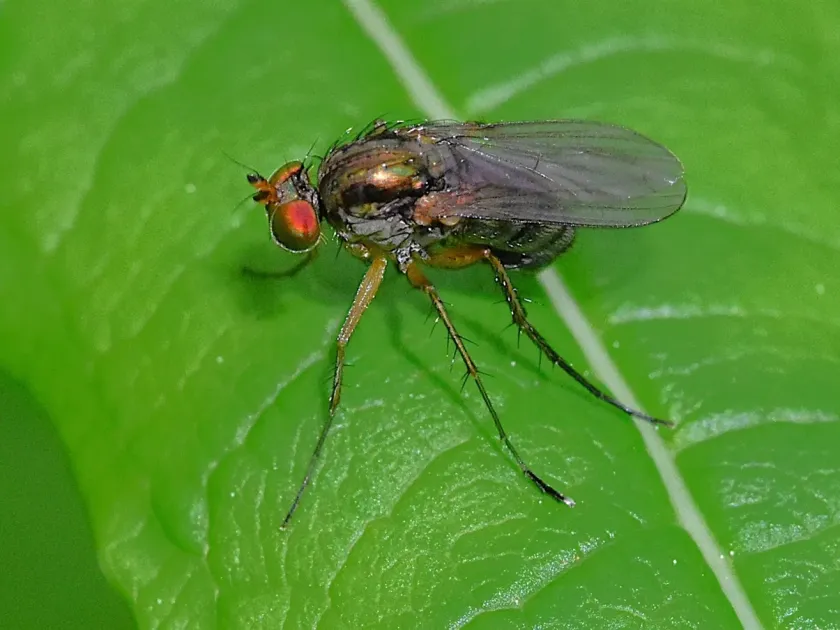
The long-legged fly Dolichopus popularis belongs to the order Diptera and the family Dolichopodidae. These are small insects distinguished by their metallic body sheen, which can appear green, copper, or bluish.
Adults have a slender body approximately 5-7 mm long, elongated legs, and transparent wings. The head is large, with eyes covering most of its surface, providing an excellent field of vision.
The larvae of these flies are cylindrical, elongated, and whitish or yellowish in color, lacking a well-defined head capsule. They typically develop in the soil or in damp organic substrates.
Imagoes are often found on plant leaves, near water bodies, or on moist field areas, where they are active and move quickly across the surface.
Taxonomy of this species requires careful examination, as the family contains numerous similar species identified by male genitalia structures and wing patterns.
What it damages
While most members of the family are predatory, the larvae of certain species can damage the underground parts of young plants, leading to wilting.
In an agronomic context, these flies are often seen as associated species, but high populations can cause significant harm to the root systems of agricultural crops.
Young seedlings of cereals and vegetables are most vulnerable to damage, as root infestation leads to a loss of turgor and potential plant death.
Crops grown on waterlogged soils are at the highest risk, as larvae prefer a moist environment for their development.
Damage manifests as microscopic feeding tunnels, which can act as entry points for pathogenic fungi and bacteria, causing root rot.
When it appears
Adult activity of Dolichopus popularis is observed during the warm season, typically from late May through early September.
Population peaks usually occur in mid-summer, coinciding with the active growth period of many field crops.
The life cycle includes the egg stage, three larval instars, the pupal stage, and the imago, with overwintering most commonly occurring at the larval stage in the soil.
Under favorable conditions, one or two generations may develop during a single season, depending strictly on soil temperature and moisture levels.
Damp weather conditions facilitate faster development of the larval stage and increase female fecundity.
Signs of infestation
A sign of infestation can be localized wilting of seedlings in waterlogged field sections that is not caused by insufficient irrigation.
Upon inspecting the root systems of affected plants, one may discover larvae or characteristic feeding galleries within the root tissues.
Sudden yellowing of leaf tips in young plants, without visible signs of foliage-eating pests, often indicates hidden root damage.
The presence of large numbers of adult flies on the soil surface or lower leaves during the morning hours serves as an indirect indicator of high population density.
Specific soil-related damage accompanied by secondary bacterial infections confirms the activity of dipterous soil larvae.
Control measures
Effective management relies on agronomic practices aimed at regulating soil moisture and improving field drainage.
Crop rotation helps interrupt the pest life cycle, preventing the accumulation of larvae in the soil associated with continuous cultivation of a single crop.
Deep autumn plowing aids in destroying larvae and pupae residing in the topsoil layer, exposing them to entomophages and birds.
Chemical protection is rarely used and is only justified in cases of massive crop damage during early vegetative stages through the application of soil insecticides.
- Drainage of waterlogged field sections
- Adherence to optimal planting dates
- Use of high-quality seed material
- Monitoring imago populations with yellow sticky traps
Taxonomy
- Latin name
- Dolichopus popularis
- Order
- Diptera (flies)
- Family
- Dolichopodidae
- EPPO code
- DLPSPO
Discussion
No discussions yet — be the first.