
Campsicnemus
Campsicnemus
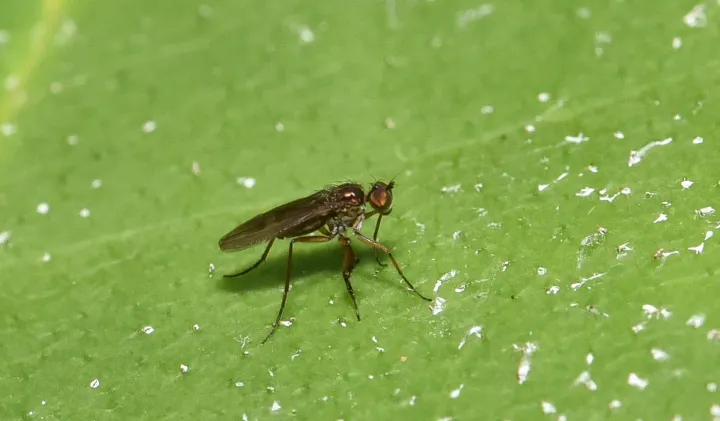
Description
How to identify
Campsicnemus is a genus of flies belonging to the family Dolichopodidae, commonly known as long-legged flies. These insects are typically small, often characterized by a metallic or shiny coloration, which is a common trait among many species in this diverse family.
Identification of specific species within the genus requires professional entomological keys, as the morphology of wings and legs is highly specialized. Adults are generally active and exhibit unique movement patterns on the surface of soil or vegetation.
The larvae of Campsicnemus live in hidden environments, preferring moist habitats. They possess a cylindrical, legless body, which allows them to navigate easily within plant tissues or the upper layers of damp soil.
The biological cycle follows a complete metamorphosis, including egg, larva, pupa, and adult stages. This life cycle allows the genus to adapt effectively to moist microclimates, which are often found in irrigated agricultural landscapes.
While many species in the Dolichopodidae family are known predators, certain species may exhibit associations with crops that become problematic under high population densities, necessitating careful monitoring by agronomists.
What it damages
The primary damage to crops is caused by the larval stage. In agricultural settings, Campsicnemus larvae can attack the root system and the base of the stems of young plants, particularly in waterlogged areas.
Feeding damage by larvae creates entry points for secondary infections, such as fungi and bacteria. This often leads to the development of root rots or vascular diseases, making it difficult to diagnose the original cause of plant wilting.
Crops that require frequent irrigation are particularly susceptible to infestation. High larval density can lead to patchy crop stands, stunted development, and potential seedling mortality during the early stages of growth.
Economic losses arise from both direct seedling loss and reduced overall yield potential. Inconsistent crop development complicates mechanical field operations and may necessitate additional investments in reseeding or intensive protection.
The severity of the damage is closely linked to soil moisture levels and temperature. Favorable conditions allow populations to build up rapidly, making regular field inspections crucial for effective damage control.
When it appears
Adult activity peaks during the spring and summer months, corresponding with favorable temperatures for mating and egg-laying. This period coincides with the germination and early seedling growth of many crops, which are the most vulnerable stages.
In irrigated farming systems, multiple generations may occur within a single growing season. This creates a constant risk of infestation if soil conditions remain consistently moist and conducive to larval development.
Adult flies are most active during the early morning and late evening hours. These times are ideal for conducting monitoring activities, including the use of yellow sticky traps to track population fluctuations.
The larval stage is highly dependent on groundwater levels and moisture content. While drought conditions can reduce their activity, larvae can survive in deeper soil layers or near water sources, awaiting more favorable conditions to re-emerge.
As the season ends, the insects transition into overwintering stages. Successful control often depends on identifying these hibernation sites, which typically include soil protected from frost and high moisture retention areas.
Signs of infestation
The first indicator of infestation is often the appearance of irregular patches of stunted or wilting plants within a field. These areas typically show uneven growth compared to the rest of the crop.
Upon inspecting the root system, researchers may find characteristic feeding channels made by the larvae. The damaged areas of the roots often show necrosis, turning dark brown or black as the tissue decomposes.
The presence of adult flies on damp soil surfaces or lower leaves in the early morning can serve as a diagnostic sign. Yellow sticky traps placed near the base of the plants can help confirm the presence of the pest.
Damage often mimics symptoms of common root diseases. Therefore, thorough examination of the subterranean parts of the plant is necessary to distinguish between microbial pathogens and insect feeding damage.
General plant malaise, despite adequate irrigation and nutrient availability, is a strong signal that soil-dwelling pests might be interfering with the plant’s ability to take up water and minerals.
Control measures
Integrated pest management strategies are essential for controlling Campsicnemus. Improving soil drainage is a critical measure, as reducing stagnant water significantly discourages larval development.
Crop rotation is an effective preventive strategy. Avoiding the planting of susceptible crops in the same field for several consecutive years disrupts the life cycle and reduces the local population density.
Seed treatment with systemic insecticides provides a necessary protective barrier for seedlings during the most vulnerable early growth stages, effectively preventing initial larval attacks.
When monitoring data indicates that the population has crossed the economic injury threshold, chemical intervention with systemic insecticides may be required. Timing treatments to coincide with peak larval emergence is key.
- Enhancing field drainage systems.
- Deep autumn plowing to disturb overwintering sites.
- Continuous monitoring using traps.
- Managing weed populations that serve as alternative hosts.
Taxonomy
- Latin name
- Campsicnemus
- Order
- Diptera (flies)
- Family
- Dolichopodidae
- EPPO code
- CMPSSP
Discussion
No discussions yet — be the first.