
African buffalo
Syncerus caffer
Description
How to identify
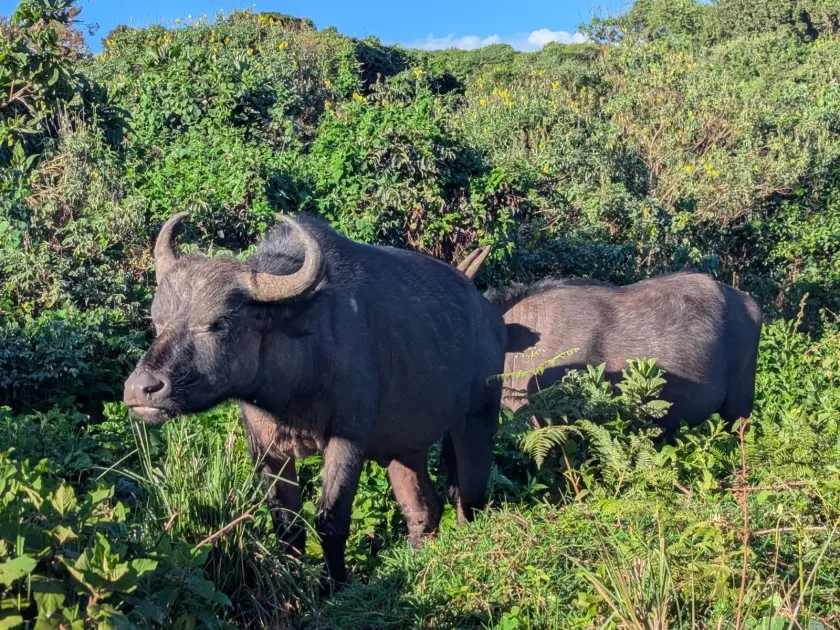
The African buffalo (Syncerus caffer) is a large bovid, a member of the Bovidae family, known for its massive physical build and aggressive temperament.
The species is identified by its heavy, curved horns that meet in the middle to form a hard, helmet-like shield across the forehead of adult individuals.
These animals possess a thick, coarse coat that typically ranges in color from dark brown to deep black, often appearing darker in older males.
They are highly gregarious animals, living in large herds that can range from a few dozen to several hundred individuals, creating a significant impact on any environment.
They require large amounts of water and forage, which forces these herds to move across wide territories in search of suitable grazing areas.
What it damages
The main agricultural threat is the total destruction of crops through heavy trampling, which packs the soil and kills the root systems of young plants.
Herds consume vast quantities of grain crops, including maize, sorghum, and wheat, often clearing entire fields during a single nocturnal feeding session.
They frequently destroy infrastructure, including irrigation pipes, water channels, and perimeter fencing, causing significant financial losses to farmers.
African buffaloes are documented as vectors for several livestock diseases, such as foot-and-mouth disease, which can devastate local ranching operations.
Repeated grazing by buffalo herds leads to severe soil degradation and compaction, reducing the long-term fertility and water-holding capacity of the land.
When it appears
The movement of herds towards agricultural zones usually intensifies during the dry season when natural water sources and grazing lands in the wild become depleted.
They follow seasonal patterns of rainfall, moving towards fertile, irrigated farmlands that provide fresh, green feed when surrounding areas are barren.
Most damage occurs during the night or early morning hours, as buffaloes are primarily crepuscular and nocturnal feeders in agricultural landscapes.
The presence of herds on farmland is highly correlated with the vegetative stage of the crops, as they are attracted to the high nutrient content of cultivated plants.
Farmers must monitor local wildlife movements throughout the year, especially during periods of extreme drought when herd migrations become unpredictable.
Signs of infestation
Deep, distinct tracks left by heavy hooves in the soil are the most obvious indicator that a herd has recently passed through or stayed in the field.
Evidence of feeding consists of broken stalks, stripped vegetation, and uprooted crops, indicating a large, non-selective group of herbivores.
The presence of large, fresh dung piles is a reliable sign of recent buffalo activity in the immediate vicinity of the cultivated land.
Damage to perimeter security, such as bent fence posts, torn wire, or broken gates, clearly indicates that a herd has attempted to penetrate the field.
Characteristic noise and the strong, musky odor of the herd can often be detected by farm workers shortly after the animals have occupied an area.
Control measures
Effective control requires the construction of high-tensile steel fencing, which is designed to withstand the physical weight and impact of large buffalo.
Electric fencing systems with high-voltage capabilities are highly effective at discouraging buffalo herds from entering restricted agricultural areas.
Motion-activated alarm systems combined with flashing strobe lights can successfully deter buffalo from approaching crops during night hours.
Integrated wildlife management strategies, including the creation of buffer zones, are essential for preventing direct contact between wild herds and farms.
Constant vigilance and proactive patrolling are required, especially near boundaries of national parks or wild savannah regions, to prevent herd incursions.
Taxonomy
- Latin name
- Syncerus caffer
- Family
- Bovidae
- EPPO code
- SYKRCA
Discussion
No discussions yet — be the first.