
Springbok
Antidorcas marsupialis
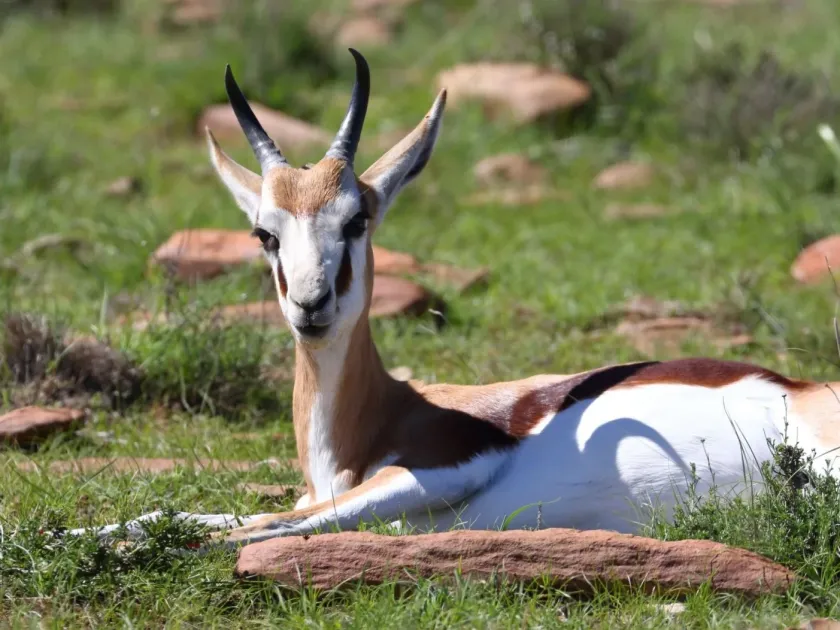
Description
How to identify
The Springbok (Antidorcas marsupialis) belongs to the order Artiodactyla and the family Bovidae. It is a small but extremely agile antelope characterized by a distinctive white pocket-like flap on its back.
The animal is easily identified by its contrasting coloration: a reddish-brown back separated from a white belly by a dark stripe. With a shoulder height of 70–85 centimeters, it can navigate various terrains with ease.
The species is known for its high jumping ability, often leaping up to 3 meters into the air. This skill makes it a significant challenge for conventional agricultural fencing.
Its biology is closely linked to the arid regions of Southern Africa. They are gregarious animals, which increases the intensity of their impact on specific agricultural areas during migration.
Breeding is not restricted to a specific season, though activity peaks occur after rainfall when vegetation becomes highly succulent and attractive for grazing.
What it damages
The primary damage caused by springboks involves intensive grazing on field crops, especially during their active growth stages. They consume both wild grasses and cultivated cereals with equal appetite.
The most severe losses are recorded in wheat, maize, and alfalfa fields. During drought periods, when natural pastures dry up, springbok herds frequently migrate onto irrigated agricultural lands.
In addition to consuming green biomass, the animals cause mechanical damage to soil and seedlings with their hooves. During mass movements, herds are capable of trampling significant areas of young crops.
Damaged plants lose their ability to develop properly, leading to a substantial decrease in yield. In some cases, crops can be almost entirely destroyed within a very short period.
Furthermore, springboks can potentially act as vectors for various diseases that pose a risk to livestock kept on adjacent farming plots.
Control measures
Protecting crops from springboks requires a multifaceted approach, as they are a protected species in many areas. The primary defense is the installation of specialized fencing designed to withstand jumping.
An effective solution is the installation of "high" fences (over 2 meters) with a reinforced bottom section to prevent both leaping over and digging under the mesh.
Visual and acoustic deterrents may provide a temporary solution, but these animals adapt very quickly to static frightening devices.
The application of repellents on the perimeter of fields shows moderate effectiveness, as springboks demonstrate high adaptability to changing dietary conditions.
It is recommended to integrate agrotechnical measures, such as creating buffer zones around fields that are less attractive to antelopes, in order to divert them from the main crop area.
Taxonomy
- Latin name
- Antidorcas marsupialis
- Family
- Bovidae
- EPPO code
- ATDCMA
Discussion
No discussions yet — be the first.