
European bison
Bison bonasus
Description
How to identify
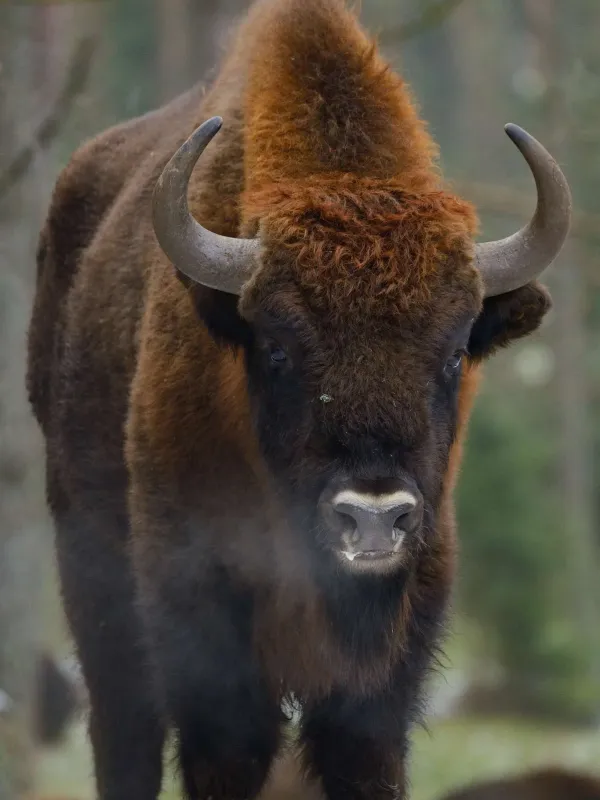
The European bison (Bison bonasus) is the largest herbivorous mammal in Europe, belonging to the Bovidae family. Characterized by a massive frame, a prominent shoulder hump, and thick brown fur, these animals are truly imposing.
They are gregarious animals that move in herds. This social structure allows them to cover large territories, which increases their potential impact on nearby agricultural lands during migration or foraging.
Bison are biologically adapted to forest environments, but habitat loss and seasonal food scarcity often lead them to venture into open fields, especially those located near forest edges.
From an agronomic perspective, the bison acts as a sporadic but highly impactful pest. Due to their immense weight, a single herd can compromise the soil structure of a field in a matter of hours.
Understanding their behavior is essential for developing long-term strategies that balance wildlife conservation with the protection of essential food production areas.
What it damages
Winter wheat and rye are among the primary targets for bison, especially during late winter and early spring when natural food sources in the forest are depleted. The animals graze on green shoots, hindering crop establishment.
In addition to cereals, bison feed on fodder beet, maize, and rapeseed. They can consume large quantities of biomass, significantly reducing the yield potential of the affected field sections.
Mechanical damage is a significant factor. The heavy weight of the bison leads to soil compaction and the destruction of seedlings, which disrupts the growth uniformity across the entire field.
Orchards and young forest plantations are also prone to damage. Bison often strip bark from trees or break branches, which leads to stunted growth or the eventual death of the affected trees.
The cumulative damage often extends beyond simple consumption, as the disturbance to the field makes subsequent agricultural machinery operations more difficult and inefficient.
Signs of infestation
The most obvious signs of bison presence are their large, deep hoof prints, which are easily distinguishable from those of deer or domestic livestock due to their size and weight.
Large patches of flattened and trampled vegetation appear in the fields. These areas show signs of heavy feeding, with plants being grazed down to the ground in a non-selective manner.
The presence of large dung piles is a definitive indicator of a herd's movement. These droppings are similar in appearance to those of large domestic cattle but are scattered along the path of the herd.
Broken branches and damaged bark on trees adjacent to the fields suggest that the herd uses these areas for resting or rubbing, which can damage the edges of commercial plantations.
Farmers can often identify patterns of movement through the field, where the bison have established trails leading from the forest edge toward the most palatable crops.
Control measures
Physical barriers such as high-tensile electric fencing remain the most reliable method for protecting valuable crops from bison intrusion. These fences must be maintained to handle the weight and strength of the animals.
Implementing a buffer zone strategy, where specific low-value forage crops are planted on the fringes of the property, can help lure bison away from premium commercial crops.
Non-lethal deterrents, including strobe lights and sonic devices, can be effective in the short term, though they require regular adjustment to prevent the animals from becoming habituated.
Collaboration with local conservation authorities is critical. Establishing designated winter feeding stations within the forest interior can significantly reduce the pressure on neighboring agricultural fields.
- Maintenance of electric fencing systems.
- Strategic planting of decoy food plots.
- Use of movement-activated alarm systems.
- Coordination with forest rangers for herd management.
- Monitoring of migration corridors using drone surveillance.
Taxonomy
- Latin name
- Bison bonasus
- Family
- Bovidae
- EPPO code
- BISOBO
Discussion
No discussions yet — be the first.