

Pest · Lepidoptera (butterflies)
Currant clearwing
Synanthedon tipuliformis
Description
How to identify
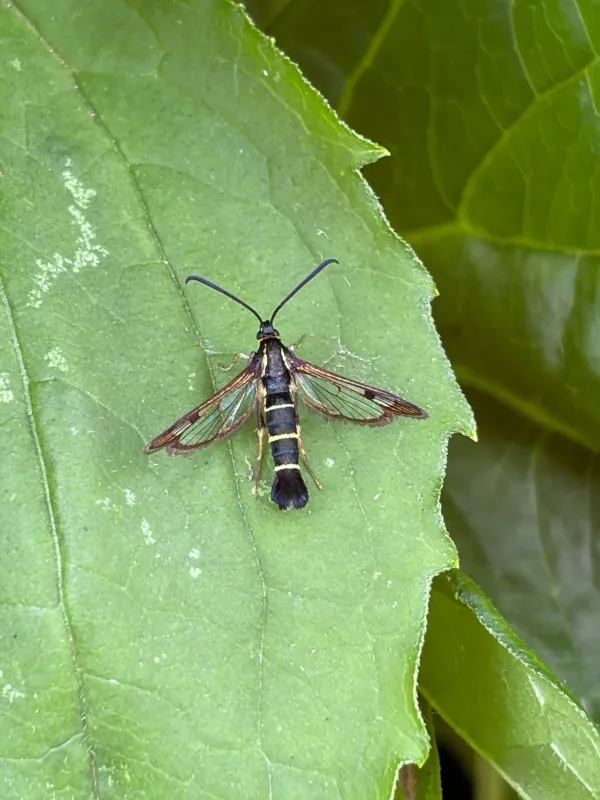
The currant clearwing Synanthedon tipuliformis is a moth belonging to the family Sesiidae. Its appearance is a form of mimicry, as it closely resembles a small wasp.
Adult moths have a wingspan of approximately 20–22 mm, with clear, transparent wings that feature distinct dark margins and veins.
The body of the adult is dark blue or black with three yellow transverse bands on the abdomen, which is a key trait for identification in the field.
The larvae are creamy-white with a brownish head. They spend up to two years developing inside the stems of their host plants, hidden from predators.
Female moths lay eggs singly near the buds or in bark crevices. This strategic placement ensures that neonate larvae can quickly bore into the woody tissue.
What it damages
The currant clearwing primarily infests blackcurrants, but it also attacks redcurrants, whitecurrants, and gooseberries in home gardens and commercial orchards.
Larvae bore into the center of the shoots, creating tunnels that destroy the pith. This disruption affects the flow of nutrients and water within the plant.
Infested branches often show reduced vigor, stunted growth, and significantly smaller berries, eventually leading to the death of the affected canes.
Young shoots are particularly vulnerable. When these are targeted, the overall development of the bush is severely hampered, reducing its lifespan.
High infestation levels can lead to cumulative damage, where the bush becomes sparse, unproductive, and prone to secondary infections or winter damage.
When it appears
The flight period for adult moths typically begins during the flowering phase of the currants and continues through late June.
Monitoring for adults during this period is essential for timing management practices, such as the deployment of pheromone traps.
Larvae overwinter within the stems of the host plant in various stages of development, protected from extreme cold by the woody structure.
Pupation occurs inside the tunnels in the spring. Before the adult emerges, the pupa moves toward a pre-drilled exit hole in the bark.
Because the emergence of adults is staggered over several weeks, repeated monitoring is necessary to ensure that control measures are applied at the right time.
Signs of infestation
The most visible sign of an infestation is the wilting and premature drying of individual branches during the growing season while the rest of the bush remains healthy.
When cutting open an affected stem, one can observe a hollow tunnel running through the pith, which is often filled with larval frass.
Small circular exit holes on the surface of the bark, often near buds or pruning wounds, indicate that adults have successfully emerged.
Leaves on infested branches often turn yellow or wither before autumn, providing a clear contrast to the healthy foliage of the bush.
- wilting and dieback of currant branches;
- hollowed pith inside the shoots;
- stunted bush growth and reduced yields;
- visible exit holes on the stems.
Control measures
The primary control method is thorough pruning of infested branches. Cuts must be made well below the tunnel until healthy, solid pith is reached.
All infested wood must be removed and burned immediately to destroy the larvae and prevent further spread throughout the orchard.
Pheromone traps are highly effective for monitoring flight activity and can help reduce the mating success of adult moths if used in sufficient numbers.
Chemical control should target the period of egg-laying or early larval emergence before they bore into the shoots, as they become impossible to reach once inside.
Maintain plant health through appropriate fertilization and water management, which helps bushes withstand minor infestations and recover more effectively.
Content graph
Connections · Currant clearwing
Most often together:
Marketplace
Products · 1
Biology
Taxonomy
- Latin name
- Synanthedon tipuliformis
- Order
- Lepidoptera (butterflies)
- Family
- Sesiidae
- EPPO code
- SYNATI
Community
Discussion
No discussions yet — be the first.