
Hornet moth
Aegeria crabroniformis
Description
How to identify
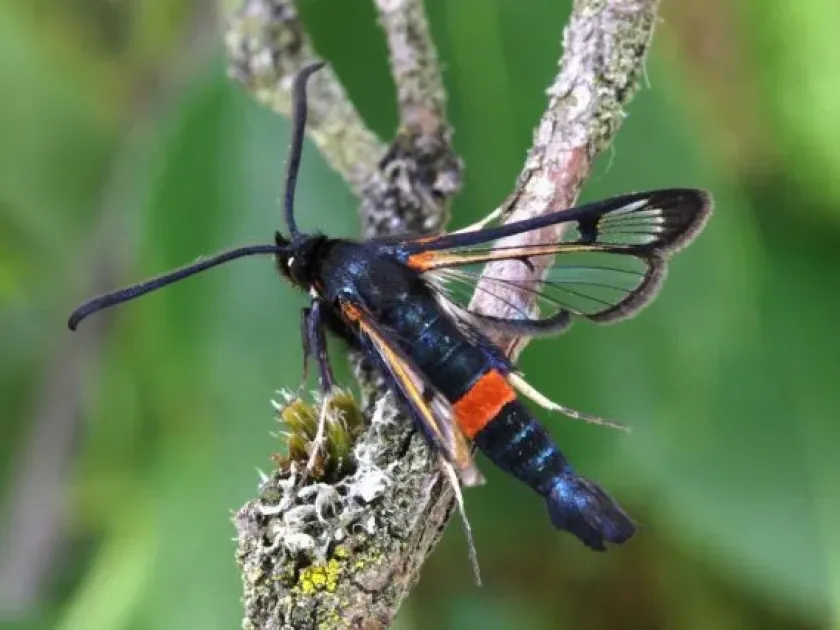
The hornet moth (Aegeria crabroniformis) is a clearwing moth from the family Sesiidae. Its appearance is a classic example of Batesian mimicry, as it closely resembles a hornet in both size and coloration.
The adult moth features black and yellow banding on its abdomen and transparent wings with dark margins. These features effectively protect the adult from many predators that avoid stinging insects.
The larvae are whitish-yellow with brown heads and can grow up to 40 mm in length. They spend their life cycle living inside the trunks and root stocks of host trees, protected by the wood.
The life cycle typically spans two years. During this period, the larvae consume the internal tissues of the tree, significantly damaging the vascular system necessary for water and nutrient transport.
Pupation occurs within the larval galleries. Before the adult emerges, the pupa uses specialized hooks to move toward the exit hole, allowing the moth to escape the tree effectively.
What it damages
The primary hosts of the hornet moth are trees in the Salicaceae family, specifically poplars (Populus) and willows (Salix). It is considered a significant pest in both forests and ornamental plantings.
Larvae bore deep galleries into the lower trunk and root collar. These tunnels severely weaken the structural integrity of the tree and disrupt the flow of sap, which is critical for survival.
Young trees are especially vulnerable to infestation. Repeated damage by larvae can cause stunted growth and, in severe cases, the tree may snap or die during strong winds or drought conditions.
The galleries serve as entry points for secondary infections. Fungi and bacteria can infiltrate the wood through these holes, leading to further internal decay and potential tree mortality.
In commercial tree nurseries, the hornet moth causes significant economic losses by lowering the quality of timber and reducing the viability of young saplings before they reach maturity.
Signs of infestation
Visible signs of infestation usually appear at the base of the trunk. The most characteristic indicator is the presence of frass (larval waste) that accumulates in small mounds at the exit holes.
Affected trees often exhibit swellings or irregular cracks on the bark near the soil line. These deformations occur as the tree attempts to heal the wounds created by the burrowing larvae.
General tree decline is another warning sign. Symptoms include sparse canopy cover, yellowing leaves, or premature leaf drop, signaling that the roots are no longer functioning optimally.
The presence of empty pupal cases protruding from the bark during late spring and early summer is a definitive sign that the moth has successfully completed its development within that specific tree.
- Mounds of sawdust and frass near the root collar
- Circular exit holes on the trunk surface
- Bark cracking and localized stem swellings
- Premature yellowing or shedding of foliage
- Empty pupal shells protruding from the exit holes
Control measures
Effective management begins with good silvicultural practices. Protecting the bark from mechanical damage is essential, as the moth is attracted to wounds where it can easily deposit eggs.
Sanitation is a vital control measure. Infested trees should be identified early, removed, and destroyed to prevent the adult moths from spreading the infestation to nearby healthy trees.
Chemical control involving systemic or contact insecticides can be applied during the flight period of the adult moths. Proper timing is crucial to target eggs before larvae bore into the bark.
Biological control, such as encouraging natural predators like insectivorous birds or parasitic wasps, can help keep moth populations within acceptable levels in natural forest environments.
Monitoring using pheromone traps is highly recommended for plantation management. This allows for precise timing of interventions, reducing the need for excessive chemical use.
Taxonomy
- Latin name
- Aegeria crabroniformis
- Order
- Lepidoptera (butterflies)
- Family
- Sesiidae
- EPPO code
- AEGECR
Discussion
No discussions yet — be the first.