
Hornet moth
Aegeria
Description
How to identify
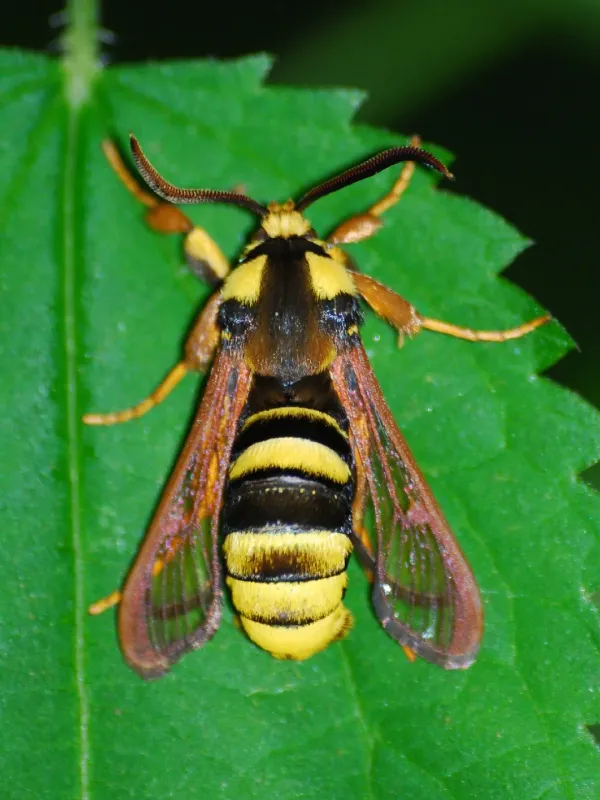
The hornet moth (lat. Aegeria apiformis) belongs to the order Lepidoptera and the family Sesiidae. The adult moth displays a remarkable resemblance to a hornet, which is a classic example of mimicry.
The wingspan of the adult moth ranges from 35 to 45 millimeters. Its body is covered with dense yellow and black hairs, and the wings are mostly transparent with dark margins and veins.
The larvae, or caterpillars, grow up to 50 millimeters long and have a yellowish-white body with a brown head. They lead a cryptic lifestyle, tunneling through the wood.
The life cycle of this insect in northern regions often lasts two years, while in warmer southern climates, it may be completed in a single season.
Pupae are brownish in color and possess specialized spines that help them protrude from the exit hole before the adult moth emerges.
What it damages
The primary host plants for this pest include various species and hybrids of poplar. It can also infest willows and aspens.
The damage is caused by the larvae, which bore galleries into the lower trunk and root collar, significantly weakening the tree.
The hornet moth poses the greatest threat to young plantations and nurseries, where heavy infestations can lead to the widespread death of saplings.
Mature trees, when heavily infested, lose structural integrity, becoming prone to windthrow and more susceptible to secondary fungal infections through open wounds.
Damage to the root collar disrupts sap flow, causing stunted growth, premature leaf yellowing, and eventual tree mortality.
When it appears
Adult flight occurs from late June through early August, coinciding with the flowering period of many nectar-producing plants.
After mating, females lay eggs individually in bark crevices or near the base of the trunk, close to the soil surface.
Upon hatching, young larvae begin boring into the bark, gradually moving deeper into the wood to feed and continue their development.
The larvae overwinter in their galleries within the roots or the lower section of the trunk, remaining in a state of diapause until warm weather returns.
Pupation takes place inside the wood in spring or early summer, after which the pupa moves toward the exit, allowing the adult to emerge safely.
Signs of infestation
The primary sign of hornet moth presence is the appearance of circular holes in the lower trunk and root collar area.
Frass—a mixture of larval excrement and wood shavings—can often be found accumulating at the base of infested trees.
Empty pupal cases protruding from the bark are visible after adult emergence, signaling that the moths have recently left the tree.
Infested trees often appear weakened, with visible signs of crown dieback and discoloration of the bark where larval feeding is active.
- Darkening of the bark near the root collar.
- Sap or resin leaking from larval galleries.
- Premature leaf drop.
- Reduced annual shoot growth.
Control measures
In forestry, maintaining high sanitary standards and removing heavily infested trees are essential steps for managing populations.
The use of biological control agents, such as entomopathogenic nematodes, has proven effective when applied directly into larval galleries.
In nurseries, pheromone traps are recommended for monitoring moth population levels and disrupting mating by confusing the males.
Chemical treatments with insecticides during the egg-laying period can help eliminate young larvae before they penetrate deep into the wood.
Good silvicultural practices, including proper site selection and ensuring optimal growing conditions, help boost the tree's natural resilience to infestation.
Taxonomy
- Latin name
- Aegeria
- Order
- Lepidoptera (butterflies)
- Family
- Sesiidae
- EPPO code
- AEGESP
Discussion
No discussions yet — be the first.