
Pacific clearwing moth
Aegeria pacifica
Description
How to identify
The Pacific clearwing moth (Aegeria pacifica) belongs to the Sesiidae family of the order Lepidoptera, well-known for their resemblance to Hymenoptera.
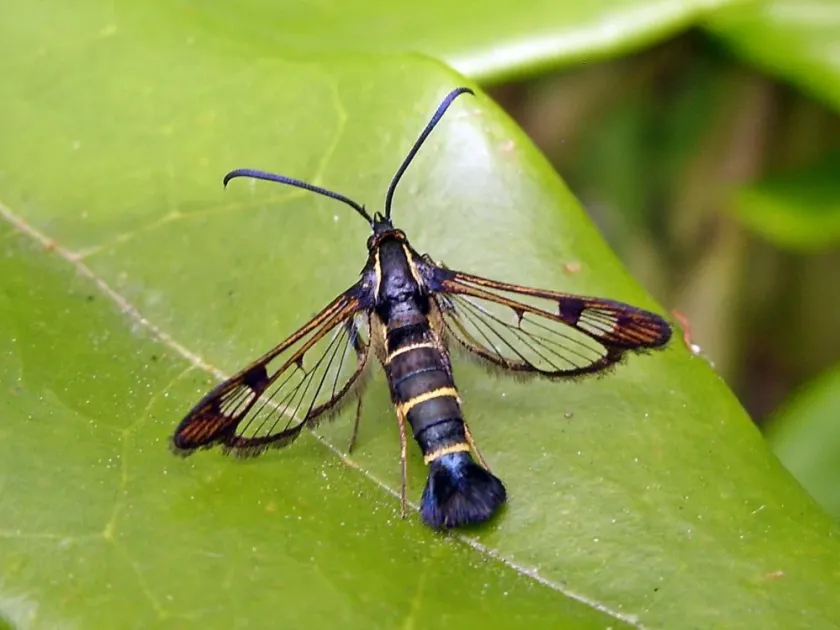
Adult moths feature clear, transparent areas on their wings and dark bodies with bright bands, mimicking the appearance of wasps or hornets to deter predators.
The larvae are internal feeders, developing inside the wood or under the bark of their host trees, which makes them difficult to identify during early stages.
As members of the clearwing family, these moths are primarily active during the day, which is atypical for many other nocturnal moth species.
The duration of their life cycle is highly dependent on environmental factors, typically requiring one to two years to complete development.
What it damages
These pests target a variety of pome and stone fruit crops, including apple, pear, and cherry trees, causing significant structural damage.
The larvae bore into the trunk and branches, often entering through wounds, pruning cuts, or frost cracks, and feed on the nutrient-rich cambium layer.
This mining activity disrupts the tree's vascular system, preventing the flow of water and essential nutrients from the roots to the canopy.
Severe infestations can lead to limb dieback, reduced fruit quality, and can ultimately kill young or weakened trees if the trunk is girdled.
The cumulative damage often weakens the tree, making it susceptible to secondary infections by wood-decay fungi and other pests.
Signs of infestation
The presence of fine, sawdust-like frass (larval excrement) ejected from holes in the bark is the most reliable indicator of an active infestation.
On stone fruits, clear or amber-colored sap oozing from the entry holes is a common sign, often mixed with larval debris and wood shavings.
Careful inspection of the trunk may reveal visible entrance holes, sometimes covered with silk or small bits of bark debris.
During the growing season, infected branches may show chlorosis (yellowing), wilting, or premature leaf drop due to impaired nutrient transport.
Peeling back the outer layer of bark in suspected areas will expose the galleries where the larvae live and feed, providing definitive proof of their presence.
Control measures
Effective management begins with maintaining tree health, including proper pruning and sealing pruning wounds with sealant to prevent egg-laying.
Pheromone traps are excellent tools for monitoring population levels and timing insecticide applications to coincide with the peak flight of adult moths.
Mechanical control involves carefully cutting out localized infestations and applying systemic insecticides to the affected trunk areas to eliminate larvae.
Treatment should be focused on the egg-laying period, ensuring that the chemical barrier prevents the neonate larvae from successfully entering the bark.
- Sanitary pruning to remove infested wood
- Use of systemic insecticides during adult flight
- Encouraging natural bird predators in the orchard
- Installing trunk guards or sticky barriers
Taxonomy
- Latin name
- Aegeria pacifica
- Order
- Lepidoptera (butterflies)
- Family
- Sesiidae
- EPPO code
- AEGEPA
Discussion
No discussions yet — be the first.