
Alcathoe clearwing
Alcathoe
Description
How to identify
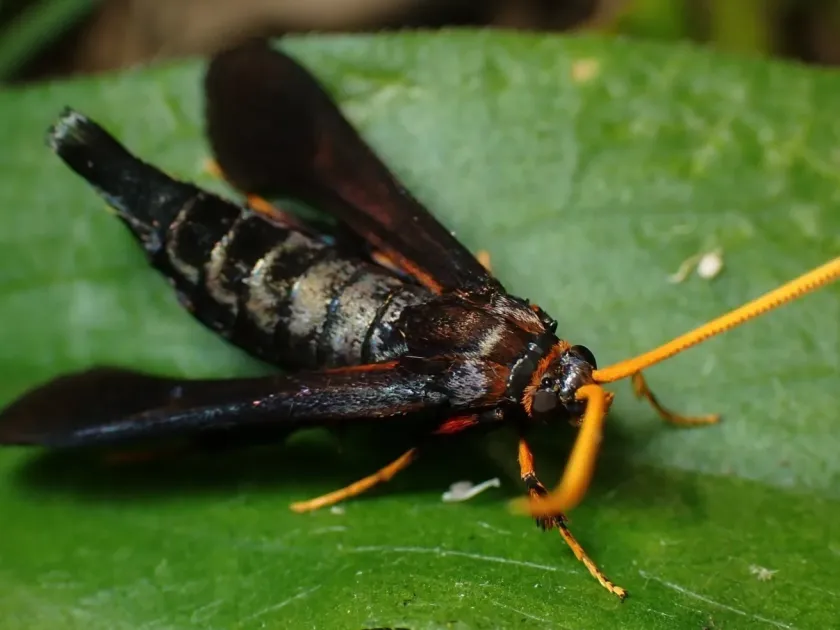
Alcathoe clearwing (Alcathoe caudata) is a moth belonging to the family Sesiidae, known for its remarkable mimicry, which allows it to resemble wasps or hornets to evade predators.
The adult moth features narrow, transparent wings with distinct dark margins and a slender abdomen, often banded with orange or yellow, characteristic of this specific clearwing moth species.
The larvae, which are the primary damaging stage, are creamy-white with a brownish head capsule and can grow up to 20 millimeters in length within the host plant's tissues.
Pupation occurs inside the larval galleries within the roots or stems of the plant, with the pupa partially protruding from the exit hole just before the adult emerges.
Due to their secretive lifestyle, identifying the adults is challenging, making monitoring efforts through pheromone trapping essential for accurate population assessment.
What it damages
The primary hosts of the Alcathoe clearwing are members of the Rosaceae family, with Clematis species being particularly susceptible to infestation by this moth.
Larvae feed internally on the roots and the root collar, creating tunnels that disrupt the vascular flow and cause severe stress to the entire plant structure.
Physical damage to the root system is often irreversible, leading to the gradual wilting of stems and a significant loss of plant vigor during the growing season.
These entry points provide ideal conditions for opportunistic pathogens, including various wood-decay fungi and soil-borne bacteria, which exacerbate the damage caused by the larvae.
In cases of heavy infestation, the entire root crown can be hollowed out, eventually leading to the death of the plant, especially in young or sensitive nursery specimens.
When it appears
Adult moths typically emerge in late spring or early summer, depending on local temperatures and the accumulation of degree-days in the specific growing region.
Females deposit eggs near the base of the plant, often on the root collar or exposed surface roots, where the larvae can immediately begin burrowing upon hatching.
The life cycle can extend over one or two years, a temporal flexibility that allows the pest to adapt to various environmental conditions and host plant availability.
Adults are diurnal, meaning they are most active during warm, sunny days, which is the most opportune time for pest control professionals to conduct monitoring or treatments.
Understanding these biological timing factors is crucial for implementing control measures that coincide with the most vulnerable stages of the pest's life cycle.
Signs of infestation
Sudden wilting or chlorosis of specific stems that does not respond to regular irrigation or fertilization is a primary symptom of larval infestation in the root system.
The presence of fine, sawdust-like frass (insect excrement) at the base of the plant or around the root collar indicates that larvae are actively tunneling inside the wood.
Deformations, unusual swellings, or cracks in the bark at the root collar level suggest that the plant is attempting to respond to the internal larval activity.
Infested plants may become loose in the soil because the root system has been largely consumed, allowing the plant to be easily pulled up from the ground.
Look for small, round exit holes on the surface of the root collar or lower stem, which remain after the pupa has successfully emerged as an adult moth.
Control measures
Effective management begins with maintaining high plant health, as vigorous specimens are better able to withstand or recover from low levels of pest pressure.
Systemic insecticides applied as soil drenches or sprays to the base of the plant during egg-laying periods are often the most effective method for controlling emerging larvae.
- Use pheromone-baited traps to detect the onset of adult moth flight and time chemical applications precisely.
- Prune and destroy heavily infested plant parts to reduce the overall population of larvae in the garden.
- Ensure adequate soil moisture to reduce the attractiveness of the root zone to egg-laying females.
Biological control options, such as the application of entomopathogenic nematodes to the soil, provide an environmentally friendly alternative for suppressing larval populations.
Maintaining a clean garden environment by removing infested debris prevents the accumulation of pests and reduces the risk of future generations damaging nearby plants.
Taxonomy
- Latin name
- Alcathoe
- Order
- Lepidoptera (butterflies)
- Family
- Sesiidae
- EPPO code
- ALCHSP
Discussion
No discussions yet — be the first.