
Poplar clearwing moth
Aegeria tibialis
Description
How to identify
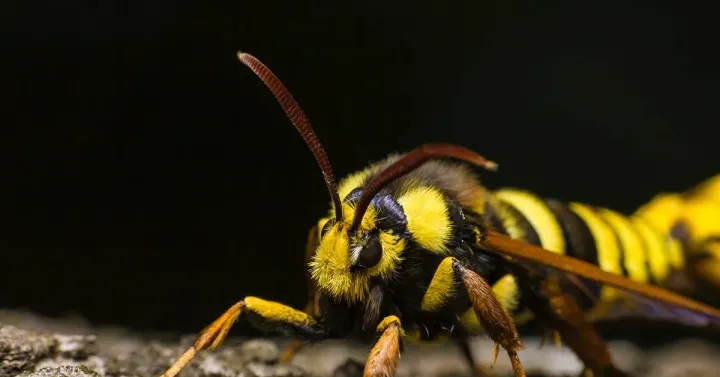
The Poplar clearwing moth (Aegeria tibialis) is a member of the Sesiidae family, commonly known as clearwing moths. These insects are famous for their remarkable mimicry, as they closely resemble wasps or hornets in both appearance and behavior.
The adult moth possesses a slender, dark body adorned with yellow bands. A key identifier is their transparent wing membranes, which lack the typical scales found on other moth species, enhancing their wasp-like look.
The larvae are cream-colored with a distinct brown head capsule. They are specialized wood-borers that spend their developmental life deep within the trunks of host trees, hidden from predators.
The life cycle typically spans one to two years, depending on regional climatic factors such as average temperature and humidity levels in the tree stands.
Pupation occurs within a prepared chamber, where the larva creates a pre-formed exit tunnel, ensuring the adult moth can easily emerge once metamorphosis is complete.
What it damages
Host trees for this pest are primarily species within the Salicaceae family, specifically poplars and willows. They represent a significant threat to young plantations and nurseries.
The larvae primarily target the cambium and xylem layers. By tunneling extensively within these tissues, they disrupt the tree's vascular system, hindering the transport of water and nutrients.
Mechanical injuries or pre-existing cracks in the bark often serve as entry points for the female moth to deposit her eggs, making stressed trees more susceptible to infestation.
The damage caused by the larvae weakens the structural integrity of the wood. This makes the tree more prone to wind breakage and secondary attacks by other boring insects or fungal pathogens.
Heavy infestations can lead to stunted growth, loss of timber value, and in severe cases, the total death of young saplings, causing significant economic losses in silviculture.
When it appears
Adult moths are typically active during the summer months, with flight periods generally occurring from June through August, peaking on warm, sunny days.
Females lay eggs individually on the bark of host trees. After hatching, the neonate larvae immediately bore into the bark to initiate their feeding phase.
Throughout their development, the larvae create winding tunnels beneath the bark and into the sapwood, feeding on the tree's nutritious inner layers.
The winter period is passed in the larval stage, tucked away inside the trunk, which offers protection against freezing temperatures and external environmental hazards.
As spring arrives, the larvae resume feeding before eventually transforming into pupae, signaling the final stage before the next generation of moths emerges.
Signs of infestation
The most reliable sign of an infestation is the presence of frass (sawdust-like excrement) collecting at the base of the trunk or around entry holes in the bark.
Sap exudation, often referred to as bleeding, may appear on the bark surface as the tree reacts to the larval tunneling and wounding of the inner tissues.
Observation of empty pupal cases protruding from the bark is a clear diagnostic feature, indicating that the moth has successfully completed its life cycle and exited the tree.
Trees showing signs of distress, such as thinning canopies, premature yellowing of leaves, or dieback of upper branches, are often heavily infested by these borers.
Visible bark deformation, including localized swellings or necrotic patches, serves as another indicator of long-term larval activity and tissue damage.
Control measures
Management of the Poplar clearwing moth relies on a combination of cultural practices. Maintaining tree vigor through proper site selection and care is the primary defense against successful colonization.
Sanitation is critical; removing and destroying infested wood during the winter months helps reduce the local population of larvae before they can emerge as adults.
Monitoring using pheromone-baited traps is an effective way to detect the timing of moth flights, allowing foresters to time interventions or chemical applications accurately.
Biological control, including the conservation of natural predators like parasitic wasps and insectivorous birds, plays a vital role in keeping moth populations in check.
- Prompt removal of infested, weakened, or dead wood from the site.
- Protection of tree trunks from mechanical damage to prevent entry points.
- Application of systemic or contact insecticides during the larval hatching period.
Taxonomy
- Latin name
- Aegeria tibialis
- Order
- Lepidoptera (butterflies)
- Family
- Sesiidae
- EPPO code
- AEGETI
Discussion
No discussions yet — be the first.