
Paper wasp parasite
Sulcopolistes
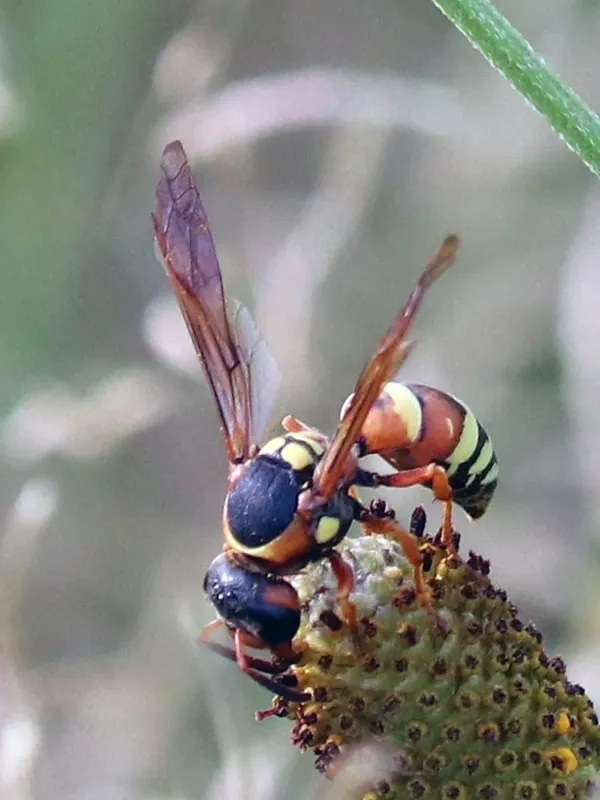
Description
How to identify
The paper wasp parasite, belonging to the genus Sulcopolistes, is a fascinating example of social parasitism in the insect world. These wasps are closely related to the common Polistes wasps and are often indistinguishable at a glance.
Morphologically, they are characterized by their slender bodies and long, thin legs. Unlike typical wasps, they do not possess a worker caste, having evolved to rely entirely on the labor force of their host colonies.
Systematically, they fall under the order Hymenoptera and the family Vespidae. Their survival strategy is based on the usurpation of established nests belonging to host species.
During the spring, the fertilized queen of Sulcopolistes infiltrates a host colony, subdues the queen, and begins laying her own eggs, which are then reared by the host's workers.
Proper identification requires expert entomological analysis of the brood and adult morphology, as these wasps are highly specialized to mimic their hosts.
What it damages
Sulcopolistes does not cause direct economic damage to crops, as they do not consume plant tissues. Their impact is primarily ecological rather than agricultural.
The main concern is the indirect impact on biological pest control. Since these parasites exploit wasp colonies that would otherwise hunt caterpillars and other pests, the efficacy of the host colony is significantly reduced.
A high density of these parasites can destabilize the local population of beneficial predatory wasps, potentially leading to an increase in harmful insect infestations in the garden.
While damage to fruits is rare, if the host colony is weakened or fails due to parasitism, the remaining wasps might turn to alternative food sources, such as damaged fruit or plant juices.
In most agricultural contexts, the presence of these parasites is considered a minor factor that rarely justifies specific intervention, unless it significantly impacts local biodiversity.
When it appears
The active season begins in early spring, when overwintering queens emerge to find host nests. This timing is crucial for their life cycle to synchronize with the host's colony initiation.
Mid-summer marks the peak of the brood development within the infested nests. During this period, the parasite's progeny are fed and reared by the host's workers.
By late summer and early autumn, the new generation of parasite queens emerges, prepares for hibernation, and leaves the nest, leading to the gradual decline of the host colony.
Weather conditions heavily influence the success rate of host usurpation; warm and stable climates are favorable for their flight and nest-seeking activities.
Agronomic observation during the early vegetation phase is the best way to determine the presence of these insects in the garden environment.
Signs of infestation
The primary sign of infestation is an unusually low rate of prey collection and foraging activity in a wasp nest that appears to be normally occupied.
Internal examination of the nest might reveal a mix of brood or irregular developmental stages that do not align with the typical phenology of the host species.
A noticeable decrease in worker activity around the nest entrance while the nest size remains steady can be a strong indicator of social parasitism.
In some cases, the abandonment of the nest mid-season or an abnormally small number of new workers emerging from the colony suggests the presence of parasites.
An unusual concentration of wasps on flowers or fruit instead of hunting suggests a change in the colony's nutritional strategy due to the parasite's influence.
Control measures
Control measures are rarely required for Sulcopolistes. Since they are part of a natural regulatory mechanism in the ecosystem, they are generally not considered pests to be eradicated.
If wasp presence becomes a nuisance near human dwellings, basic physical exclusion methods, such as sealing gaps in buildings, are recommended to prevent nest establishment.
Avoiding the use of broad-spectrum insecticides is crucial to protecting the balance between hosts and their natural parasites in the garden.
- Monitor and remove nests only if they present a direct safety risk.
- Use physical protection, such as netting, for fruit crops if wasp damage occurs.
- Promote the presence of birds and beneficial insects that naturally regulate wasp populations.
Intervention should be minimal to ensure that the ecological benefits provided by the broader community of social wasps are preserved.
Taxonomy
- Latin name
- Sulcopolistes
- Order
- Hymenoptera
- Family
- Vespidae
- EPPO code
- SULCSP
Discussion
No discussions yet — be the first.