
Ilex hairstreak
Strymonidia spini
Description
How to identify
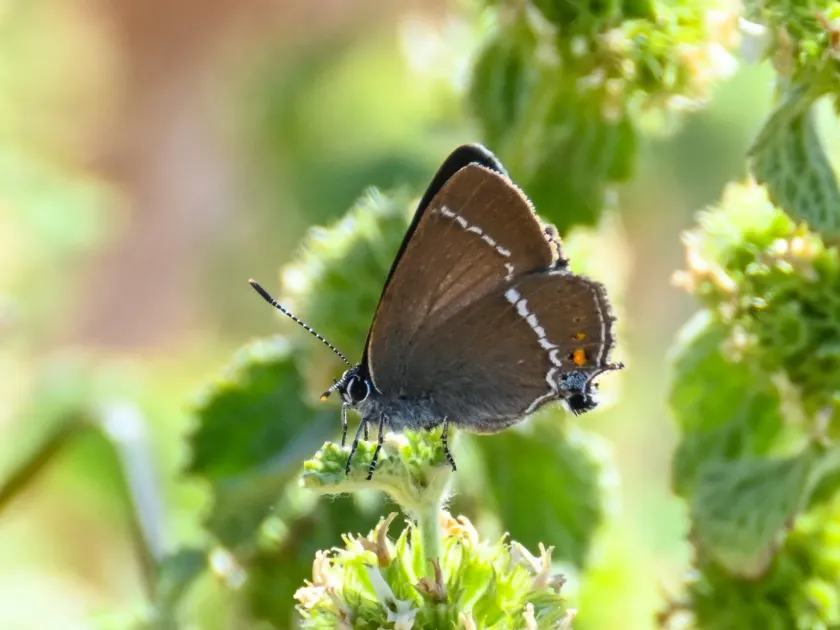
The Ilex hairstreak (Satyrium spini, formerly known as Strymonidia spini) is a day-flying butterfly belonging to the Lycaenidae family. The adult wingspan typically ranges from 30 to 35 mm.
The upper side of the wings is dark brown; females often display distinct orange spots on the hindwings. The common name comes from the characteristic thin, tail-like projection on the hindwings.
The larvae (caterpillars) are woodlouse-shaped, a common trait in many hairstreak butterflies. They are typically green with oblique, paler stripes, providing excellent camouflage against leaves.
The pupa of the Ilex hairstreak is stout and brown with darker markings, blending perfectly with tree bark or leaf litter on the ground.
Adults are active during hot, sunny days and are frequently observed feeding on the nectar of umbelliferous flowers or tree sap on trunks.
What it damages
The primary damage is caused by the caterpillars, which are polyphagous and feed on various shrubs and trees within the Rosaceae family.
In orchards, this pest most frequently targets blackthorn, plum, and cherry, although it may occasionally affect apple, pear, and hawthorn trees.
The caterpillars primarily consume young foliage, buds, and developing fruitlets, which weakens the plant's vegetative growth and leads to reduced crop yields.
High population densities can cause widespread defoliation, which severely reduces the tree's vigor and its ability to withstand winter conditions.
Furthermore, the tissue damage caused by feeding provides entry points for secondary pathogens, such as fungal infections that affect leaves and woody tissues.
When it appears
The Ilex hairstreak has one generation per year (monovoltine). The adult flight period typically occurs from June through late July.
The species overwinters in the egg stage. Females lay their eggs singly or in small clusters on the bark of young twigs of host plants, where they remain until spring.
As buds begin to break in early spring, the larvae hatch. The primary period of larval feeding and development occurs from late April through early June.
Pupation takes place on branches or among leaf litter on the soil surface, where the pupa remains until the adult emerges in the summer.
Spring temperatures significantly influence larval development rates; extended cool springs may prolong the development cycle, increasing the pest's impact duration.
Signs of infestation
Early signs of infestation include ragged edges or skeletonized leaves found on the terminals of young branches.
Upon inspection, the larvae are often difficult to spot due to their green coloration and sedentary nature, which camouflages them effectively against leaf stems.
Frass (caterpillar excrement) on the leaves below feeding sites is a reliable indicator of active larval presence within the canopy.
Damaged flower buds or deformed, drying fruitlets are secondary indicators that the pest is actively feeding on reproductive plant parts.
The presence of adult butterflies on nearby nectar sources during mid-summer confirms a breeding population that will likely lay eggs for the following season.
Control measures
Cultural management involves regular sanitary pruning of fruit trees, which helps remove twigs that may harbor overwintering eggs.
While less effective than for other pests, sticky bands on trunks during spring can help monitor or limit larval movement in some garden settings.
During peak larval emergence, biological control using Bacillus thuringiensis sprays is highly effective and selectively targets the caterpillars without harming beneficial insects.
Chemical intervention with broad-spectrum insecticides should be reserved for cases where economic thresholds are significantly exceeded during the early vegetative stage.
Enhancing habitat for natural enemies, such as insectivorous birds, parasitic wasps, and predatory bugs, is crucial for long-term population suppression.
Taxonomy
- Latin name
- Strymonidia spini
- Order
- Lepidoptera (butterflies)
- Family
- Lycaenidae
- EPPO code
- STYMSN
Discussion
No discussions yet — be the first.