
White-letter Hairstreak
Strymonidia pruni
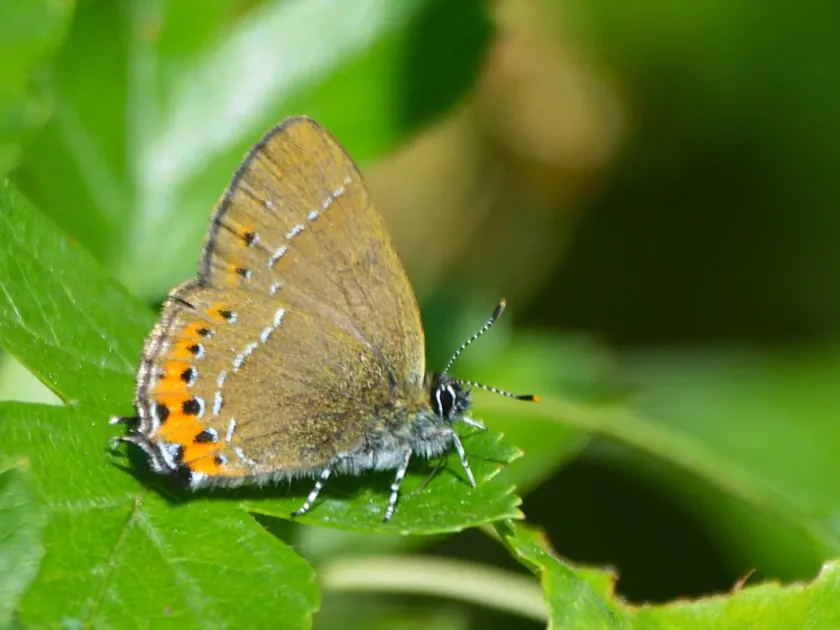
Description
How to identify
The White-letter Hairstreak (Strymonidia pruni) is a butterfly species of the Lycaenidae family. Adults typically have a wingspan of 30–35 mm. The upper side of the wings is dark brown, while the underside features a distinct white "W" shape (the letter "white-letter"), which gives the species its common English name.
The larvae, or caterpillars, are remarkably flat and green, mimicking the shape and color of their host plant's leaves. This adaptation allows them to remain cryptic and avoid detection by predators while feeding on foliage.
The eggs are laid singly or in small clusters in the forks of twigs. They have a rough, textured surface, which helps them blend into the bark of the host tree, making them extremely difficult to locate during the winter months.
Pupae are brown with darker markings, resembling small pieces of bird droppings or dried plant debris. They are attached to leaves or branches by a silken girdle, providing them with a highly effective camouflage against birds and parasitic wasps.
The development of the species is strictly synchronized with the phenology of their host trees. Temperature fluctuations in early spring can directly affect the emergence rate of the larvae from their wintering eggs.
What it damages
This pest primarily attacks trees within the genus Prunus. Common hosts include plum, blackthorn, wild cherry, and occasionally apricot. The infestation is particularly damaging in young orchards or nursery settings.
Caterpillars initially feed on the developing buds, causing them to fail to open or causing severe deformation. As they grow, they move onto the foliage, consuming the leaf blades and leaving only the main veins, which significantly impairs the tree's photosynthetic capability.
Severe infestations can lead to a drastic reduction in fruit yield, as the damage to buds and flowers directly limits the potential for fruit set. Furthermore, the overall vitality of the tree is compromised, making it more susceptible to environmental stress.
Young shoots are frequently damaged, leading to stunted or irregular growth patterns. This affects the structural development of the tree and requires additional remedial pruning to restore the natural canopy shape.
Damaged tissues create entry points for secondary infections. Fungal diseases often follow heavy caterpillar grazing, leading to branch dieback and further loss of productive wood in the affected orchard.
When it appears
The White-letter Hairstreak is univoltine, meaning it has only one generation per year. The winter is spent in the egg stage, firmly attached to the branches of the host trees, where they remain until the following spring.
Larval emergence coincides with the budburst phase of the host trees. This ensures that the caterpillars have immediate access to the most nutrient-rich plant tissues, which is essential for their rapid growth and development.
The larval feeding stage lasts for approximately four to six weeks. Once the caterpillars have gained enough mass, they seek a suitable spot on the twigs or leaves to undergo pupation, which typically occurs in late spring or early summer.
Adult butterflies appear on the wing during June and July. During this time, they engage in nectar feeding, mating, and searching for suitable sites on the host trees to lay eggs, which will restart the cycle the following year.
Monitoring is most critical during the budburst period in early spring. This is when the larvae are at their most vulnerable and when damage prevention measures are most effective.
Signs of infestation
The primary indication of an infestation is the presence of damaged or hollowed-out buds in early spring. Trees that appear to have delayed or sparse leaf growth should be inspected closely for the presence of larvae.
Caterpillars are often found by observing the damage they leave on the leaves. Look for irregular "windows" or entirely consumed leaf margins, often accompanied by small, dark fecal pellets scattered on the foliage below the feeding site.
Fine silk strands or webbing on the twigs are another sign of activity. Caterpillars use this silk to anchor themselves to the plant while they are feeding or during the molting process, providing stability against wind and rain.
The presence of adult butterflies in the garden during summer months indicates a breeding population. While the adults themselves do not harm the plants, their presence suggests that eggs are likely being laid for the next season.
In cases of heavy infestation, branch tip necrosis can occur due to extensive feeding, which provides a visible cue for the need for pest management intervention in the affected orchard sectors.
Control measures
Cultural control is the first line of defense. Pruning and removing infested branches during the dormant season helps to reduce the number of overwintering eggs. Maintaining tree health through proper fertilization and watering also improves resilience.
Biological control can be achieved by encouraging natural predators such as ladybirds, lacewings, and insectivorous birds. Providing habitat for these beneficial species can naturally keep populations of the Hairstreak under control.
Chemical control should be applied judiciously, targeting the larval stage if infestation levels exceed economic thresholds. Systemic insecticides applied during the budburst stage are generally effective against early-stage caterpillars.
Integrated Pest Management (IPM) practices, including the use of pheromone traps to monitor adult flight activity, allow for precise timing of interventions. This minimizes unnecessary chemical use and protects non-target pollinators.
- Regular inspection of twigs for winter egg masses.
- Promotion of orchard biodiversity to attract natural enemies.
- Targeted use of Bacillus thuringiensis-based bio-pesticides.
- Removal of unwanted wild host plants (e.g., blackthorn) from orchard peripheries.
Taxonomy
- Latin name
- Strymonidia pruni
- Order
- Lepidoptera (butterflies)
- Family
- Lycaenidae
- EPPO code
- STYMPR
Discussion
No discussions yet — be the first.