
Hairstreaks
Strymonidia
Description
How to identify
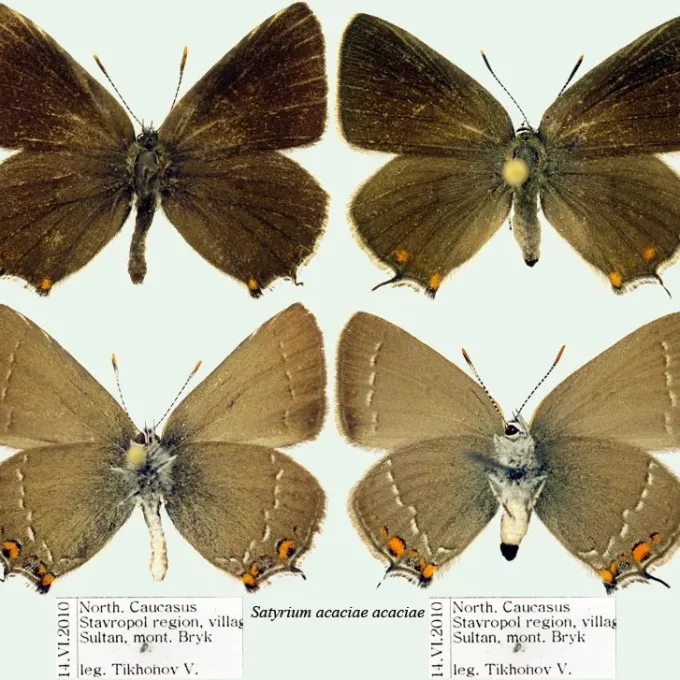
Hairstreaks (Strymonidia) are members of the Lycaenidae family within the order Lepidoptera. Their common name refers to the distinctive, thread-like tails found on the hindwings of adult butterflies.
Adult hairstreaks typically have a wingspan ranging from 25 to 35 mm. The upper sides of their wings are usually dull brown or grey, while the undersides feature intricate, cryptic patterns of lines and spots that help them blend in with tree bark.
The larvae, or caterpillars, are flattened and often display green or yellowish-green hues, providing excellent camouflage among foliage. Their skin is covered in fine, dense hairs, giving them a velvety texture.
Pupae are typical for butterflies and are usually attached to twigs or leaves by a silken girdle. They are highly camouflaged, often resembling organic debris or buds, which protects them from predators.
Their life cycle includes complete metamorphosis: egg, larva, pupa, and adult. In most regions, these insects complete one generation per year, though population densities can vary significantly between seasons.
What it damages
Hairstreaks primarily target various fruit trees belonging to the Rosaceae family. Orchards containing apples, pears, plums, and cherries are the most frequent hosts for these pests.
Caterpillars feed on young foliage, chewing irregular holes in leaves. In cases of high infestation, they can cause significant defoliation, which reduces the tree's ability to photosynthesize and store energy.
Beyond leaf damage, larvae may feed on flower buds and young fruit sets. This activity can lead to poor fruit development, deformation, or premature fruit drop, directly impacting the harvest volume.
Trees weakened by larval feeding are more susceptible to secondary infections, such as fungal pathogens, which can enter through the wounds caused by the caterpillars.
While hairstreaks are generally considered a minor to moderate pest, their impact on young orchards or nurseries can be severe enough to warrant targeted monitoring and control measures.
When it appears
Adult hairstreaks are typically seen during the summer months, with peak flight activity occurring between June and July. During this time, they feed on nectar and mate.
Females deposit their eggs individually or in small clusters on the bark of young twigs near the buds. The insect usually overwinters in the egg stage, attached to the host tree.
Larval emergence happens in the spring, coinciding with the opening of buds. This is the period when caterpillars begin their feeding cycle and are most vulnerable to control efforts.
The larval stage lasts for several weeks before they pupate. The pupal stage typically lasts about two to three weeks, depending on the ambient temperature and local climate conditions.
Monitoring should be concentrated in early spring during bud burst to identify early signs of infestation before the larvae cause substantial damage to the developing canopy.
Signs of infestation
The first signs of infestation include small, irregular holes or notched edges on emerging spring leaves. Careful inspection of the underside of the leaves often reveals the presence of larvae.
The presence of frass (small, dark pellets of excrement) on leaves or trapped in cobwebs within the canopy serves as a reliable indicator of active larval feeding.
Damage to buds, where the tissues appear hollowed out or necrotic, is another sign. This damage often occurs before the buds have fully unfurled, preventing healthy leaf development.
While the butterflies themselves are elusive and well-camouflaged, an increase in their activity around tree canopies on sunny days can indicate a potential egg-laying event.
Stunted growth of new shoots or the appearance of malformed leaf clusters can indicate that larvae have been feeding in those specific areas of the tree crown.
Control measures
Effective hairstreak management involves an integrated pest management (IPM) strategy that combines physical, biological, and chemical methods to maintain population levels below economic thresholds.
In cases where infestations are significant, well-timed applications of insecticides during the larval emergence period are the most effective way to prevent crop loss.
- Application of biological insecticides containing Bacillus thuringiensis, which target larvae specifically while preserving beneficial predatory insects.
- Enhancing the presence of natural enemies, such as parasitic wasps, which can help keep hairstreak populations in check naturally.
- Utilizing pheromone traps for monitoring adult butterfly flight patterns, which allows for precise timing of treatment applications.
- Pruning and removing heavily infested branches during the dormant season to eliminate overwintering egg sites.
Chemical control should be used as a last resort, strictly adhering to product labels and harvest interval requirements to ensure food safety and minimize environmental impact.
Taxonomy
- Latin name
- Strymonidia
- Order
- Lepidoptera (butterflies)
- Family
- Lycaenidae
- EPPO code
- STYMSP
Discussion
No discussions yet — be the first.