
Strangalia quadrifasciata
Strangalia quadrifasciata
Description
How to identify
Strangalia quadrifasciata is a species of longhorn beetle belonging to the family Cerambycidae, commonly found in various wooded habitats.
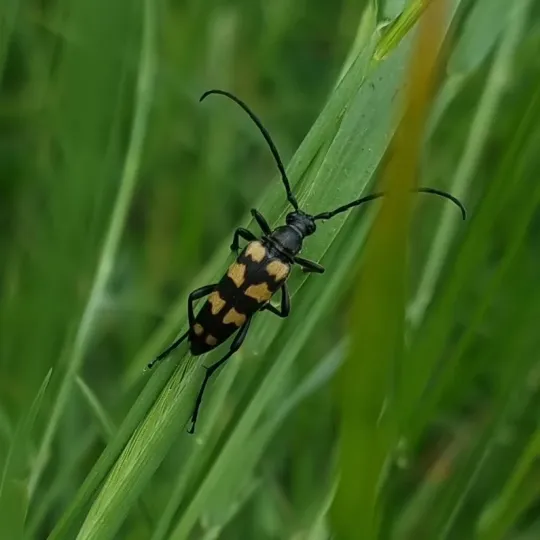
The adult beetle is slender, typically measuring 11 to 20 mm in length. Its elytra (wing covers) are yellowish-brown with four distinct transverse black bands, which is the key diagnostic feature for identification.
The pronotum is narrow and constricted anteriorly. The antennae are long, often reaching the end of the elytra, characteristic of the subfamily Lepturinae.
Larvae have a typical cerambycid morphology, featuring a pale, cylindrical, soft body with well-developed mandibles specialized for boring into dense wood tissue.
The pupal stage occurs within the wood, where the insect undergoes metamorphosis before emerging as an adult through a small, characteristic exit hole.
What it damages
The primary damage is caused by the larvae, which are wood-boring (xylophagous). They feed on the wood of both broadleaved and coniferous tree species.
In forest ecosystems, they infest trees such as birch, oak, lime, pine, and spruce, particularly targeting those that are already stressed or decaying.
In orchards or managed landscapes, the beetle may exploit old, neglected fruit trees that have structural damage or areas of rotting bark.
Larval galleries disrupt the transport of nutrients and water within the tree, causing systemic weakening and significantly accelerating the decline of the host tree.
By creating these tunnels, the larvae provide entry points for secondary pathogens, such as fungi and bacteria, which contribute to the further degradation of the wood.
When it appears
Adult beetles are most active during the warmer months, with the flight period typically occurring from June through August.
During the day, they are frequently found on umbelliferous flowers, where they feed on pollen and nectar, which provides the necessary energy for their reproductive activities.
Females lay their eggs in bark crevices or existing wounds, carefully choosing sites where the wood is softening, which facilitates the start of larval feeding.
The larval development stage is long, often lasting two to three years depending on environmental conditions and the quality of the host wood.
Pupation typically takes place towards the end of spring, resulting in the emergence of new adults during the following summer season.
Signs of infestation
One of the first signs of an infestation is the presence of small, oval-shaped exit holes on the bark of the affected trees.
Accumulations of frass—a mixture of wood dust and larval excrement—often collect at the base of the tree or within bark cracks, indicating active boring.
Trees infested by the larvae may exhibit signs of decline, including thinning foliage, premature yellowing, and drying of branches due to internal structural damage.
If a piece of bark is removed, the characteristic winding tunnels (galleries) filled with dense, tightly packed wood dust will be visible in the sapwood.
The presence of adult beetles on flowers in the vicinity of wooded areas during mid-summer is a strong indicator of a local population and potential host tree colonization.
Control measures
The most effective management strategy is sound forest and orchard hygiene, which includes the prompt removal of dead, dying, or wind-thrown timber.
Keeping the area clear of wood debris and old stumps is essential, as these materials provide optimal breeding grounds for the species.
For high-value trees, application of protective trunk treatments can help deter egg-laying if applied at the start of the adult flight season.
Promoting natural biodiversity, especially the presence of woodpeckers and other insectivorous birds, is a powerful biological control method for longhorn beetle larvae.
- Regular inspection of trees for signs of wood dust or exit holes.
- Sealing large bark wounds to prevent female access for egg-laying.
- Sanitary logging conducted in the winter to remove infected wood before new adults emerge.
Taxonomy
- Latin name
- Strangalia quadrifasciata
- Order
- Coleoptera (beetles)
- Family
- Cerambycidae
- EPPO code
- STRLQC
Discussion
No discussions yet — be the first.