
Beech pigmy moth
Stigmella tityrella
Description
How to identify
The beech pigmy moth (Stigmella tityrella) is a member of the Nepticulidae family, which includes some of the smallest moths in the world. Adult moths have a wingspan of only 4 to 6 millimetres.
These moths are inconspicuous, featuring dark brown or greyish forewings with a subtle metallic sheen. Because of their tiny size, they are rarely seen by the casual observer, spending most of their time in the canopy or resting on bark.
The larval stage is exclusively leaf-mining. The larvae are legless and pale in colour, adapted for living and feeding within the narrow space between the upper and lower epidermis of the beech leaf.
The life cycle involves complete metamorphosis, typically passing through two generations within a single growing season. This reproductive strategy allows the species to build up populations quickly in warm, favourable conditions.
Overwintering occurs as a pupa, protected within a tough, silken cocoon. These cocoons are usually found in leaf litter, debris at the base of the tree, or in bark crevices, where they remain dormant until the following spring.
What it damages
The beech pigmy moth is an oligophagous species, feeding specifically on the European beech (Fagus sylvatica). Its host range is limited to this tree species, making it a specialist pest.
The larvae feed on the internal tissues of the leaf, specifically the parenchyma. This mining action destroys the photosynthetic capacity of the affected leaf area, leading to localized starvation of the leaf tissues.
Heavy infestations can lead to widespread damage across the canopy. This significantly weakens the tree, as it loses the ability to produce sufficient carbohydrates for winter storage and spring growth.
While mature trees can usually tolerate a moderate level of infestation, repeated attacks over several years can lead to premature leaf drop, stunted growth, and increased vulnerability to secondary pests or pathogens.
Young trees are particularly susceptible to severe damage. A high density of mines can compromise the structural integrity of the foliage, making the plant look scorched or sickly by mid-summer.
Signs of infestation
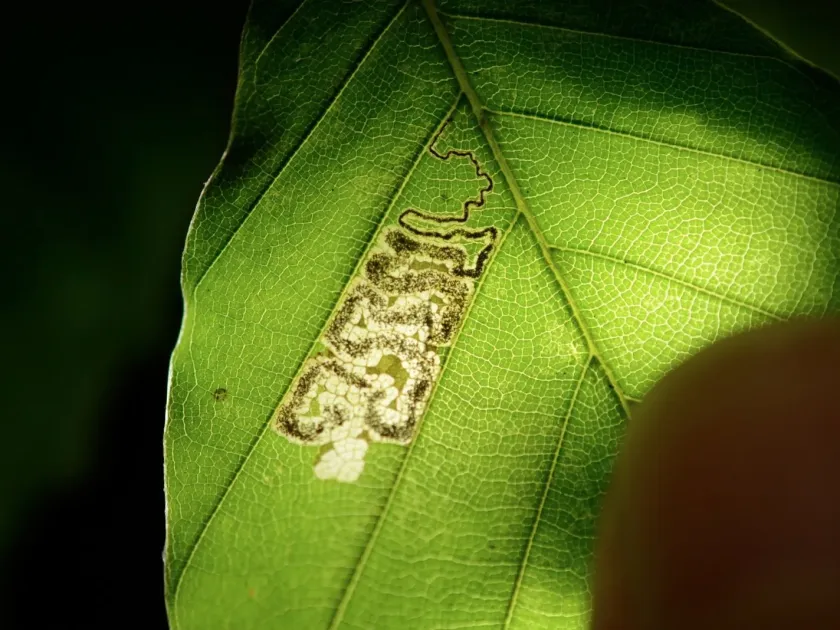
The most diagnostic sign is the presence of winding, narrow mines inside the leaf. These mines start very small where the egg was laid and widen as the larva consumes more leaf tissue while growing.
Inside the mine, a dark trail of frass (larval droppings) is clearly visible. This central line is a classic indicator of Stigmella species and helps distinguish this moth from other leaf-mining insects.
Affected leaves often show discoloration or localized necrosis along the track of the mine. In heavy attacks, multiple mines per leaf cause the entire leaf to curl or turn yellow and drop early.
Exit holes are another critical sign. Once the larva has completed its development, it cuts a small, clean circular hole through the epidermis to vacate the mine and seek a pupation site.
Field detection is best achieved by holding leaves up to the light. The transparency makes the mines, the larval position, and the frass patterns stand out clearly against the healthy green leaf tissue.
Control measures
Sanitation is a primary control method. Collecting and destroying fallen leaves in the autumn is highly effective, as it removes the overwintering pupae from the environment around the host trees.
Biological control using microbial insecticides based on specific bacteria can target larvae without harming beneficial insects. This is the preferred method for maintaining balance in forest ecosystems.
Chemical intervention is generally reserved for severe outbreaks in high-value ornamental or park settings. Systemic insecticides can be applied during the adult flight period to interrupt the next generation's egg-laying.
Natural enemies, including various species of parasitic wasps (hymenopterans), play a crucial role in controlling population explosions. Preserving these natural predators is essential for long-term tree health.
- Regular inspection of foliage during the summer months.
- Removal of leaf litter to disrupt the life cycle.
- Encouraging natural predator populations through habitat diversity.
- Strategic use of insecticides only when economic thresholds are met.
Taxonomy
- Latin name
- Stigmella tityrella
- Order
- Lepidoptera (butterflies)
- Family
- Nepticulidae
- EPPO code
- NEPTTU
Discussion
No discussions yet — be the first.