
Rose leaf miner
Stigmella centifoliella
Description
How to identify
The Rose leaf miner (Stigmella centifoliella) is a member of the Nepticulidae family, order Lepidoptera. These are among the smallest moths known, often measuring less than 6 millimeters in wingspan.
Adult moths are generally inconspicuous, with brownish or dark grey wings that may exhibit a metallic sheen when observed under bright light.
The larvae are specialized miners; they possess a flattened body structure specifically adapted for feeding inside the leaf tissues of their host plants.
The lifecycle involves several generations per year depending on the climate, with the pest often overwintering as a pupa within a small cocoon.
These moths are highly dependent on the host plant's seasonal cycle, with emergence timing perfectly synchronized with the bud burst of rose species.
What it damages
The primary host plants for Stigmella centifoliella are roses (Rosa species). Both garden cultivars and wild rose varieties are susceptible to infestation.
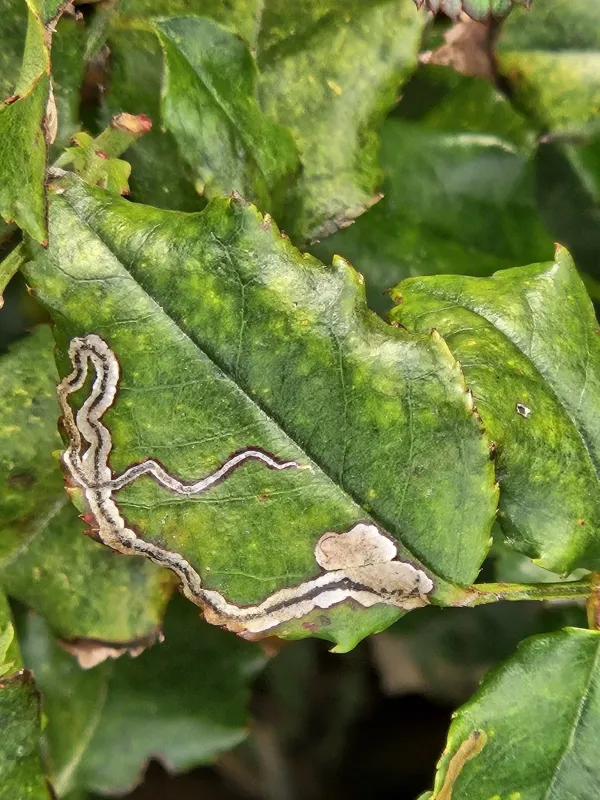
Larvae feed within the leaf, creating intricate tunnels known as mines. This feeding disrupts the internal structure of the leaf, hindering essential plant functions.
Severe infestations lead to significant leaf drop, which weakens the plant over time and makes it less capable of producing vibrant flowers.
The loss of chlorophyll in infested leaves reduces the plant's overall vigor, potentially making the host more susceptible to various fungal pathogens.
While a single miner may cause negligible damage, high population densities can lead to aesthetic degradation of the entire plant or hedge.
Signs of infestation
The most reliable sign of an infestation is the presence of winding, narrow lines on the leaves, which represent the tunnels carved by the feeding larvae.
- Snake-like or spiral mines visible on the upper surface of the leaves.
- Small dark dots inside the mines, which are waste products (frass) left by the larvae.
- Premature yellowing of leaves that precedes leaf drop in late summer.
- Deformed or curled leaves in areas with high larval density.
By inspecting the underside of the leaf, one might find the exit hole left by the larva when it leaves the mine to pupate in the soil.
Control measures
Effective management requires a combination of sanitation practices and targeted treatments to reduce the overwintering population.
Good garden hygiene, specifically the removal and destruction of fallen leaves in autumn, is crucial to eliminate overwintering pupae.
Cultivating the soil around the base of rose bushes in spring can expose and destroy pupae, significantly reducing the pressure from the next generation.
For chemical control, systemic insecticides applied at the beginning of the growing season can be highly effective as they reach the larvae hidden inside the leaves.
Integrated Pest Management (IPM) strategies, including the use of biological agents or pheromone monitoring, should be prioritized to maintain the ecological balance.
Taxonomy
- Latin name
- Stigmella centifoliella
- Order
- Lepidoptera (butterflies)
- Family
- Nepticulidae
- EPPO code
- NEPTCE
Discussion
No discussions yet — be the first.