
Stictoleptura scutellata
Stictoleptura scutellata
Description
How to identify
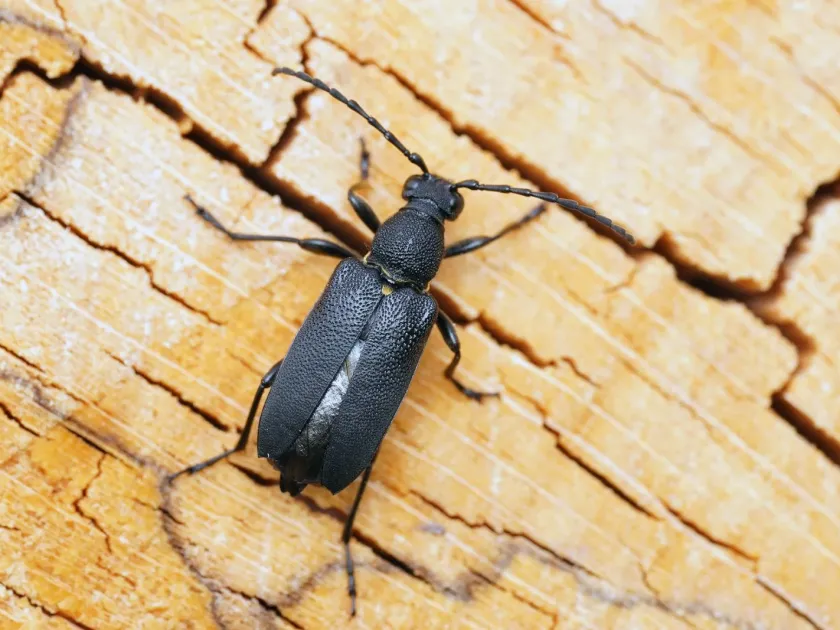
Stictoleptura scutellata is a beetle belonging to the Cerambycidae family, commonly known as longhorn beetles. Adults typically measure between 15 to 20 mm in length.
The beetle has a distinct matt black appearance. The scutellum, a small shield-shaped plate on the back, is often covered with dense hair, which serves as a key identification feature.
As with other longhorn beetles, the antennae are well-developed, with males often possessing longer antennae compared to females, aiding in species identification.
The larvae are typical for the family: fleshy, white, legless grubs with a heavily sclerotized head and powerful mandibles adapted for boring into timber.
Adults are commonly observed during the day feeding on flowers, where they are attracted to pollen and nectar, playing a minor role in plant pollination.
What it damages
The primary damage is caused by the larval stage, which develops inside the wood of various deciduous trees, particularly oaks, beeches, and hornbeams.
Larvae create extensive tunnel systems within the trunk and branches. These galleries disrupt the tree's vascular system, leading to physiological stress and reduced growth.
While often categorized as a secondary pest that prefers weakened or dying trees, large populations can attack healthier specimens if environmental stress is present.
Structural damage is a major concern, as the tunneling weakens the wood, increasing the risk of branch breakage and overall tree instability during storms.
The galleries also provide entry points for secondary pathogens, such as fungi, which accelerate the decay process and contribute to premature tree death.
When it appears
The flight period for adult beetles generally occurs during the summer months, specifically June and July, when they are most active in finding mates.
Eggs are deposited into cracks or wounds in the bark of suitable host trees, where the larvae will eventually emerge to begin their wood-boring life cycle.
The larval stage is notably long, typically lasting between two to three years, depending on the nutritional quality of the host wood and ambient temperatures.
Pupation takes place inside the wood at the end of the larval stage, usually in the spring, as the insect prepares for the final transition into adulthood.
This multi-year cycle means that an infestation can persist in a tree for a significant amount of time before outward symptoms become clearly visible.
Signs of infestation
One of the earliest signs of an infestation is the presence of small, round exit holes on the bark of the trunk or larger branches, indicating completed development.
Accumulation of "frass"—a mixture of wood dust and excrement—at the base of the tree or within bark fissures is a definitive indicator of internal larval activity.
A decline in canopy health, characterized by yellowing leaves or the dieback of specific branches, often signals that the tree's internal structure is severely compromised.
In some cases, the tapping or rustling sounds produced by larvae actively feeding within the wood can be detected during quiet periods.
Bark separation or localized depressions can occur where larval galleries have caused the underlying cambium or xylem tissue to degrade.
Control measures
Integrated pest management is essential, with a strong focus on sanitation as the primary method to prevent the spread of Stictoleptura scutellata.
- Promptly remove and destroy heavily infested, dead, or dying trees to reduce breeding sites.
- Perform regular sanitary pruning of branches that show signs of larval infestation.
- Maintain tree vigor through proper irrigation and fertilization to minimize stress that attracts beetles.
- Protect wounds on tree trunks using pruning sealers to prevent adult beetles from laying eggs.
- Monitor adult populations during the summer and implement localized insecticide treatments if necessary.
Taxonomy
- Latin name
- Stictoleptura scutellata
- Order
- Coleoptera (beetles)
- Family
- Cerambycidae
- EPPO code
- LPTUSC
Discussion
No discussions yet — be the first.