
Banana lace bug
Stephanitis typica
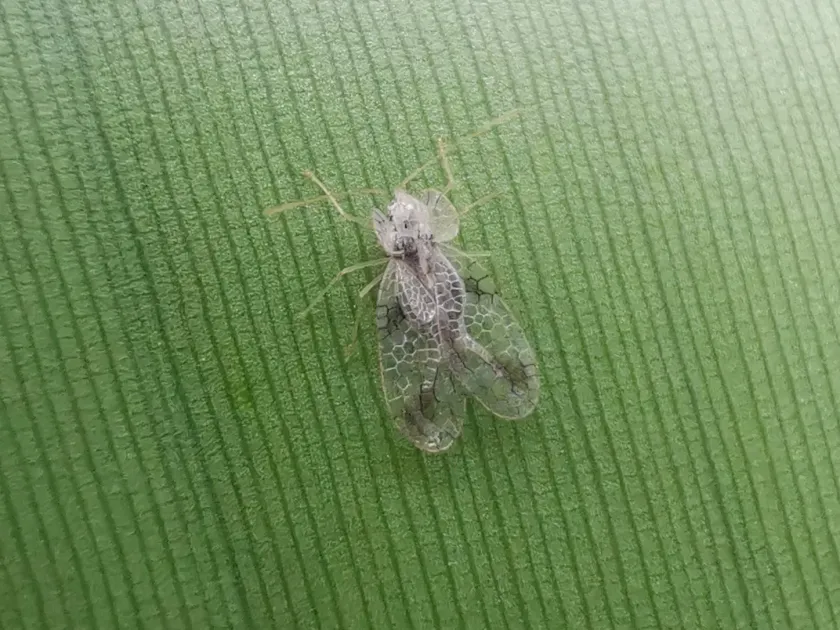
Description
How to identify
The banana lace bug Stephanitis typica is a member of the Tingidae family, characterized by its distinctive, intricate, lace-like appearance. These insects are commonly found in tropical and subtropical regions where they primarily attack banana and coconut plantations.
Adult insects are tiny, usually measuring between 3 to 4 millimeters. They possess flattened bodies with a highly ornate, reticulated pronotum and wings that look like delicate gauze, which provides them with excellent camouflage against the foliage.
The nymphs go through several developmental stages and are typically smaller than the adults, often covered in spine-like projections. They are relatively immobile compared to other hemipteran pests and stay in the same colony throughout their development.
These pests prefer the underside of leaves for feeding and oviposition. Their secretive behavior often leads to an underestimation of their population density until visible signs of plant stress become apparent.
The life cycle of the lace bug is temperature-dependent, allowing for multiple generations per year in tropical environments. Rapid life cycle completion during warm, dry weather allows for quick population explosions that can quickly overwhelm a crop.
What it damages
Banana plants are the primary victims of Stephanitis typica, but the pest also infests various other monocotyledonous and dicotyledonous crops such as turmeric, ginger, and certain palms. This makes it a multi-crop threat.
By using their piercing-sucking mouthparts, the bugs extract sap from the phloem and parenchyma tissues. This feeding process deprives the plant of essential nutrients and disrupts its ability to perform photosynthesis efficiently.
The aesthetic and physical impact on the leaves is severe, leading to chlorosis, necrosis, and eventual wilting. If the infestation is left unmanaged, the overall yield per plant decreases significantly, affecting the market value of the produce.
One of the most dangerous aspects of this pest is its ability to act as a vector for the Banana streak virus (BSV). This viral infection can stunt growth and cause severe leaf streaking, leading to total crop failure in sensitive varieties.
Plants under water stress are particularly vulnerable to attack. The depletion of nutrients by the bugs causes further decline in the plant's natural defense mechanisms, creating a feedback loop of increasing susceptibility.
Signs of infestation
The primary symptom of infestation is the presence of yellow, chlorotic stippling on the upper leaf surface. These small dots are the direct result of feeding punctures made by the bugs on the underside.
Dark, sticky, or crusty excrement deposited on the underside of the leaves is a common indicator of a growing colony. These spots may also become a site for sooty mold growth if the infestation is heavy.
As damage progresses, leaves develop irregular brown, necrotic patches. Eventually, the entire leaf may wither and curl at the edges, significantly reducing the plant's capacity for energy production.
Signs of Banana streak virus infection, such as yellow or necrotic streaks running parallel to the leaf veins, may appear if the lace bug population is high. This signifies an advanced stage of phytosanitary distress.
The presence of cast-off exuviae (molted skins) on the lower surface of the foliage is a telltale sign that the insects are actively developing and multiplying on the specific leaf area.
Control measures
Cultural control remains the first line of defense. Keeping the surrounding area free of weeds and secondary host plants prevents the buildup of pest populations that could migrate to the main crop.
Pruning and removing severely infested leaves is a practical method to reduce the insect load within the plantation. This material should be destroyed away from the field to prevent further infestation.
Biological control methods are becoming increasingly popular. Utilizing natural predators such as lady beetles, lacewings, or entomopathogenic fungi like Beauveria bassiana can suppress populations effectively.
For chemical interventions, systemic insecticides are preferred. Since the bugs stay on the underside of the leaves, contact sprays are often ineffective unless combined with specialized application equipment that targets the lower surface.
- Regular scouting for early detection of yellow stippling.
- Sanitation by removing infested foliage.
- Application of systematic neonicotinoid pesticides when thresholds are exceeded.
- Use of entomopathogenic fungi to provide long-term biological suppression.
Taxonomy
- Latin name
- Stephanitis typica
- Order
- Hemiptera (bugs, aphids, leafhoppers)
- Family
- Tingidae
- EPPO code
- STEPTY
Discussion
No discussions yet — be the first.