
Pear lace bug
Stephanitis nashi
Description
How to identify
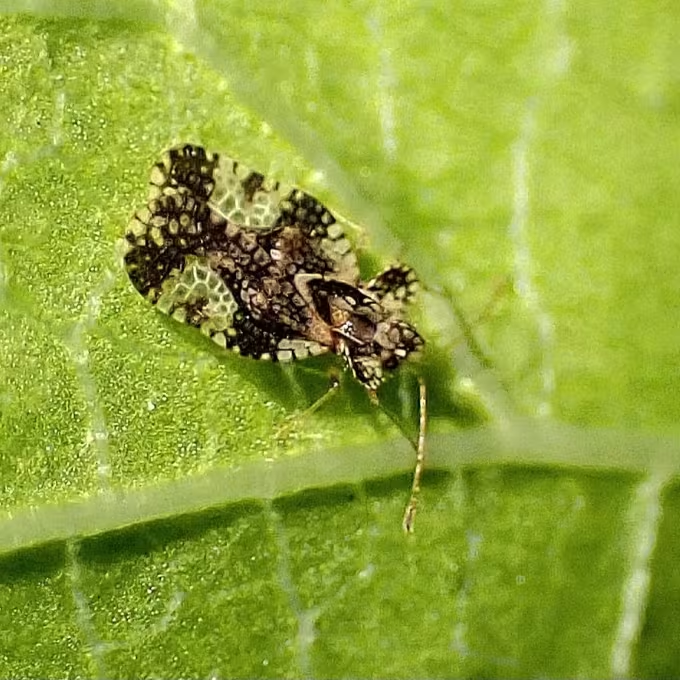
The pear lace bug (Stephanitis nashi) belongs to the order Hemiptera and the family Tingidae. This small insect, measuring 3–4 mm, is named for its intricately patterned, lace-like wings that are translucent and delicate.
The adults feature a flattened body with distinct, ornate projections on the pronotum. Their coloration ranges from brownish to dark brown, which provides excellent camouflage against tree bark and leaves.
Nymphs (immature stages) resemble adults in appearance but are smaller, wingless, and often possess small spines along their bodies to aid in stability on the leaf surface.
Their life cycle consists of egg, nymph, and adult stages. Overwintering adults emerge in the spring as temperatures rise, seeking out host plants to begin the reproductive cycle.
Identification is best achieved by inspecting the underside of the leaves, where both nymphs and adults aggregate to feed and shelter from environmental factors.
What it damages
The primary hosts of this pest include pear trees (Pyrus), but it also frequently infests apple, quince, and various other Rosaceae species, leading to significant economic losses in orchards.
Both nymphs and adults feed by piercing leaf tissues and extracting cellular sap. This feeding method disrupts the plant's photosynthesis and causes widespread tissue damage.
As a result of nutrient depletion, the foliage loses its green pigment, weakens, and becomes susceptible to drying out, which ultimately impacts the tree’s overall vitality and growth rate.
Repeated infestation can lead to stunted growth, reduced fruit yield, and poorer fruit quality, as the tree lacks the energy reserves needed to support a healthy harvest.
The impact is cumulative over the season, meaning that early detection and prevention are vital to ensuring the tree remains productive and healthy throughout the year.
When it appears
Adult activity begins in the spring, typically coinciding with the leafing out of pear trees. Overwintered adults emerge, mate, and deposit eggs on the undersides of the leaves.
During the growing season, the species can complete multiple generations, leading to a exponential increase in population size that often peaks during the warmer mid-to-late summer months.
Hot and dry weather conditions are particularly favorable for the pear lace bug, as these factors accelerate their developmental rate and increase the survival rate of the offspring.
As autumn approaches and temperatures drop, adults prepare for dormancy. They move away from the foliage to seek shelter in bark crevices, leaf litter, or under debris at the base of the tree.
Dormancy continues throughout the winter months, allowing the pests to survive extreme cold until the cycle restarts with the arrival of the next spring’s warming temperatures.
Signs of infestation
The earliest symptom of an infestation is the appearance of tiny, pale spots or stippling on the upper leaf surface, corresponding to the feeding sites underneath.
Over time, these spots expand and coalesce, causing the leaf to turn a grayish or brownish marble color. The leaves eventually lose their luster and appear withered or prematurely aged.
Checking the underside of the leaves will reveal colonies of the bugs, dark fecal spotting (excreta), and the shed skins of nymphs, all of which are definitive signs of an active lace bug presence.
In severe cases, the foliage may curl, deform, and undergo early senescence, leading to premature leaf drop which can stress the tree significantly before the dormant season.
- Stippling and light spotting on leaves.
- Marble-like discoloration of the foliage.
- Small black fecal droplets on leaf undersides.
- Early leaf drop and premature wilting.
Control measures
Cultural control is a cornerstone of management. It involves removing and destroying fallen leaves and orchard debris during the autumn and winter to eliminate overwintering sites.
During the growing season, regular monitoring is essential. If infestation levels exceed a threshold, systemic or contact insecticides registered for orchard use should be applied.
When applying insecticides, it is critical to ensure thorough coverage of the leaf undersides, as the bugs tend to concentrate there and are often protected by the leaf architecture.
Biological control, by encouraging natural predators such as lacewings, lady beetles, and predatory bugs, can help keep lace bug populations below damaging levels without excessive chemical use.
Integrating these strategies into an overall orchard management plan ensures long-term control and minimizes the risk of significant damage from this persistent pest.
Taxonomy
- Latin name
- Stephanitis nashi
- Order
- Hemiptera (bugs, aphids, leafhoppers)
- Family
- Tingidae
- EPPO code
- STEPNA
Discussion
No discussions yet — be the first.