
Lace bug
Stephanitis
Description
How to identify
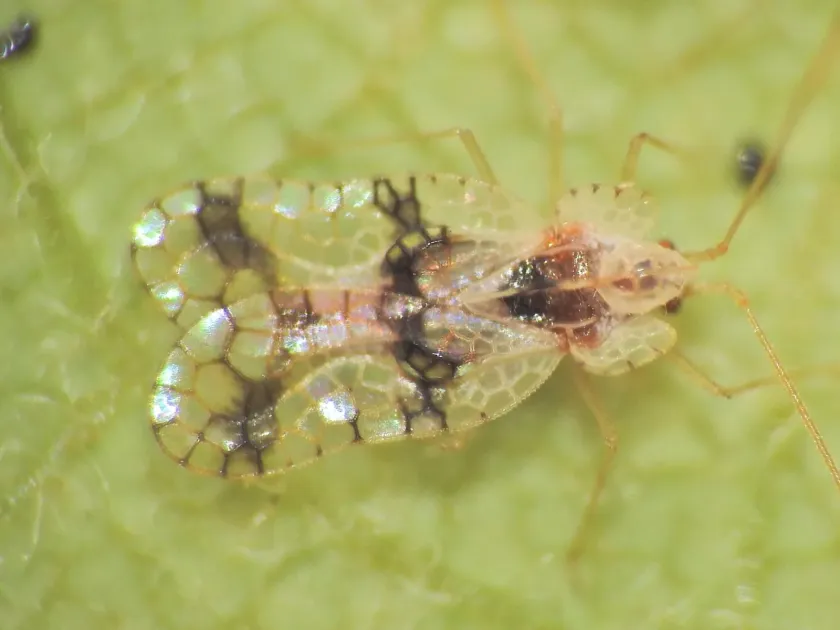
Lace bugs (family Tingidae) are named for the intricate, lace-like appearance of their wings. These are small hemipterans, with adult individuals typically measuring between 3 to 5 mm in length.
The adult body is flattened, and the wings and pronotum are covered with a dense network of cells, giving them a semi-transparent look. Their coloration varies from pale yellow to dark brown depending on the specific species.
Nymphs (immature stages) differ significantly from adults: they are darker, often covered with spines or bristles, and lack fully developed wings. They live a secluded life, preferring the undersides of leaves.
Eggs are typically deposited inside leaf tissues, often along the veins, and may be covered by the female's excrement. Due to their microscopic size, they are nearly impossible to detect without magnification.
Systematically, they belong to the order Hemiptera, family Tingidae. There are many species, with the azalea, oak, and pear lace bugs being among the most well-known examples.
What it damages
These pests are typical phytophagous insects that attack a wide range of ornamental and fruit crops. They are particularly dangerous to rhododendrons, azaleas, pears, apples, and various oak species.
Lace bugs feed on the plant's cell sap. By piercing the leaf epidermis and sucking out cell contents, they disrupt photosynthesis and weaken the plant's overall immune system.
The most significant damage occurs in nurseries and ornamental landscapes, where mass infestations can lead to premature leaf drop and the loss of aesthetic value.
Damage is caused not only by direct sap extraction but also by the potential transmission of certain phytopathogens, although this aspect remains a subject of ongoing research.
The damage is widespread across many garden plants, including ornamental shrubs and forest trees, making them polyphagous pests with high adaptability to new hosts.
When it appears
Lace bugs overwinter as adults in bark crevices, under leaf litter, or in other sheltered areas. As stable warmth arrives in spring, typically in May, they emerge from diapause.
The period of active nymph development coincides with the phase of intense leaf growth in host plants. Depending on climatic conditions, one or more generations can develop throughout the season.
Peak population density is usually observed in the second half of summer, during July and August, when weather conditions favor rapid reproduction and development.
Hot and dry weather accelerates the development cycle of lace bugs. During such periods, the intensity of their feeding and reproduction rates increases significantly.
In autumn, as mean daily temperatures drop, adults begin searching for hibernation sites, concluding their life cycle for the current season.
Signs of infestation
The first sign of infestation is the appearance of a characteristic "mottled" or chlorotic pattern on the upper leaf surface, which looks like tiny whitish stippling.
Upon closer inspection of the leaf's underside, one can find colonies of nymphs, excrement appearing as black or brown spots ("varnish" spots), and cast-off skins from molting.
In severe cases, leaves lose their color entirely, turn silvery, dry out at the edges, and fall prematurely, which severely reduces the attractiveness of the plantings.
The decline in ornamental quality is often accompanied by stunted shoot growth, caused by a chronic deficiency of nutrients resulting from the pest's activity.
- Yellowing and chlorosis of leaf blades.
- Presence of black dots (excrement) on the underside of leaves.
- Silvery appearance on damaged leaf areas.
- Premature leaf drop in mid-summer.
Control measures
An important preventive measure is maintaining high air humidity, as lace bugs prefer dry conditions. Regular spraying of the canopy with water helps suppress population growth.
Autumn cleanup and the destruction of fallen leaves, where adults may hibernate, significantly reduce the number of pests in the following season.
In cases of high infestation, the use of systemic insecticides is recommended, as they penetrate plant tissues and effectively kill the sap-sucking insects during feeding.
Treatments should be carried out considering the period of nymph activity, as they are most vulnerable to insecticides during this stage. Repeated applications may be necessary to control subsequent generations.
For biological control, preparations based on entomopathogenic fungi can be used, and natural enemies such as predatory bugs and lacewings can be encouraged in the garden area.
Taxonomy
- Latin name
- Stephanitis
- Order
- Hemiptera (bugs, aphids, leafhoppers)
- Family
- Tingidae
- EPPO code
- STEPSP
Discussion
No discussions yet — be the first.