
Azolla weevil
Stenopelmus rufinasus
Description
How to identify
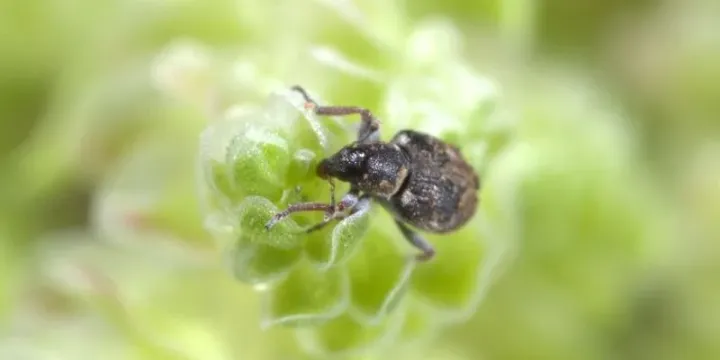
The Azolla weevil (Stenopelmus rufinasus) is a small beetle belonging to the family Curculionidae. Adult weevils typically measure between 2 and 3 millimeters in length.
They possess a distinct snout, characteristic of the weevil family, and have a coloration ranging from light brown to reddish-orange, which provides excellent camouflage on the Azolla fern.
The larvae are small, legless, cream-colored grubs that live inside the plant tissues, making them difficult to detect during the early stages of infestation.
Adults are capable of flight, which allows them to colonize new aquatic environments rapidly, often spreading across interconnected water bodies.
The entire life cycle of this beetle is aquatic, meaning that all developmental stages, including egg-laying and larval feeding, occur on or within the host plant.
What it damages
The primary host for this pest is the aquatic fern Azolla (Azolla filiculoides). The insect is highly specialized and feeds exclusively on this plant species.
Larvae tunnel through the stems and leaves of the fern, causing the plant tissues to collapse and the plant to eventually die.
Adult feeding causes further damage, characterized by small pits and irregular holes in the leaves, which reduces the photosynthetic capacity of the plant.
Severe infestations result in the total destruction of the floating mats of Azolla, which can be devastating for operations relying on this plant for fertilizer or fodder.
However, in some areas where Azolla is considered an invasive weed, the Azolla weevil is successfully employed as a biological control agent to manage the plant's spread.
When it appears
The activity level of the Azolla weevil is heavily dependent on ambient temperature and water temperature, which regulate its reproductive rate.
The weevils become active in the spring as temperatures rise, signaling the beginning of their breeding season and increased feeding activity.
Several generations can emerge during the warmer summer months, leading to exponential increases in population density if left unmanaged.
Overwintering occurs in the adult stage, with the insects seeking shelter in leaf litter or soil along the banks of the infested water bodies.
Metabolic activity slows down as the weather cools in autumn, with the weevils entering a period of dormancy until the return of favorable spring conditions.
Signs of infestation
The initial signs of an infestation include the appearance of tiny holes on the leaves of the fern, indicating adult feeding activity.
As the larval population grows, patches of the fern mat begin to turn brown or necrotic, clearly distinguishing them from healthy, vibrant green areas.
Infested patches often become waterlogged and sink, as the damage to the plant's structure compromises its ability to remain buoyant.
- Widespread discoloration of the fern mat (browning).
- Presence of small exit holes in stems caused by emerging adults.
- Fragmentation of the Azolla mats on the water surface.
In advanced cases, the entire surface of the water body may be covered in decaying organic matter rather than healthy fern tissue.
Control measures
Effective control strategies focus on reducing the weevil population in environments where Azolla must be preserved for agricultural or ecological purposes.
Mechanical removal involves scooping out the infested mats of Azolla from the water to physically eliminate a large portion of the larvae and adults.
In selective environments, biological control using natural predators or pathogens may be implemented, although this is complex to manage in open water.
The use of chemical insecticides is generally discouraged in aquatic systems due to the high risk of environmental contamination and harm to non-target species.
Quarantine and monitoring protocols are essential when transporting Azolla from one site to another to ensure the pest is not unintentionally introduced to clean waters.
Taxonomy
- Latin name
- Stenopelmus rufinasus
- Order
- Coleoptera (beetles)
- Family
- Brachyceridae
- EPPO code
- STNPRU
Discussion
No discussions yet — be the first.