
Brachycerus muricatus
Brachycerus muricatus
Description
How to identify
Brachycerus muricatus is a species of weevil belonging to the Curculionidae family, commonly known for being a pest in vegetable production.
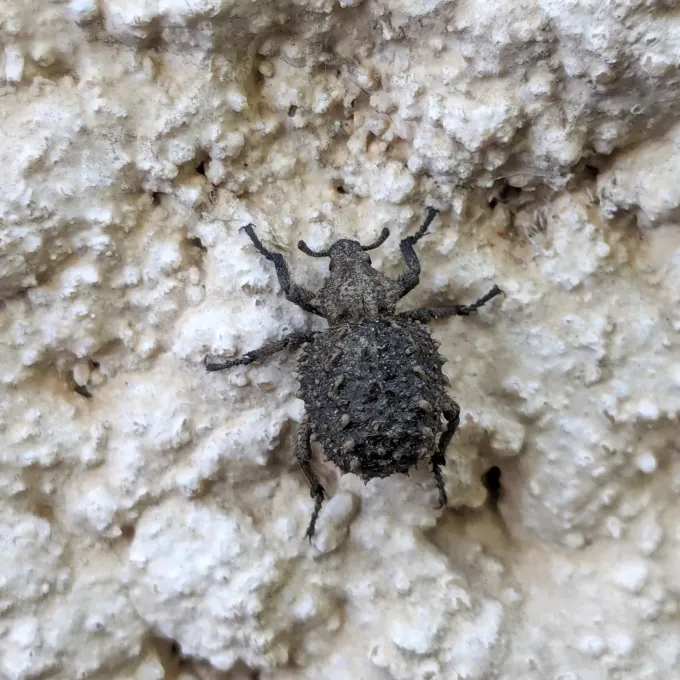
The adult insect is a medium-to-large sized weevil, typically measuring 10 to 14 mm in length, with a robust and compact body shape.
Its external appearance is defined by a rough, dull surface covered with numerous tubercles and stiff setae, providing excellent camouflage in soil.
The snout is characteristically short and thick, typical of the genus Brachycerus, and the antennae are elbowed and club-shaped.
Larvae are legless, fleshy, and creamy-white, featuring a well-defined, darker head capsule, perfectly adapted for boring into the succulent tissues of bulbs.
What it damages
This weevil primarily targets the Amaryllidaceae family, with cultivated onion and garlic being the most frequent hosts for the pest.
Both adults and larvae cause significant damage, although the larvae are responsible for the most severe economic impact on crops.
Adults feed on foliage and flower stalks, causing minor aesthetic damage and reducing the overall photosynthetic capacity of the plant.
Larvae burrow deep into the bulbs and the basal plate, consuming internal tissues, which often results in the total collapse of the plant.
Infested crops often suffer from secondary fungal or bacterial rots, leading to complete yield loss if the pest population remains uncontrolled.
When it appears
Adult weevils overwinter in the soil or under plant debris, emerging in the spring when temperatures begin to rise significantly.
The emergence phase usually coincides with the early vegetative growth stages of spring-planted garlic or onion crops.
Females deposit their eggs directly into the bulb tissue or in the immediate vicinity within the soil profile.
Larvae hatch and immediately begin feeding internally, moving through the layers of the bulb, causing internal damage that is often hidden from view.
Pupation occurs in the soil during the summer, followed by the emergence of a new generation of adults that prepare for the following winter season.
Signs of infestation
Stunted plant growth and premature yellowing of the leaves are often the first visible signs that an infestation is present in the field.
Leaves may show small, irregular holes or margins damaged by adult feeding activity during the early season.
Plants become easily detachable from the soil because the root system and the basal plate have been hollowed out by larval feeding.
A distinctive putrid odor is often detected in the field, indicating the decomposition of bulbs due to larval activity and subsequent secondary infections.
When digging up affected plants, one can easily find the characteristic larvae or the empty exit holes in the bulb tissue.
Control measures
Crop rotation is the most essential cultural practice, preventing the buildup of larval populations in the soil for subsequent growing seasons.
Deep plowing in late autumn or early spring helps to expose overwintering adults and pupae to predators and adverse weather conditions.
For small-scale gardens, manual collection of adult weevils during the early morning hours can be an effective way to lower the population.
Chemical control involving systemic insecticides can be applied if monitoring thresholds are exceeded, ensuring proper application timing.
- Selection of pest-free, healthy planting material.
- Removal of volunteer onion or garlic plants.
- Strict adherence to field sanitation practices to reduce debris.
Taxonomy
- Latin name
- Brachycerus muricatus
- Order
- Coleoptera (beetles)
- Family
- Brachyceridae
- EPPO code
- BRCCAL
Discussion
No discussions yet — be the first.