
Brachycerus undatus
Brachycerus undatus
Description
How to identify
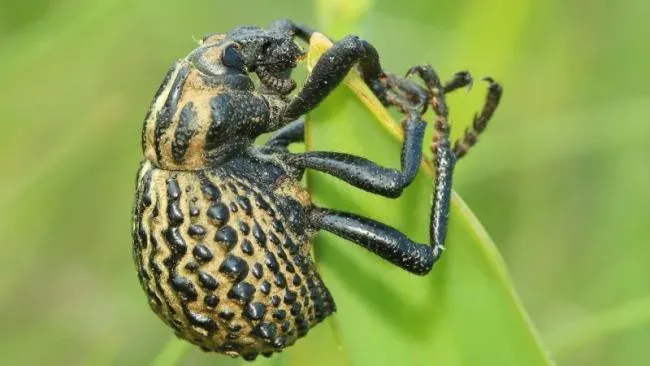
Brachycerus undatus belongs to the Curculionidae family, a group of beetles known as true weevils. It is a large, robust insect, easily recognized by its coarse, bumpy, and grooved body surface.
The coloration of this weevil typically ranges from dark grey to black. White scales often form distinct, wavy patterns on the elytra, which provides camouflage against soil and plant debris.
Larvae are legless, fleshy, and C-shaped, matching the typical appearance of weevil larvae. They are specialized for mining deep into the dense tissues of bulbs, which offers protection during their development.
The pupal stage occurs within the plant tissue or in the surrounding soil. The beetle exhibits a high degree of structural adaptation, allowing it to withstand harsh environmental conditions.
As a pest, its morphology allows it to remain unnoticed while feeding, as it often works from within the host plant, leaving the outer skin partially intact.
What it damages
The primary hosts for Brachycerus undatus include various bulbous plants, particularly those in the Amaryllidaceae and Liliaceae families, such as garlic and onions.
Adult weevils feed on the foliage, causing ragged holes and notches. However, the most severe damage is caused by the larvae, which hollow out the bulb from the inside.
Infested bulbs lose their structural integrity and are highly susceptible to secondary pathogens, including various bacteria and fungi that cause rapid rot.
In many cases, the entire root system is severed by larval feeding, leading to the yellowing and collapse of the plant. Such damage makes the crop entirely unmarketable.
Fields with high pest pressure can experience significant yield losses, often requiring complete destruction of the affected crop patches to prevent further spread.
When it appears
The life cycle of the weevil is closely synchronized with the growth of host plants. Adults emerge in spring when rising temperatures trigger their activity after winter diapause.
Mating and oviposition occur throughout the spring. Females deposit eggs near the base of the plant, ensuring that larvae can easily access the soft tissue of the developing bulb.
Larval development typically spans several weeks, during which the larvae consume the nutrient-rich interior of the bulb. This stage is the most damaging for the crop.
New adults emerge during mid-to-late summer. They continue to feed on host foliage before finding suitable sites in the soil or under debris to enter winter diapause.
Environmental conditions, particularly moisture levels in the soil, play a critical role in the beetle's survival rate between seasons.
Signs of infestation
Initial signs of infestation often include irregular feeding patterns on leaf blades, which appear as notches or holes along the margins of the foliage.
Plants may show stunted growth and premature yellowing of the leaves. When pulled, heavily infested plants often detach easily from the soil because the bulb and roots have been consumed.
The presence of frass or larval excrement near the base of the stem is a diagnostic indicator. This material often becomes visible after rainfall or irrigation.
Bulb softness and the onset of putrefaction are late-stage symptoms. The bulb might feel spongy or hollow when pressed, indicating internal tissue destruction.
Monitoring the soil surface near the bulb neck during the evening can help reveal adult beetles, as they are often more active when temperatures are cooler.
Control measures
The most effective strategy is the implementation of a rigorous crop rotation program. Avoiding bulbous crops on the same site for several years reduces localized population buildup.
Deep plowing in autumn helps destroy overwintering sites, exposing larvae and pupae to predators and environmental stresses like freezing temperatures.
Systemic insecticides can be applied during the adult activity window. Precise timing is essential to target the weevils before they lay eggs on the crops.
Sanitation is key; removing and burning infected crop residues prevents the weevil from completing its life cycle and finding shelter for the next season.
- Use only clean, certified bulb material.
- Implement trap crops or pheromone monitoring where available.
- Maintain adequate spacing between rows to improve air circulation.
- Encourage natural predators by avoiding broad-spectrum pesticide use.
Taxonomy
- Latin name
- Brachycerus undatus
- Order
- Coleoptera (beetles)
- Family
- Brachyceridae
- EPPO code
- BRCCUN
Discussion
No discussions yet — be the first.