
Rice water weevil
Helodytes
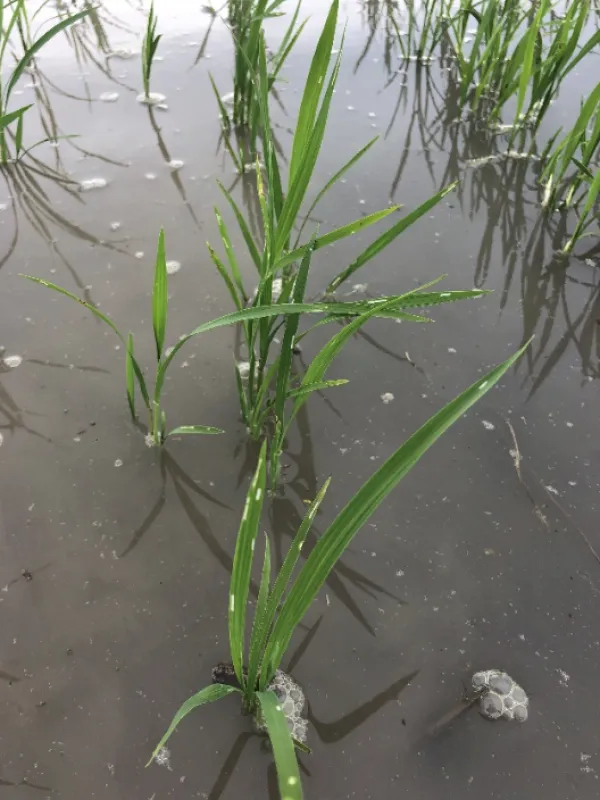
Description
How to identify
The Rice water weevil (Helodytes) is a significant pest of rice belonging to the Curculionidae family. It is a semi-aquatic beetle that is highly specialized for life in flooded irrigation systems.
Adult beetles are small, measuring approximately 3-4 mm in length. Their coloration is typically grey to brown, featuring darker markings that help them blend in with moist soil and vegetation.
The larvae are legless, white in color, and possess a small, dark head capsule. They are specifically adapted to thrive in the submerged environment of rice paddies.
Adult weevils are capable of flying, which facilitates rapid migration between flooded paddies at the start of the planting season.
The biology of the species is inextricably linked to water management in rice farming, as both larvae and adults rely on flooded conditions to complete their life cycles.
What it damages
The primary crop damaged by this pest is rice. However, it can also infest various semi-aquatic weed species found in and around irrigation canals.
Adult beetles feed on rice leaves, creating characteristic longitudinal scars or strips. This reduces the leaf surface area available for photosynthesis.
Larval damage is far more severe, as they feed on the root systems of the rice plants. This feeding destroys the fine root hairs and lateral roots, drastically hindering water and nutrient uptake.
Plants affected by larval feeding exhibit stunted growth, yellowing (chlorosis), and may even die if root damage is extensive enough to cause the plant to collapse.
Significant yield losses can occur, with estimates ranging from 20% to 50% in heavy infestations, making early detection critical for rice productivity.
When it appears
Rice water weevils overwinter as adult beetles in leaf litter, debris, or dry grasses near the edges of rice fields or forested areas.
In spring, when fields are flooded and temperatures rise, adults migrate into the paddies to feed and initiate egg-laying on the submerged parts of the plants.
The larval stage is most active during the rice tillering phase, which corresponds to the period when the crop is most vulnerable to root-system degradation.
Multiple generations can occur within a single growing season, depending on local climate conditions and the duration of the irrigation period.
As the season draws to a close and water is drained for harvest, the adults move out of the paddies toward their overwintering sites.
Signs of infestation
The most visible sign of an infestation is the appearance of light-colored, narrow slits on the leaves, which are indicative of adult feeding activity.
Yellowing of the rice crop, which often mimics nutrient deficiency, is a primary indicator of larval damage occurring below the water line.
If affected plants are pulled from the soil, the roots will often appear pruned or missing, and larvae may be found within the soil near the root zone.
Uneven patches of growth within a field often signify where the weevil population density is highest.
Scouting for adults at the edges of the fields shortly after flooding is an essential early-warning step for effective management.
Control measures
Water management is the most effective cultural control; draining fields (drying) for a short period kills larvae by exposing them to desiccation.
Chemical control using systemic insecticides applied to the irrigation water or as a seed treatment is common practice to protect the crop during the vulnerable tillering phase.
Regular monitoring of adult populations using pheromone traps or field sweeps helps to determine the precise timing for intervention.
Maintaining clean field borders by removing host weeds reduces the local population reservoir and minimizes re-infestation risks.
- Rotate crops to disrupt the weevil's life cycle.
- Use certified, high-quality seeds to ensure vigorous initial growth.
- Implement integrated pest management (IPM) practices to balance chemical use.
- Time the planting to avoid peak migration periods of the adults.
Taxonomy
- Latin name
- Helodytes
- Order
- Coleoptera (beetles)
- Family
- Brachyceridae
- EPPO code
- HELDSP
Discussion
No discussions yet — be the first.