
Brachycerus labrusca
Brachycerus labrusca
Description
How to identify
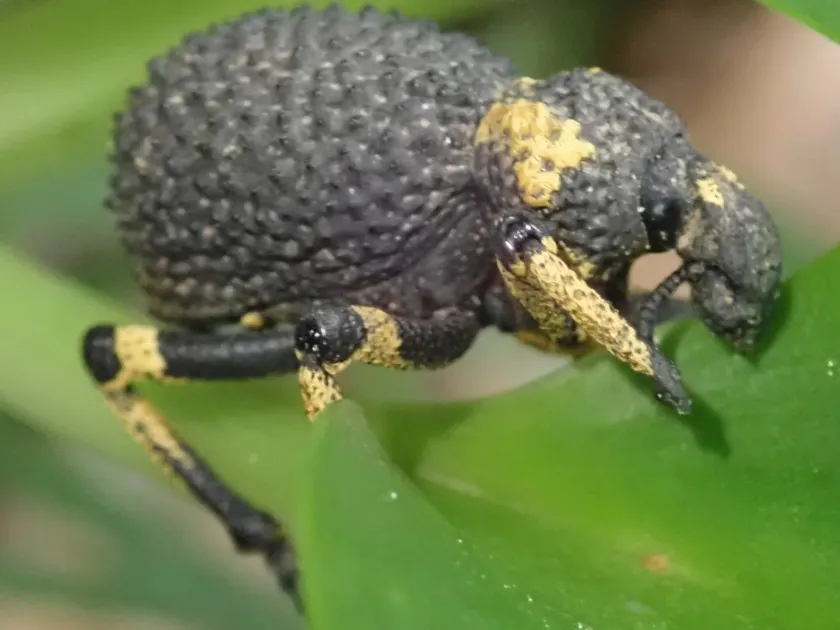
Brachycerus labrusca is a species of weevil belonging to the Curculionidae family, order Coleoptera. These insects are characterized by their sturdy, globular bodies often covered with tubercles, which provide a robust defense against environmental stressors.
The adult weevils are dark in color with a short, thick rostrum. The larvae are typically legless, fleshy, and pale-colored, specifically adapted for boring into plant tissues. Their appearance allows them to blend in with soil clods, aiding in their concealment.
This species is primarily found in warmer climates, where bulbous plants serve as their primary food source. They are closely related to other members of the Brachycerus genus, which are notorious pests of lily and amaryllis family plants.
The lifecycle is soil-dependent, with both pupation and overwintering occurring underground. Adult weevils have limited mobility and flight capacity, making their localized spread steady but relatively predictable for monitoring purposes.
Identification is often difficult due to their behavior of playing dead (thanatosis) when threatened. They retract their legs and remain motionless, blending into the surrounding soil or debris to escape detection.
What it damages
The primary hosts of Brachycerus labrusca are plants within the Amaryllidaceae and Liliaceae families. This includes major agricultural crops like onions and garlic, as well as various ornamental bulbs such as tulips and hyacinths.
Damage is inflicted on both the foliage and the subterranean bulbs. The bulb damage is particularly destructive as it compromises the plant's food storage and structural integrity, leading to significant yield losses.
Adults feed on the leaves, leaving irregular holes and notches, which weakens the plant's photosynthetic capacity. However, the larvae are the most damaging stage, as they burrow into the bulb, consuming its internal tissues.
High infestations can result in total crop failure in affected patches. Damaged bulbs are highly susceptible to secondary pathogens, including bacteria and fungi, which cause rapid rot and decomposition of the plant tissues.
Economic damage is severe because once the bulbs are infested, they become unsalable and unsuitable for storage. Farmers face significant financial risks if early detection and management are not implemented.
When it appears
Adult activity usually begins in early spring when soil temperatures rise, triggering the emergence of weevils from their overwintering sites. This initial feeding phase is critical, as it coincides with the emergence of young crop shoots.
During the summer, adults continue to feed, although their activity may fluctuate depending on humidity and extreme heat. Egg-laying typically occurs near the base of host plants, providing immediate access to food for the emerging larvae.
Larval development occurs over several weeks in late spring and early summer. This period of rapid growth correlates with the plant's active bulb-forming stage, which makes the crop exceptionally vulnerable to damage.
Pupation takes place within the soil profile. Depending on the geographical region and climate, the species may complete one or two generations per year, with activity peaking during favorable moist conditions.
As autumn approaches, adults seek shelter for overwintering by burying themselves deeper into the soil or hiding under crop debris. This survival strategy ensures the population survives the winter to re-emerge the following year.
Signs of infestation
The first external sign of an infestation is the presence of holes on the leaves. As the infestation progresses, plants may exhibit stunted growth, yellowing foliage, and a general lack of vigor leading to premature wilting.
Bulbs affected by larval feeding show visible tunnels and excavations. Internally, the bulb tissue may be soft or hollowed out, frequently accompanied by a foul-smelling rot caused by secondary bacterial infections.
Stunted development of the entire plant is a reliable indicator of subterranean damage. Upon uprooting, one may find destroyed roots or a complete lack of structural integrity in the bulb's basal plate.
Adults can often be found near the base of the plant during early morning or evening hours. They may also be unearthed during soil cultivation or close inspection of the root zone.
- Irregular holes in the foliage.
- Premature yellowing and wilting of plants.
- Soft, decaying consistency of the bulb.
- Tunnels found inside the bulb tissues.
- Reduced overall crop yield.
Control measures
Effective management requires an integrated approach, starting with strict crop rotation to disrupt the life cycle of the weevil. Avoiding the cultivation of susceptible bulb crops on the same site for several years is highly recommended.
Deep autumn plowing helps expose larvae and pupae to predators and adverse weather conditions, significantly reducing the population density. Clearing away crop residues post-harvest is crucial to remove overwintering sites.
Chemical control via systemic insecticides can be effective if applied early in the season. Treatment must be timed carefully to reach the adults before they lay eggs or before the larvae burrow deeply into the bulbs.
Treating planting material with appropriate dressings before sowing acts as a protective barrier. Furthermore, biological control agents, such as entomopathogenic fungi, show promise in reducing larval populations in the soil.
Regular field scouting is essential to identify hotspots. Immediate removal and destruction of infested plants, including the surrounding soil, can prevent the pest from spreading across the entire field.
Taxonomy
- Latin name
- Brachycerus labrusca
- Order
- Coleoptera (beetles)
- Family
- Brachyceridae
- EPPO code
- BRCCLA
Discussion
No discussions yet — be the first.