
Avocado seed moth
Stenoma catenifer
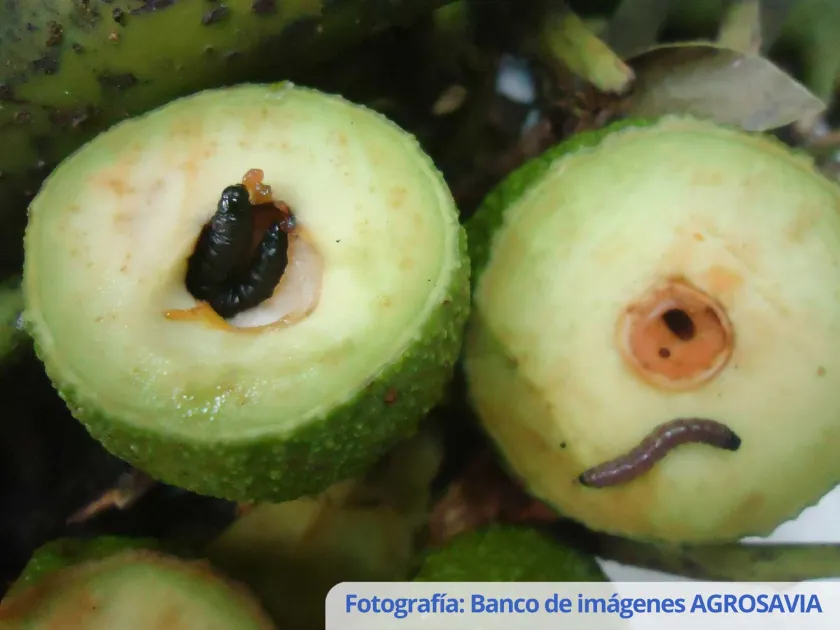
Description
How to identify
The Avocado seed moth Stenoma catenifer is a lepidopteran insect belonging to the family Elachistidae. It is considered one of the most destructive pests for commercial avocado production in tropical regions.
The adult moth is small and cryptic, usually showing grayish-brown coloration that mimics the bark of the avocado tree, which makes it difficult to detect during daylight hours.
Development goes through four distinct stages: egg, larva, pupa, and adult. The larval stage is responsible for the economic damage as it burrows into the fruit and feeds on the pulp and seed.
Monitoring the adult population is crucial and is primarily achieved using pheromone-baited traps which are highly specific to this species.
Given its high reproductive potential, this species is classified as a quarantine pest, posing a significant risk to avocado-exporting countries that are currently free from its infestation.
What it damages
The primary host for Stenoma catenifer is the avocado Persea americana. It specifically targets the fruit, where larvae feed on the pulp and eventually reach the seed.
The pest also attacks young shoots and twigs of the tree. By tunneling through these soft tissues, the larvae cause shoot dieback, which stunts the growth of young trees.
Infested fruits typically show entry holes and internal tunnels filled with frass, making them completely unmarketable and unsuitable for human consumption or processing.
Damage often triggers secondary infections by pathogens, causing the fruit to decay rapidly and drop from the tree before reaching full maturity.
Economic losses are severe, as even low levels of infestation in a shipment can result in total rejection at export inspection points due to strict phytosanitary regulations.
Signs of infestation
The most common external sign of an infestation is the presence of small entry holes on the avocado skin, often accompanied by brown frass accumulations.
Once cut open, the flesh of the infested fruit reveals complex, brownish tunnels where the larva has been actively feeding toward the central seed.
Early fruit drop is a strong indicator of larval activity, especially when healthy fruit remains attached to the tree while damaged ones fall prematurely.
Visible wilting of terminal shoots indicates that a larva has bored into the stem, interrupting the flow of nutrients and water to the growing tip.
In packaged fruit, the appearance of internal damage is often only confirmed after a destructive sampling procedure, emphasizing the need for pre-harvest control.
Control measures
Management strategies for Stenoma catenifer are centered on strict phytosanitary measures, including the inspection and certification of export consignments.
Chemical control is employed as part of an Integrated Pest Management (IPM) program, utilizing targeted insecticide applications based on pheromone trap monitoring.
Good agricultural practices, such as the removal and deep burial or destruction of fallen fruit, are essential to break the life cycle of the moth in the orchard.
Biological control efforts include the use of parasitoids and natural predators that can help regulate the moth population in organic production systems.
- Use of sex pheromone traps for monitoring and mating disruption.
- Strict adherence to quarantine and phytosanitary protocols.
- Removal and destruction of infested fruit and plant material.
Taxonomy
- Latin name
- Stenoma catenifer
- Order
- Lepidoptera (butterflies)
- Family
- Oecophoridae
- EPPO code
- STENCA
Discussion
No discussions yet — be the first.