

Description
How to identify
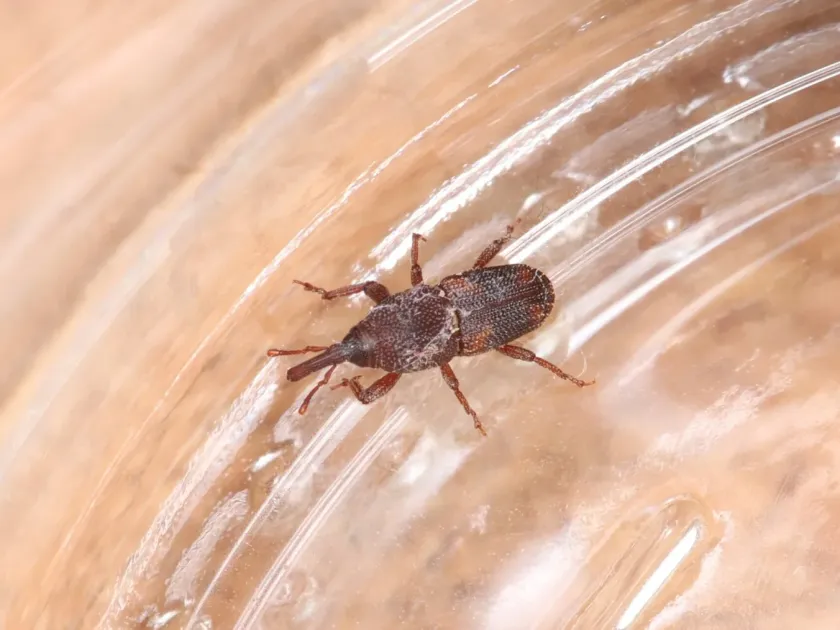
The rice weevil (Sitophilus oryzae) is a member of the Coleoptera order and the Curculionidae family. Adult beetles typically measure between 2.5 to 3.5 mm in length and possess a characteristic elongated rostrum (snout).
The body coloration is usually dark brown to black, with four distinct reddish-orange spots located on the elytra. These spots serve as a key morphological feature for distinguishing the rice weevil from similar species like the maize weevil.
Larvae are white, legless, and C-shaped, equipped with strong mouthparts suited for excavating the grain's endosperm. The pupal stage is also completed inside the grain kernel, where the insect develops until it matures into an adult.
Equipped with well-developed wings, these beetles are capable of flight, enabling them to migrate from field crops to storage facilities or between different warehouses, facilitating the spread of infestation.
Female weevils bore a small hole into the grain, deposit an egg inside, and seal the opening with a secretion plug. This hidden lifecycle makes early detection challenging, as most development occurs entirely within the kernel.
What it damages
This pest is a primary threat to stored cereal grains, including rice, wheat, corn, barley, and sorghum. It also readily infests processed products such as pasta, flour, and cereals kept in storage for extended periods.
The primary damage is caused by the larvae consuming the grain's endosperm. This results in significant weight loss and a total depletion of nutritional value, rendering the grain useless for food processing or market sale.
Once the adult emerges, it leaves a perfectly circular hole in the grain. Heavily infested batches lose their germination capacity, making them unfit for use as seeds, and often exhibit significant quality degradation.
Weevil activity increases the moisture content within the grain mass, which frequently triggers secondary issues such as mold growth and fermentation, leading to further spoilage of the stored commodity.
Economic losses are severe, stemming from direct consumption of the grain, the degradation of remaining stocks, and the costs associated with mandatory fumigation and disposal of infested materials.
When it appears
In temperature-controlled storage facilities, the rice weevil does not undergo a true diapause and can reproduce continuously throughout the year, provided temperatures remain favorable for development.
The optimal temperature range for the rice weevil is between 25°C and 30°C. In these conditions, the lifecycle can be completed in as little as 30 to 40 days, leading to rapid population explosions.
In warmer climates, the infestation can begin in the field before harvest. When this grain is moved to storage, it brings the population with it, quickly spreading the infestation throughout the warehouse.
Adults are hardy and can overwinter in cracks, crevices, or residual debris within empty silos and warehouses. They survive until conditions improve, at which point they begin to exploit any available grain supply.
Seasonal dynamics are heavily dependent on grain temperature. Monitoring internal grain temperature is essential, as sudden rises often indicate an active pest colony that has begun its lifecycle within the mass.
Signs of infestation
The most prominent sign of infestation is the presence of small, circular exit holes on the surface of grain kernels. A thorough examination of the grain mass often reveals the presence of adult beetles.
A musty or distinct "grain warehouse" odor is often present in infested areas. This smell is produced by the accumulation of insect frass, excrement, and the associated microbial activity within the grain.
Hot spots, or localized areas of increased temperature within the grain mass, are classic indicators of rice weevil activity. This self-heating process is a direct result of the insects' metabolic processes.
Visual inspection often reveals dusty, matte-looking grain. When grains are dissected, internal cavities containing larvae, pupae, or adults become visible, confirming the extent of the internal damage.
Caking or the formation of a "crust" on the top layer of grain is a critical warning sign, indicating that moisture levels have increased to the point where mold growth and insect proliferation are severe.
Control measures
Sanitation is the cornerstone of management. Warehouses must be thoroughly cleaned before storing new crops, with all dust, debris, and grain residues removed to prevent cross-contamination.
Maintaining proper grain moisture levels (below 14%) and cool temperatures is crucial. Physical cooling through aeration is an effective non-chemical method to suppress the metabolic activity of the weevils.
Routine monitoring using grain probes and pheromone traps is recommended to detect populations before they reach economic threshold levels, allowing for targeted management interventions.
- Regular inspection of stored grain samples.
- Application of residual contact insecticides to warehouse surfaces.
- Fumigation with approved gases to eliminate internal stages.
- Proper sealing of storage facilities to prevent pest re-entry.
If an infestation is confirmed, fumigation is the only reliable method to eliminate all life stages (eggs, larvae, pupae, and adults). This process must be conducted by licensed professionals adhering to safety protocols.
Content graph
Connections · Rice weevil
Most often together:
Marketplace
Products · 43


Dzhin
«Юнісіті Ентерпрайсіс Л.П.», Единбург, Великобританія
Rodenticides
0
0
·
62
1 offer
14.19 €per 1 kg
Buy


Geliophos
Longleon Ltd. ( Zhejiang Shipping Group Co.,Ltd. ), Жейянг, Китай
Rodenticides
0
0
·
56
No offers
—
Details
Biology
Taxonomy
- Latin name
- Sitophilus oryzae
- Order
- Coleoptera (beetles)
- Family
- Dryophthoridae
- EPPO code
- CALAOR
Community
Discussion
No discussions yet — be the first.