
Granary weevil
Calandra
Description
How to identify
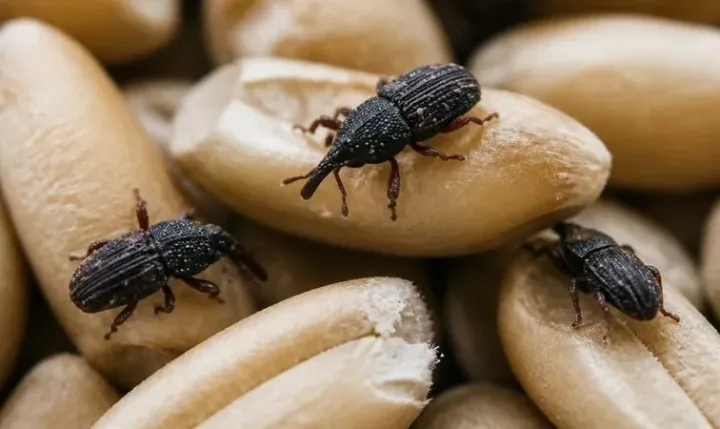
The granary weevil (Sitophilus granarius) is a small beetle belonging to the Curculionidae family. It is one of the most significant pests affecting stored grain worldwide. Adults are typically 2.5 to 4 mm long with a distinctive snout.
The body is cylindrical and ranges in color from reddish-brown to almost black. Unlike many other stored product beetles, the granary weevil is flightless, which limits its primary mode of dispersal to transportation within contaminated grain shipments.
The elytra, or wing covers, display deep longitudinal pits or punctures. The larvae are creamy white, legless, and have a curved, grub-like body structure adapted for living inside individual grain kernels.
Female weevils use their snouts to drill a small hole in a kernel, lay a single egg inside, and seal the cavity with a gelatinous secretion. This protective mechanism ensures the larva has a secure environment for its entire development phase.
Development from egg to adult is highly sensitive to climate. In warm conditions (around 25-27°C), the lifecycle can be completed in about one month, with adults surviving for up to a year depending on environmental moisture and temperature levels.
What it damages
The granary weevil attacks a vast range of cereal crops, including wheat, barley, rye, oats, and maize, as well as buckwheat and rice. It is a major economic threat to silos and granaries throughout the temperate regions.
Both the larvae and adults feed on grain, but the larvae cause the most profound damage by consuming the endosperm from within. This hollows out the kernel, resulting in significant weight loss and complete destruction of the grain's commercial value.
Beyond direct consumption, the feeding activity produces dust and frass, which contaminates the grain mass. This often triggers a chain reaction of moisture accumulation and self-heating within the grain bulk.
Secondary infections occur rapidly as these warm, damp pockets become ideal breeding grounds for fungi and secondary pests. This often leads to the spoilage of large quantities of grain surrounding the initial infestation point.
Grain damaged by granary weevils is unsuitable for milling or human consumption. Furthermore, the loss of seed viability makes the product useless for agricultural planting, necessitating costly disposal or remediation procedures.
Signs of infestation
The most obvious indicator of an infestation is the presence of small, round emergence holes on the surface of the grains. These are created when new adult weevils bore their way out of the kernel.
A musty or sour smell emanating from the grain storage area is a classic sign of infestation. Upon inspection, the presence of powdery material on the surface of the grain indicates ongoing beetle activity.
Monitoring for temperature fluctuations is essential. A sudden increase in temperature within the grain pile is a strong warning sign of an active infestation, as weevil respiration releases heat into the grain mass.
Visual identification of adult beetles on the grain surface is a clear sign that the population has reached an advanced stage. Sampling grain at various depths is necessary to assess the actual scale of the problem.
Using pheromone-based traps is an effective diagnostic tool. These traps attract adult weevils, providing early detection and allowing storage managers to intervene before the infestation becomes widespread.
Control measures
Integrated Pest Management (IPM) for the granary weevil starts with rigorous sanitation. Cleaning out all old grain residues from corners, crevices, and machinery before introducing new harvests is mandatory to break the cycle of infestation.
Controlling the physical environment is key. Drying grain to a moisture level below 14% makes the kernels less hospitable for larvae development and increases the overall storage lifespan of the product.
Active aeration and cooling are powerful preventative tools. Maintaining the grain mass at temperatures below 10°C puts the weevils into a dormant state or reduces their metabolic activity, significantly slowing their population growth.
When an infestation is detected, fumigation is the industry standard. This involves using gas-tight seals and registered phosphine-based fumigants to eliminate all life stages of the weevil within the grain mass.
- Sanitize storage facilities thoroughly between batches.
- Maintain grain moisture content below 14%.
- Use aeration to keep grain cool.
- Inspect grain regularly for temperature spikes.
- Consult professionals for fumigation services when infestations occur.
Taxonomy
- Latin name
- Calandra
- Order
- Coleoptera (beetles)
- Family
- Dryophthoridae
- EPPO code
- CALASP
Discussion
No discussions yet — be the first.