
Banana weevil
Cosmopolites
Description
How to identify
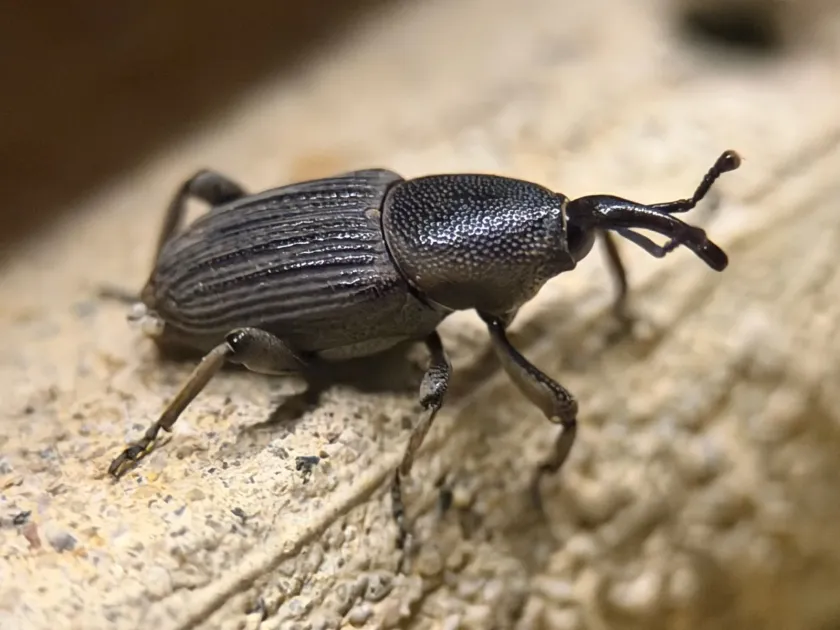
The banana weevil (Cosmopolites sordidus) is a member of the Curculionidae family. Adult weevils are about 10–12 mm long, characterized by a hard, dark-brown to black exoskeleton.
The insect possesses a distinctive elongated snout (rostrum) typical of the weevil family. While adults have wings, they are poor fliers and tend to crawl on the ground, making them sedentary.
Larvae are legless, fleshy, and creamy-white with a darker brown head capsule. They grow up to 15 mm in length and reside exclusively inside the banana corm and pseudostem.
Eggs are laid singly by the female in small holes chewed into the banana pseudostem base. This strategic placement provides shelter from predators and environmental stressors.
The pupal stage occurs within the larval tunnels inside the plant tissue. This internal development makes the weevil particularly difficult to detect and eradicate.
What it damages
The primary host of the banana weevil is the banana plant (Musa spp.). It thrives on both dessert bananas and plantains, causing severe economic losses worldwide.
Larvae bore extensive galleries into the corm (rhizome) and the base of the pseudostem. This internal destruction disrupts the plant's vascular system, hindering water and nutrient uptake.
The structural damage caused by tunnels weakens the plant's stability, often resulting in premature toppling of the banana bunch even before it reaches full maturity.
Secondary infections by pathogens (fungi and bacteria) frequently occur in the weevil-damaged tunnels, accelerating the decay and necrosis of the plant tissue.
Young plantations are especially vulnerable; a severe infestation can prevent the establishment of the crop and lead to the total abandonment of the field.
When it appears
The banana weevil is active throughout the year in tropical regions where temperature and moisture remain favorable for continuous reproduction.
The life cycle takes approximately 30 to 50 days to complete, depending largely on soil temperature. Warmer climates lead to more rapid population growth.
Adult weevils are primarily nocturnal and highly elusive. They prefer high-humidity environments, and their survival is significantly lower in arid or well-drained, dry soil conditions.
Migration between fields is largely facilitated by human activity, primarily the movement of infested rhizomes or "suckers" used for vegetative propagation.
Without significant seasonal variations, populations can reach epidemic levels if sanitation practices on the farm are neglected over successive harvest cycles.
Signs of infestation
Early symptoms include yellowing and drooping of the lower leaves. The plant appears stunted, and new suckers show slow, irregular development compared to healthy stalks.
Visible boreholes near the soil line are a classic diagnostic sign. These openings are where larvae have entered or exited the tissue during their development.
Upon removing the soil from the base of the pseudostem, one can often see frass—a dark, sawdust-like mixture of plant debris and excrement—accumulated near the entry points.
A cross-section of the corm reveals severe tunneling, which appears as a network of holes filled with decomposing plant matter and necrotic tissue.
Plants become prone to "snapping" or toppling, as the rhizome becomes structurally hollowed out by the feeding larvae, failing to anchor the weight of the plant.
Control measures
- Strict quarantine and use of clean, laboratory-certified planting material are the most effective preventive measures against infestation.
- Field sanitation, including the removal and destruction of crop residues after harvest, eliminates the primary breeding habitats.
- Pheromone traps are highly recommended for monitoring weevil population levels and conducting mass trapping of adult insects.
- Biological control using entomopathogenic fungi such as Beauveria bassiana has shown promise in reducing weevil survival rates in field conditions.
- Integrated Pest Management (IPM) strategies, combining trap crops and selective chemical applications, are essential for long-term sustainability on large plantations.
Taxonomy
- Latin name
- Cosmopolites
- Order
- Coleoptera (beetles)
- Family
- Dryophthoridae
- EPPO code
- COSMSP
Discussion
No discussions yet — be the first.