
Sirex woodwasp
Sirex noctilio
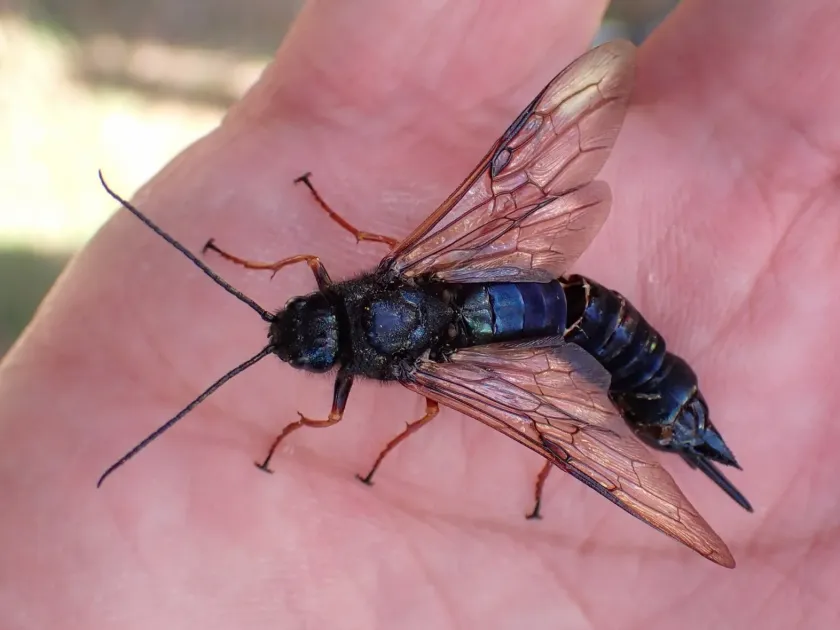
Description
How to identify
The Sirex woodwasp is a member of the Siricidae family, known for its distinct metallic blue-black appearance. Adults typically range from 10 to 40 mm in length, with females being generally larger than males.
Females possess a long, needle-like ovipositor used to drill deep into the wood of coniferous trees. Males are characterized by reddish-orange or black middle abdominal segments, depending on the subspecies.
Larvae are creamy-white and legless, with a well-developed head and a small, pointed spine at the posterior end of the body. They spend their entire larval stage boring through the inner wood of the host tree.
The species has a complex symbiotic relationship with the wood-rotting fungus Amylostereum areolatum, which the female injects into the tree during egg-laying to provide food for the larvae.
Adults are strong fliers and are attracted to volatiles released by stressed or weakened conifers, allowing them to locate suitable host trees over significant distances.
What it damages
This pest primarily attacks various species of pine, spruce, and fir. While it favors stressed trees, severe infestations can occur in healthy, dominant trees, causing major losses in forest stands.
Larvae feed on the wood, creating extensive galleries that disrupt the vascular system of the tree. This structural damage significantly reduces the tree's ability to transport water and nutrients.
The symbiotic fungus facilitates wood decay, which rapidly reduces the quality of the timber. Infested trees often suffer from rapid crown dieback and mortality within a few months of attack.
Economic impact includes the direct loss of harvestable timber, the cost of phytosanitary removal of dead trees, and trade restrictions on timber exports from affected regions.
Because the larvae reside deep within the wood, damage is often irreversible by the time external signs become obvious, posing a severe challenge to timber production management.
When it appears
The adult flight season typically occurs from mid-summer through early autumn. During this time, mated females emerge to search for host trees and initiate the reproductive cycle.
The life cycle duration varies significantly based on climate and tree condition, typically ranging from one to two years, but sometimes extending up to three years in colder climates.
Pupation takes place inside the wood, just beneath the bark. Once the transformation is complete, the adult chews its way to the surface, leaving behind a perfectly circular exit hole.
Drought conditions and high stand density are critical environmental factors that predispose coniferous forests to attacks, as stressed trees provide the most suitable conditions for larval survival.
Winter is spent as larvae deep in the timber, where they continue to tunnel through the wood, protected from extreme external temperatures until the following season.
Signs of infestation
The most visible sign of an established infestation is the presence of small, circular exit holes, usually 3–7 mm in diameter, on the surface of the bark or timber.
Resin beads or streaks on the trunk are often present where the female has used her ovipositor. However, these signs are not always consistent and depend on the tree's overall resin production.
Foliage symptoms include chlorosis and wilting of the crown, which progresses to a distinct brownish or reddish hue, indicating that the tree's health is rapidly deteriorating.
If the bark is removed, characteristic larval tunnels packed with fine wood dust (frass) will be visible, indicating the presence of active or past wood-boring activity.
Visible white fungal patches or bluish wood discoloration can sometimes be found deep within the timber, marking the internal spread of the associated Amylostereum fungus.
Control measures
Effective management focuses on forest hygiene, including the prompt identification and removal of infested trees. Sanitizing the area prevents the build-up of the woodwasp population.
Biological control has proven highly successful in many regions, primarily through the introduction of specialized parasitoid wasps like Ibalia leucospoides, which target woodwasp larvae.
Another biological approach involves using parasitic nematodes (Deladenus siricidicola) that sterilize female woodwasps, effectively reducing their ability to propagate the species.
Monitoring using pheromone-baited traps allows foresters to track the pest's spread and timing of adult emergence, facilitating targeted responses rather than broad-spectrum insecticide use.
- Strict movement regulations for timber and wood packaging to prevent spread.
- Enhancing forest health through proper thinning and site selection.
- Utilizing comprehensive integrated pest management (IPM) strategies.
Taxonomy
- Latin name
- Sirex noctilio
- Order
- Hymenoptera
- Family
- Siricidae
- EPPO code
- SIRXNO
Discussion
No discussions yet — be the first.