
Siphanta hebes
Siphanta hebes
Description
How to identify
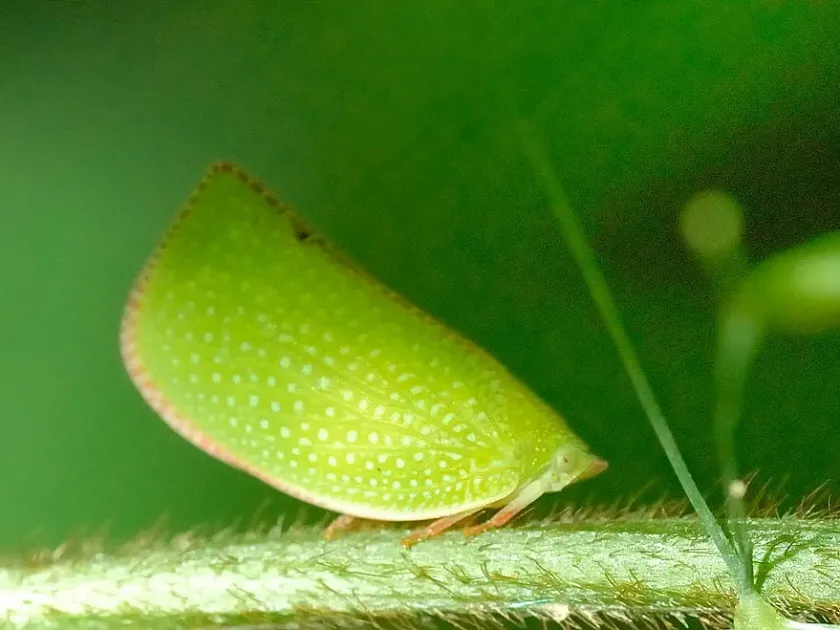
Siphanta hebes, commonly known as the green planthopper, belongs to the family Flatidae. Its appearance is a classic example of insect mimicry, as adults perfectly resemble a small green leaf.
The adult insect is triangular in shape, with bright green, translucent wings that are held vertically over the body, giving it a distinct flattened profile when viewed from the side.
The nymphs of this species are markedly different, appearing as small, white, fuzzy insects covered in long, waxy filaments that protect them from desiccation and predator detection.
During their growth cycle, nymphs progress through several instars, gradually increasing in size and losing their waxy covering as they transform into mature, winged adults capable of hopping.
They are relatively sedentary, usually congregating in dense colonies on the undersides of leaves or along young, tender stems where they can easily feed on phloem sap.
What it damages
As a polyphagous pest, Siphanta hebes impacts a broad variety of agricultural and ornamental plants, including citrus trees, grapevines, avocados, and various woody shrubs.
Both adults and nymphs cause damage by using their piercing-sucking mouthparts to feed on plant juices, which directly drains the plant of essential nutrients and fluids.
This feeding activity often results in stunted shoot growth, chlorosis, and the curling or distortion of young leaves, which significantly impacts the overall health and vigor of the plant.
A major indirect threat is the excretion of honeydew, a sticky substance that falls onto lower leaves and stems, serving as an ideal medium for the growth of sooty mold fungus.
The black sooty mold layer blocks sunlight and inhibits photosynthesis, which, when coupled with the loss of sap, can lead to reduced fruit set and poor crop yields.
When it appears
The life cycle of the green planthopper is highly dependent on temperature, with warmer climates allowing for multiple overlapping generations throughout the year.
Overwintering typically occurs in the egg stage. Eggs are laid in neat, flat clusters on the bark or foliage of host plants, remaining dormant until favorable spring temperatures trigger hatching.
First-instar nymphs usually emerge in early spring, coinciding with the onset of new vegetative growth, which provides a high-quality food source for the developing population.
Population densities typically peak during the mid-summer months when faster metabolic rates allow for rapid maturation, leading to large colonies appearing within a few weeks.
As autumn approaches and temperatures drop, the activity of adults declines, and they focus on oviposition to ensure the survival of the next generation through the winter months.
Signs of infestation
The most visible sign of an infestation is the presence of white, cottony, or waxy residues on leaves and twigs, which are actually the cast-off skins and secretions of nymphs.
The development of a black, powdery coating known as sooty mold on the foliage is a secondary but major indicator that a sap-sucking insect population is active on the plant.
Stunted or distorted foliage growth is a common symptom, often appearing as a curling of the leaf tips or a yellowing of the leaf margins near the site of heavy feeding.
Sudden disturbance of the foliage usually causes adult planthoppers to jump or fly in all directions, making them relatively easy to spot if you tap the branches during inspection.
An increased presence of ants on the plant is a strong warning sign, as ants are frequently attracted to the rich honeydew secretions left behind by the planthopper colonies.
Control measures
Managing Siphanta hebes requires an integrated approach that focuses on reducing the current population while simultaneously creating conditions that discourage further outbreaks.
Good orchard or garden sanitation is essential; regular pruning of dense foliage improves airflow and light penetration, making the environment less favorable for nymph survival.
Biological control remains highly effective, as several species of parasitic wasps and generalist predators like ladybirds are known to prey upon or parasitize the eggs and young nymphs.
When populations reach damaging thresholds, the application of contact or systemic insecticides should be timed carefully to ensure thorough coverage of the undersides of leaves.
- Utilizing yellow sticky cards to monitor adult flight activity and density.
- Application of horticultural oils or insecticidal soaps to suffocate young nymphs.
- Systemic treatment of host plants during peak infestation periods if necessary.
- Regular washing of foliage with a high-pressure water spray to dislodge nymphs and wash away honeydew.
Taxonomy
- Latin name
- Siphanta hebes
- Order
- Hemiptera (bugs, aphids, leafhoppers)
- Family
- Flatidae
- EPPO code
- SIPAHE
Discussion
No discussions yet — be the first.