
Colgaroides acuminata
Colgaroides acuminata
Description
How to identify
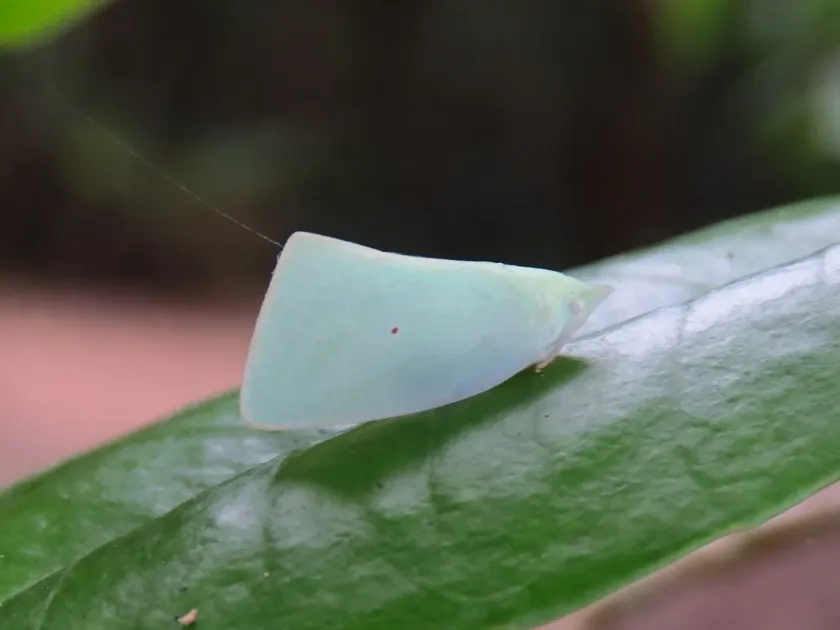
Colgaroides acuminata belongs to the order Hemiptera and the family Flatidae. It is a small insect characterized by its wedge-shaped profile and wings that fold tightly against the body, a hallmark of the family.
The adults exhibit a cryptic coloration, ranging from light brown to greenish tones, providing excellent camouflage on plant foliage. Their head is equipped with piercing-sucking mouthparts tailored for plant sap extraction.
Nymphs of this species also possess piercing-sucking mouthparts and are often covered in white, waxy secretions. These secretions provide essential protection against desiccation and natural predators during their development.
The lifecycle involves incomplete metamorphosis. The insects are highly agile, utilizing their well-developed hind legs to perform sudden, rapid jumps, which makes visual field monitoring challenging.
Taxonomically, the family is known for these adaptations, which serve as a primary diagnostic feature when identifying the pest in field crops or nursery settings.
What it damages
Both nymphs and adults cause damage by extracting phloem sap from various agricultural and ornamental crops. Common hosts include citrus, tropical fruit trees, and various woody shrubs.
Feeding leads to plant stress, stunted growth, reduced yields, and lower fruit quality. In cases of severe infestation, the cumulative impact can significantly weaken the plant's structural integrity.
Beyond physical tissue damage, Colgaroides acuminata can serve as a potential vector for plant pathogens, including viruses and phytoplasmas, posing a systemic threat to crop health.
The excretion of honeydew promotes the growth of sooty mold, which covers the leaf surface in a black layer. This blocks sunlight and hinders photosynthesis, eventually causing premature leaf drop.
Economic damage is particularly significant in nurseries and young orchards, where even moderate population levels can lead to substantial losses in plant vigor and commercial value.
When it appears
The life cycle of this pest is highly dependent on climate, with peak activity coinciding with warm, growing seasons. It typically follows a multivoltine pattern in favorable tropical or temperate regions.
Overwintering usually occurs in the egg stage, with females inserting eggs into bark or plant stems. Nymphs emerge in spring, synchronizing with the flush of new vegetative growth.
Several generations may occur within a single year, with development rates being heavily influenced by temperature. High temperatures during mid-summer often lead to rapid population spikes.
The population density usually peaks in the second half of summer, as environmental conditions become optimal for reproduction and juvenile development.
As temperatures drop in autumn, activity slows down significantly, and the pest transitions to the overwintering phase, completing its seasonal reproductive cycle.
Signs of infestation
The most immediate sign of infestation is the presence of adult insects on the underside of leaves. They are sensitive to disturbance and will quickly disperse by jumping or flying.
Initial feeding damage manifests as chlorotic spots on leaves where the mouthparts have pierced the tissue. Over time, heavy feeding causes leaf yellowing, curling, and overall tissue necrosis.
The accumulation of honeydew, a sticky substance, on foliage is a strong indicator of presence. This is quickly followed by the development of black sooty mold on the leaf surface.
White, fibrous wax-like filaments left by nymphs on stems and leaves are a key visual diagnostic indicator. Seeing these waxy traces is a clear signal that the pest is actively feeding.
Plant distress, such as flower drop, stunted apical growth, and a general lack of vitality, are critical indicators of established, high-pressure infestations requiring immediate attention.
Control measures
Integrated Pest Management (IPM) is essential for controlling this leafhopper. It involves monitoring thresholds and combining cultural, biological, and chemical interventions.
- Remove alternative host weeds surrounding fields to reduce population reservoirs.
- Prune and safely dispose of heavily infested plant parts.
- Deploy yellow sticky traps for monitoring adult activity.
- Conserve and encourage natural enemies, such as parasitoid wasps and predators.
- Apply systemic insecticides during peak infestation periods if thresholds are exceeded.
Chemical control should be executed with caution by rotating different insecticide classes to mitigate the risk of resistance development. Systemic formulations provide the most effective coverage.
Biological control focuses on supporting existing populations of natural predators and parasitoids, which can effectively keep leafhopper numbers below economic thresholds in sustainable systems.
Maintaining optimal plant health through proper irrigation and nutrition increases plant resilience, making them less susceptible to both the direct feeding impact and secondary infections by pathogens.
Taxonomy
- Latin name
- Colgaroides acuminata
- Order
- Hemiptera (bugs, aphids, leafhoppers)
- Family
- Flatidae
- EPPO code
- CLGRAC
Discussion
No discussions yet — be the first.