
Green planthopper
Siphanta
Description
How to identify
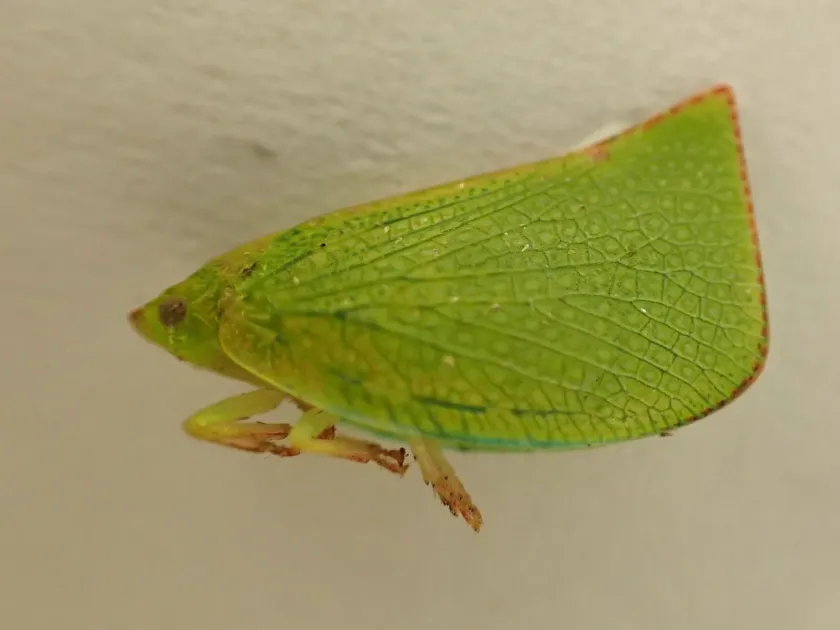
The green planthopper (genus Siphanta) belongs to the family Flatidae within the order Hemiptera. These insects are well-known for their unique triangular shape, which resembles a small leaf.
Adult Siphanta usually measure between 10 and 15 mm in length. Their coloration ranges from bright green to pale lime, often with distinctive red or brown margins on their wings.
The nymphs of Siphanta are distinct from adults; they appear as small, whitish, fluffy insects covered in wax-like filaments, which provide essential protection from environmental stress.
Their life cycle typically consists of the egg stage, five nymphal instars, and the adult stage. In favorable climates, they can complete multiple generations in a single year.
Females lay their eggs in small, neat rows on leaves or stems. These egg masses are often covered with a protective secretion that hardens into a greyish, scale-like crust.
What it damages
Siphanta is a polyphagous insect, meaning it feeds on a wide variety of plant species, including fruit trees, ornamentals, and various native shrubs.
Common hosts include citrus trees, grapevines, roses, ficus, magnolia, and coffee plants. They often target new, succulent growth where the tissues are easiest to penetrate.
By using their piercing-sucking mouthparts, these insects drain the plant's sap. This loss of nutrients causes the plant to become weak, stunted, and significantly less productive.
A major indirect threat is the excretion of honeydew. This sticky substance covers the leaves and provides a medium for the growth of black sooty mold.
Sooty mold growth blocks sunlight, which inhibits the plant's ability to photosynthesize effectively, often leading to leaf chlorosis and premature leaf drop.
Signs of infestation
The first indicator of a Siphanta infestation is often the presence of white, cotton-like masses on the undersides of leaves, which are the wax-covered nymphs.
Small yellow or pale spots appear on the foliage as a result of the insect's feeding punctures. As the infestation grows, these spots can merge, causing the leaf to yellow entirely.
Sticky surfaces on the foliage, stems, or even the ground beneath the plant are a clear sign of honeydew accumulation, which frequently attracts ant colonies.
The presence of a dark, powdery black coating (sooty mold) on the leaves is a secondary symptom that indicates the planthoppers have been present for some time.
Observing adult insects is easy; if you disturb the plant, they will jump or fly away quickly, revealing their presence in the canopy.
Control measures
For small infestations, physical removal is quite effective. You can prune away heavily infested branches or spray the plants with a strong stream of water to dislodge nymphs.
Biological control methods include encouraging natural predators, such as parasitic wasps or ladybugs, which feed on the eggs and nymphs of the planthoppers.
Chemical control with insecticides, such as insecticidal soaps, oils, or systemic neonicotinoids, should be used as a last resort during high population density outbreaks.
- Monitor plants regularly for the presence of cotton-like nymphs.
- Prune and destroy plant material containing egg masses during winter.
- Keep the garden area free of host weeds that might harbor the pests.
- Use oil-based sprays to smother the eggs and prevent them from hatching.
It is best to apply any control treatment during the cooler times of the day to ensure optimal coverage and minimize the risk of phytotoxicity on the plants.
Taxonomy
- Latin name
- Siphanta
- Order
- Hemiptera (bugs, aphids, leafhoppers)
- Family
- Flatidae
- EPPO code
- SIPASP
Discussion
No discussions yet — be the first.