
Canary grass
Serinus canaria
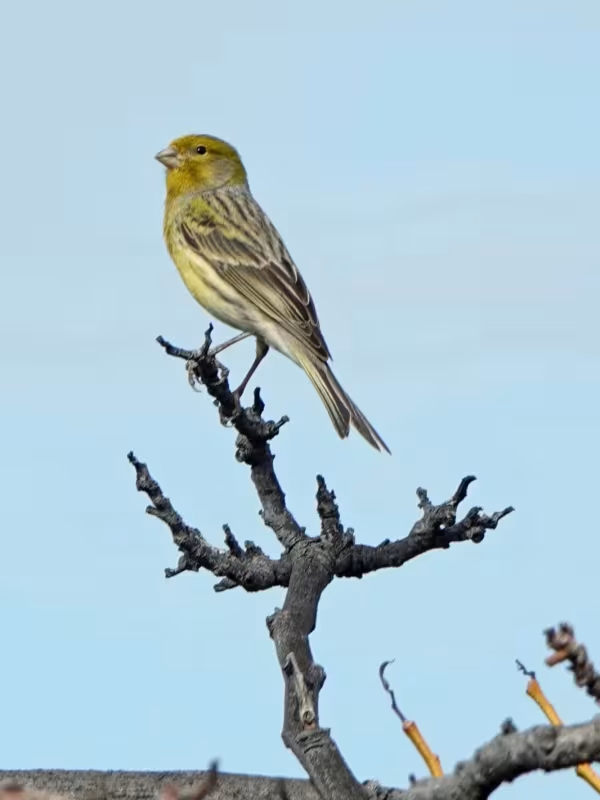
Description
How to identify
Canary grass (scientific name Phalaris canariensis) is an annual grass in the family Poaceae. Although it is commercially grown for birdseed, it often acts as an invasive weed in agricultural fields.
The plant grows to a height of 20 to 100 centimeters. Its leaves are flat, linear, and often have rough margins, making it blend in seamlessly with cereal crops like wheat and barley.
It is characterized by a dense, egg-shaped, or oblong spike-like panicle. At maturity, the spike becomes straw-colored, containing seeds that are hard and shiny.
Belonging to the order Poales, this species is highly adaptable. It thrives in various soil types, ranging from moist soils to those with higher salinity levels, which aids its survival in diverse environments.
Identification is easiest during the heading stage when the specific structure of its inflorescence distinguishes it from other wild grasses and cereal crops.
What it damages
As a weed, canary grass competes fiercely with primary crops for water, solar radiation, and soil nutrients, such as nitrogen and phosphorus, which are essential for yield.
When present in high densities, it causes significant growth inhibition in cereal crops, leading to lower biomass production and thinner crop stands.
The seeds of canary grass are similar in size to other cereal grains, causing heavy contamination in harvested yields. This makes the cleaning process difficult and expensive.
Field infestation often results in reduced market value for the harvested grain due to the presence of weed seeds, which can lead to penalties at the point of sale.
The weed also serves as an alternative host for various pests and pathogens, potentially increasing the pressure of biological attacks on the main crop.
When it appears
Canary grass seeds typically germinate in early spring as soon as soil temperatures reach 5–10 degrees Celsius, allowing it to get a head start on late-planted crops.
The active vegetative growth phase occurs throughout late spring, coinciding with the tillering phase of many commercial small grains.
Flowering and heading usually take place in the early summer, around June or July, depending on the climatic zone and planting date.
Seed maturity is reached by mid-to-late summer. Once ripe, the seeds shed easily, effectively replenishing the soil seed bank for the following growing season.
It is an annual plant, meaning its life cycle is completed within one year, which makes timely eradication before seed set a critical management objective.
Signs of infestation
The primary sign of infestation is the emergence of dense patches of light green grass that emerge earlier and grow faster than the sown crop.
In the field, stunted crop growth in localized areas often indicates that canary grass is outcompeting the crop for root-zone resources.
During the heading stage, the presence of the characteristic egg-shaped spikes becomes the most visible indicator of weed presence within the crop stand.
Post-harvest, finding small, hard, and shiny seeds in the grain sample during quality testing is a clear indication of a weed management failure.
Looking at the margins of fields and farm tracks often reveals the source of the infestation, as the seeds are easily transported by farm machinery.
Control measures
The most effective strategy is to ensure the use of high-quality, certified seeds that are free from any weed seed contamination.
Implementing a robust crop rotation, especially including broad-leaf crops, is essential to disrupt the life cycle and reduce the soil seed bank of the grass.
Post-emergence chemical control using selective herbicides is effective if applied early, specifically when the weed is in the 2–4 leaf growth stage.
Mechanical operations, such as post-harvest stubble tillage, encourage dormant seeds to germinate, allowing them to be destroyed by subsequent plowing.
- Strict equipment sanitation between fields.
- Timely mowing of field borders and ditches.
- Use of precise herbicide application technologies.
- Monitoring of field edges to prevent spread.
Taxonomy
- Latin name
- Serinus canaria
- Family
- Fringillidae
- EPPO code
- SERNCA
Discussion
No discussions yet — be the first.