
Common redpoll
Carduelis flammea
Description
How to identify
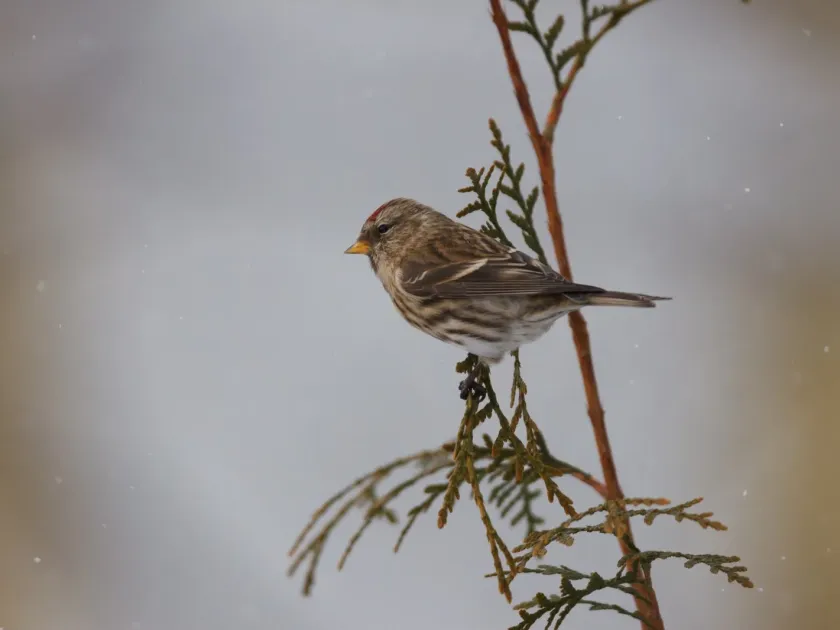
The common redpoll (Carduelis flammea) is a small passerine bird belonging to the finch family. It is easily recognizable by the vibrant red patch on its forehead, which is particularly prominent in males during the breeding season.
The plumage of the redpoll is generally brown with dark streaks, providing excellent camouflage in nature. It possesses a short, conical bill specifically evolved for efficiently cracking open small seeds, which is its primary food source.
In the wild, these birds inhabit boreal forests and scrublands, but in winter, they form large, nomadic flocks. During these movements, they often congregate in agricultural areas in search of high-energy food sources to survive the cold.
The biology of the redpoll is tied to seed availability. They are highly mobile creatures capable of covering long distances to locate areas with abundant food, making them persistent visitors to agricultural fields during winter months.
Their social behavior, characterized by flocking, ensures that they can locate and exploit food resources efficiently, often concentrating in high numbers on a single field to minimize energy expenditure while foraging.
What it damages
The common redpoll causes agricultural damage by feeding on seeds of oilseed crops such as sunflower and rapeseed, as well as various cereals. Their consumption can lead to significant economic losses, especially in seed production farms.
During winter, when natural food is scarce due to snow cover, redpolls focus on fields with unharvested crops. They peck at sunflower heads and cereal ears, directly reducing the yield quality and quantity of the harvest.
Besides direct seed consumption, the birds cause mechanical damage to the stalks and flowering parts of plants. This can lead to plant lodging, making subsequent mechanical harvesting more difficult and inefficient.
Damaged tissues in plants become susceptible to fungal infections and secondary pests, as the breach of the outer shell allows pathogens to enter. This leads to a wider spread of plant diseases across the field.
In regions with harsh winters, the damage inflicted by redpoll flocks can be cumulative. Their repeated presence on the same plot significantly impacts the overall yield, particularly in smaller plots where their concentration is higher.
Signs of infestation
A primary indicator of redpoll activity is the presence of seed husks and debris scattered on the ground beneath the plants. This clear sign suggests that a flock has been foraging in the area recently.
Visible damage to crop structures is another sign. Sunflower heads may look selectively pecked, while cereal grains will show missing seeds, often leaving the husks intact or discarded in the immediate vicinity.
Their presence is often accompanied by a distinct, rapid chirping sound. Observers may see flocks moving quickly between fields or resting in nearby trees, waiting for an opportunity to descend upon the crops.
The accumulation of bird droppings on the soil or lower leaves of the plants serves as a confirmation of their activity. This is most noticeable in spots where the birds have spent significant time feeding.
Increased uniformity in damage patterns, such as patches of empty heads or thinned-out plant stands, clearly distinguishes avian feeding from other types of crop stress. Early identification allows for timely intervention.
Control measures
Bioacoustic repellent systems that play distress calls or sounds of predators are highly effective in scaring away redpoll flocks. Placing these systems at the perimeter of the field is a standard protective measure.
Visual deterrents, including hawk decoys and reflective tapes, can provide temporary relief. To maintain effectiveness, it is recommended to rotate these devices frequently to prevent the birds from habituating to them.
Agronomic strategies, such as prompt harvesting and thorough field cleaning, are essential to remove leftover seeds. Minimizing the availability of food makes the field far less attractive to nomadic wintering birds.
For high-value seed crops or research plots, physical barriers like fine-mesh netting are the most reliable way to prevent bird access entirely. This method is highly recommended when other deterrents fail to provide adequate protection.
Integrated pest management should also include weed control along field margins. By removing alternative food sources, farmers can effectively divert bird activity away from the primary crops, reducing overall field damage.
Taxonomy
- Latin name
- Carduelis flammea
- Family
- Fringillidae
- EPPO code
- CRDLFL
Discussion
No discussions yet — be the first.