
European greenfinch
Carduelis chloris
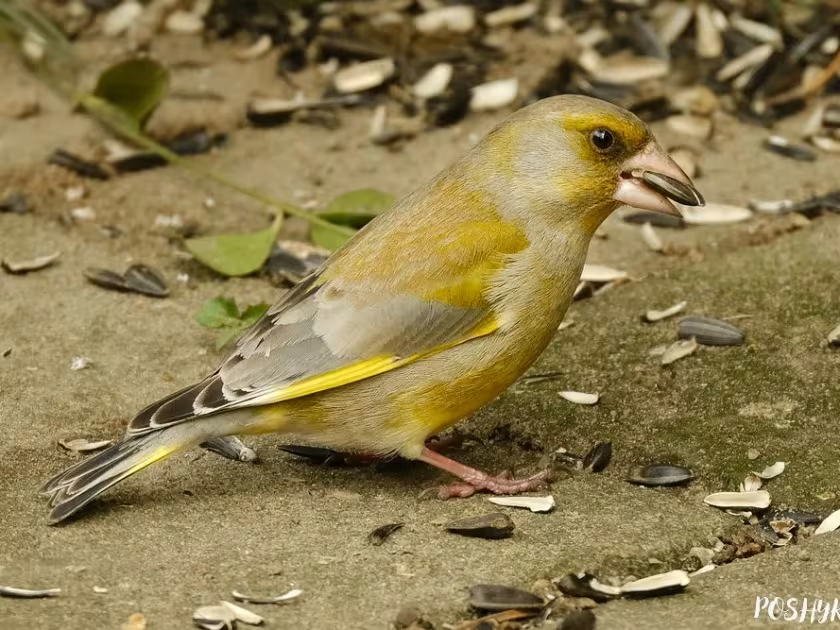
Description
How to identify
The European greenfinch is a passerine bird in the finch family, Fringillidae, commonly found in gardens, orchards, and agricultural landscapes.
Adults measure approximately 14–17 cm in length and possess a robust, heavy bill designed for crushing seeds and grains.
The male is easily identified by its olive-green plumage with distinct yellow patches on the wings and tail, which are visible during flight.
Females exhibit a duller, greyish-brown coloration, which serves as a highly effective camouflage in dense foliage during the nesting season.
These birds are gregarious, often forming large flocks after the breeding season, which increases their potential impact on local agriculture.
What it damages
Greenfinches are primarily seed-eaters, feeding on a wide variety of plant materials, including crops cultivated for seed production.
They are known to cause significant damage to sunflower plantations, extracting kernels from the heads during the ripening stage.
Orchards are susceptible as greenfinches frequently consume buds on fruit trees in early spring, leading to reduced flowering and crop yields.
Cereals and oilseeds, including oats, millet, and oilseed rape, are also targeted, particularly when fields are situated near hedges or woodland.
Vegetable crops left for seed harvesting are at high risk, as greenfinches can efficiently deplete the seed stock within a short timeframe.
When it appears
The highest level of bird activity in fields coincides with the ripening period of seeds, occurring typically from late summer through early autumn.
Spring damage in orchards occurs when natural food sources are scarce, causing birds to feed on the tender buds of fruit-bearing trees.
During the winter months, greenfinches aggregate into flocks and frequent agricultural facilities, grain stores, and areas where waste grain is available.
The breeding period spans from spring to late summer, during which time the local population increases, often leading to higher pressure on crops.
Environmental factors, such as winter severity and food availability, dictate the population density and, subsequently, the damage intensity each year.
Signs of infestation
The presence of a greenfinch flock is often signaled by their characteristic calls and the sudden disturbance of birds taking flight from crops.
On sunflowers, signs include jagged, hollowed-out areas on the seed heads and discarded husks scattered on the ground beneath the plants.
In orchards, trees appear sparse due to missing buds, which can be easily inspected visually during the pre-blooming period.
Accumulation of droppings and seed debris at field edges or near feeding stations provides clear evidence of ongoing bird activity.
Partial destruction of seed heads and broken stems on vegetable crops are common indicators of intensive feeding by these birds.
Control measures
Visual deterrents, such as reflective tapes, hawk kites, and holographic devices, are effective at discouraging birds from entering fields.
Acoustic deterrent systems that broadcast bird distress calls or predator sounds can effectively clear large areas of farmland.
For high-value seed crops, the application of physical exclusion netting is the most reliable way to prevent feeding damage entirely.
Sanitation practices, such as preventing grain spills at storage facilities, are crucial to discourage birds from establishing a presence near farms.
Integrated management plans, which include field monitoring and non-lethal deterrents, are recommended to maintain bird pressure at sustainable levels.
Taxonomy
- Latin name
- Carduelis chloris
- Family
- Fringillidae
- EPPO code
- CHLICH
Discussion
No discussions yet — be the first.