
European Goldfinch
Carduelis
Description
How to identify
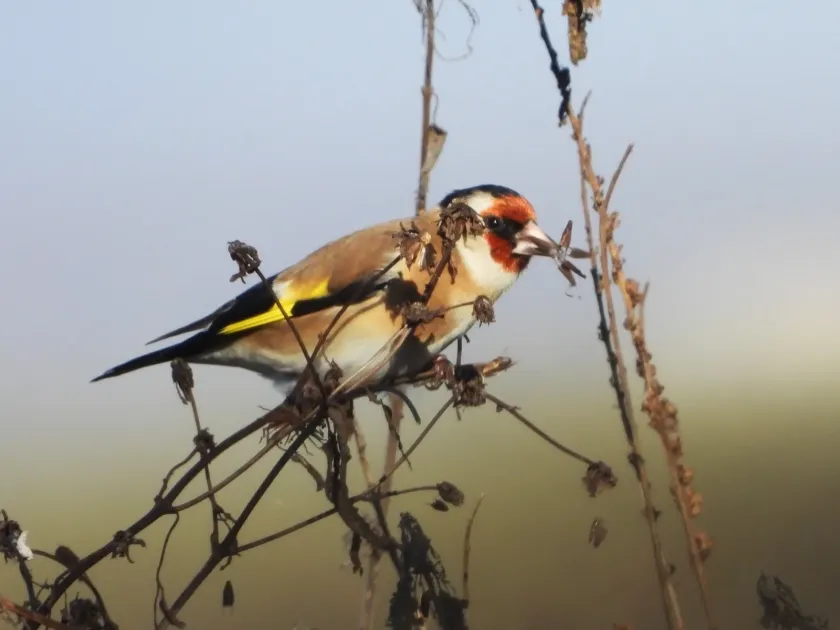
The European Goldfinch Carduelis carduelis is a small passerine bird belonging to the finch family Fringillidae. It is easily identifiable by its bright red face, black crown, and prominent yellow wing bars.
Adult birds are approximately 12–15 cm long with a thin, conical bill. This specialized beak allows them to efficiently extract seeds from various plant heads, making them highly effective seed predators in agricultural environments.
Goldfinches are highly social birds that congregate in large flocks during the post-breeding season. This flocking behavior is what makes them a significant concern for farmers, as they can cause rapid and localized destruction.
The species is well-adapted to human landscapes, frequently nesting in trees, hedgerows, and orchards near agricultural land. Their high mobility allows them to exploit food sources over large distances.
While they are beneficial in consuming weed seeds throughout the year, their diet shifts significantly during the autumn, leading them to target valuable commercial crops.
What it damages
Sunflowers are the primary crop targeted by European Goldfinches. They feed on the ripening seeds in the flower heads during the milk-to-dough stage, causing severe economic losses in seed production fields.
In addition to sunflowers, these birds damage various seed crops, including alfalfa, clover, and several types of vegetable seeds. They pick the seeds directly from the flowering heads, destroying the yield.
The damage is twofold: direct consumption of seeds and mechanical damage to the seed heads, which opens the way for secondary infections by fungi and molds, further reducing the overall crop quality.
In hybrid seed production, even a relatively small flock can cause disproportionate damage, leading to the rejection of entire batches of seeds due to low viability and broken seed coats.
The intensity of damage is highly variable and depends on the local bird population density and the availability of alternative natural food sources in the surrounding landscape.
When it appears
The peak period for agricultural damage occurs in late summer and autumn, coinciding with the maturation of sunflower and other oilseed crops. During this time, the population peaks as juvenile birds join the flocks.
In the spring and early summer, Goldfinches are less destructive to crops. They rely heavily on insects to feed their chicks and forage on the seeds of wild, non-cultivated plants.
As the harvest season approaches, the flocks become more aggressive, moving from field to field in search of ripening seeds. This pattern creates a predictable but hard-to-manage cycle of crop loss.
In milder climates, some flocks remain throughout the winter, potentially scavenging on unharvested fields or crop residues, which can complicate the preparation of land for the following planting season.
Migration patterns can lead to sudden influxes of goldfinches from neighboring regions, catching farmers by surprise if they have not established preventive measures in advance.
Signs of infestation
The presence of a goldfinch flock is often first detected by their characteristic tinkling calls. When disturbed, a large number of birds will quickly flush from the crop canopy.
Close inspection of sunflower heads reveals partially consumed seeds. Look for small, clean-cut holes in the seed coat or entirely hollowed-out seeds where the kernel has been neatly extracted.
Considerable amounts of discarded hulls found on the ground beneath the plants are a clear indicator of avian foraging activity. Significant accumulation of bird droppings on the heads is another sign.
Field staff can perform spot checks by inspecting 10–20 plants in different areas of the field. A significant percentage of damaged heads suggests that the flock is well-established and feeding regularly.
Because goldfinches are shy, they often feed on the edges of fields near trees. Monitoring these transition zones is key to identifying the early stages of a bird infestation.
Control measures
Acoustic deterrents are the most effective management tool. Automated systems that broadcast the distress calls of goldfinches or the predatory calls of hawks are highly effective at discouraging the birds.
Visual deterrents, such as reflective tape, hawk decoys, or rotating wind-powered devices, can provide temporary relief, though the birds tend to habituate to these methods if they are not rotated regularly.
Good agricultural practices, such as prompt harvesting once the crop reaches maturity, significantly minimize the window of opportunity for goldfinches to access the seeds.
Managing the vegetation along field borders is crucial. Removing weed patches that act as a primary food source for goldfinches can make the nearby crop fields less attractive to them.
Integrated bird management programs, which combine sound systems with occasional visual monitoring, offer the best protection for high-value seed crops in vulnerable regions.
Taxonomy
- Latin name
- Carduelis
- Family
- Fringillidae
- EPPO code
- CRDLSP
Discussion
No discussions yet — be the first.