
European goldfinch
Carduelis carduelis
Description
How to identify
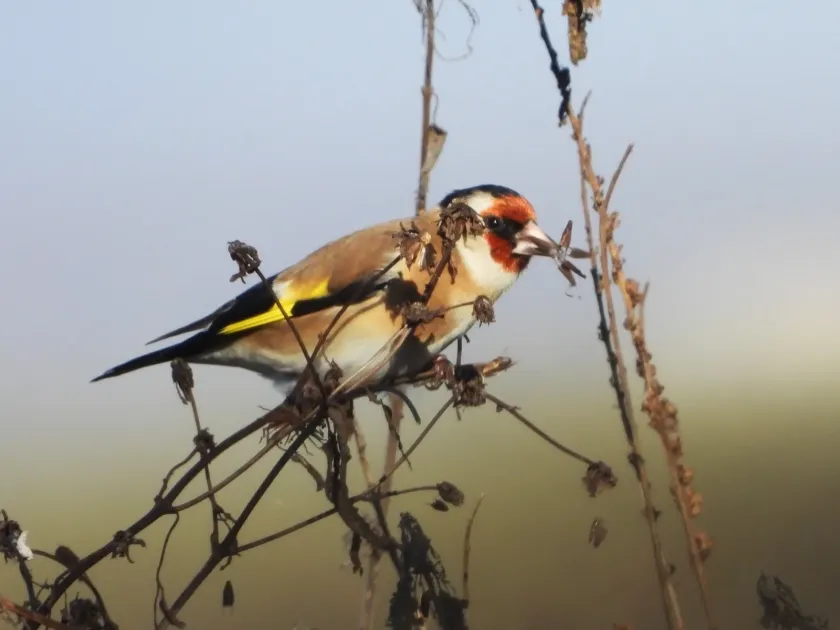
The European goldfinch (Carduelis carduelis) is a small passerine bird in the finch family (Fringillidae), recognizable by its distinctive tri-colored face mask.
Adults exhibit a bright red facial mask, a black crown, and prominent yellow wing bars, which make them easily identifiable when foraging in large flocks.
They possess a sharp, conical beak specifically adapted for extracting seeds from the seed heads of thistles, sunflowers, and other herbaceous plants.
These birds are highly social and gregarious, often forming large flocks that can descend upon fields to consume significant amounts of ripening seeds.
Nesting often occurs in nearby hedgerows, orchards, or woodland edges, providing the goldfinches with immediate access to agricultural land for their daily foraging trips.
What it damages
The primary agricultural damage is caused to seed crops, especially sunflowers, where goldfinches feed on the ripening seeds in the floral head.
In high-value seed production fields, these birds can cause substantial yield losses, sometimes compromising the entire seed harvest of a specific breeding line.
Mechanical damage to the sunflower head structure often leaves the plant susceptible to secondary infections, such as fungal rots, during humid weather conditions.
Beyond sunflowers, goldfinches may also feed on various horticultural seeds and occasionally damage buds of fruit trees, although this is generally of minor economic concern.
The cumulative effect of a large flock feeding over several days can be devastating, resulting in low seed test weights and reduced market quality of the harvest.
When it appears
The peak period of crop vulnerability occurs during the late summer and early autumn when sunflower seeds reach the stage of physiological maturity.
After the breeding season, goldfinch flocks become larger and more active, making them a significant threat to fields during the weeks preceding harvest.
Winter foraging on field leftovers can occur, but the primary economic impact is concentrated in the few weeks before the grain or seeds are ready to be harvested.
Spring activity is generally less impactful on field crops, focusing more on weed seeds and insects, though early sprout damage can occur in some intensive vegetable systems.
Monitoring for goldfinch presence is crucial during the seed-filling phase, especially in fields adjacent to natural corridors that offer ideal nesting sites.
Signs of infestation
Visible damage to seed heads, characterized by missing kernels and shredded floral structures, is a primary indicator of goldfinch activity in the field.
The presence of large, noisy flocks congregating on nearby power lines or fences is a strong warning sign that the field is being targeted for foraging.
Large quantities of empty hulls found on the ground directly beneath the crop rows provide clear evidence of prolonged feeding by a flock.
Damage often starts at the edges of the field nearest to tree lines or hedgerows, moving gradually toward the center as the food source becomes depleted.
Frequent, high-pitched vocalizations are easily detected by field workers when walking through the crop, indicating the presence of a foraging flock.
Control measures
Visual deterrents, such as holographic streamers, reflective tape, and predatory bird decoys, can be used to discourage goldfinches from landing in the field.
Bio-acoustic devices that broadcast distress calls or sounds of predators have proven effective in keeping large flocks at a distance from valuable seed crops.
Rigorous weed control in adjacent non-cropped areas reduces the local habitat's capacity to support large numbers of goldfinches throughout the season.
For high-value small-scale plots, physical barriers like netting are the most reliable way to prevent any bird access until the harvest is completed.
Scheduling harvesting as early as possible once maturity is reached is an essential strategy to minimize the window of opportunity for bird damage.
Taxonomy
- Latin name
- Carduelis carduelis
- Family
- Fringillidae
- EPPO code
- CRDLCR
Discussion
No discussions yet — be the first.