
Spruce spanworm
Semiothisa signaria
Description
How to identify
The spruce spanworm (Semiothisa signaria, syn. Macaria signaria) belongs to the Geometridae family, characterized by a unique looping movement of its larvae.
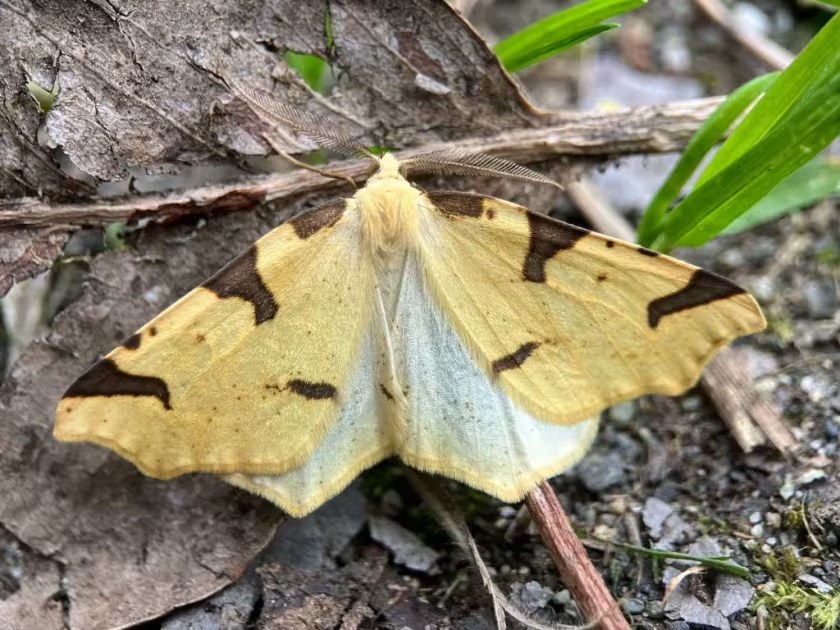
Adult moths are relatively small, typically with a wingspan of 25–30 mm, exhibiting mottled brown and grey patterns that blend perfectly with spruce bark.
The larvae, known as loopers or spanworms, possess a body structure with limited prolegs, forcing them to arch their bodies in a distinct loop during locomotion.
Their coloration is highly adaptive, ranging from light green to brownish hues with subtle longitudinal stripes, providing excellent camouflage among the conifer needles.
Pupation usually occurs in the forest litter or in bark crevices, where the pupae remain dormant through the winter to emerge as adults the following season.
What it damages
The primary hosts for Semiothisa signaria are various spruce species (Picea spp.), though it can occasionally feed on fir or pine trees.
Larvae feed by consuming the needles, often starting from the margins, which leaves ragged edges and leads to the eventual premature drop of damaged foliage.
Large populations can lead to significant thinning of the crown, which compromises the tree’s photosynthetic capacity and weakens its physiological condition.
Cumulative damage reduces annual tree growth and makes the affected spruce stands more susceptible to secondary pests like bark beetles or wood-boring insects.
In nurseries, repeated infestation by spruce spanworm can lead to the stunting of young trees, rendering them unsuitable for reforestation or decorative use.
When it appears
Adult moth activity typically peaks in the early summer, when environmental conditions are optimal for mating and subsequent egg-laying on host trees.
The larval stage is the most active period, occurring throughout the mid-summer months when the foliage is most nutritious for the developing caterpillars.
The life cycle is generally univoltine, meaning there is one generation per year, although warmer microclimates can slightly accelerate the development process.
Feeding intensity is at its highest during the later larval instars, which require substantial foliage intake before transitioning into the pupal stage.
As summer draws to a close, the spanworms descend to the lower parts of the tree or the ground to initiate the pupation process for overwintering.
Signs of infestation
Visual identification of infestation often starts with noticing partially consumed needles, which look frayed or jagged compared to healthy, intact ones.
The presence of fine, dark granular frass (excrement) dropping from the upper canopy onto lower branches is a strong indicator of active larval feeding.
Larvae can be detected by examining branches closely, as they often assume a rigid, branch-like posture when disturbed, making them difficult to spot.
The occurrence of fine silk webbing between needles or branches is another sign, used by the caterpillars to secure themselves or move between host needles.
Yellowing and thinning of the crown foliage become apparent as the infestation progresses, eventually leading to a noticeable reduction in the density of the tree's needles.
Control measures
Pheromone traps are highly effective for monitoring adult populations, allowing foresters to predict the risk of outbreaks and time interventions accordingly.
Natural predation by insectivorous birds and parasitic wasps plays a critical role in keeping spanworm numbers below the economic injury threshold.
Biological control agents, such as formulations of Bacillus thuringiensis (Bt), are recommended for targeted control without harming non-target beneficial insects.
In highly valuable nursery settings, chemical insecticides may be applied if infestation levels threaten the survival or structural integrity of the planting stock.
- Regular inspection of spruce foliage during June and July.
- Removal of dense leaf litter near susceptible young trees.
- Preservation of natural habitats for avian predators.
Taxonomy
- Latin name
- Semiothisa signaria
- Order
- Lepidoptera (butterflies)
- Family
- Geometridae
- EPPO code
- SEMOSI
Discussion
No discussions yet — be the first.