
Hazel leaf moth
Semioscopis avellanella
Description
How to identify
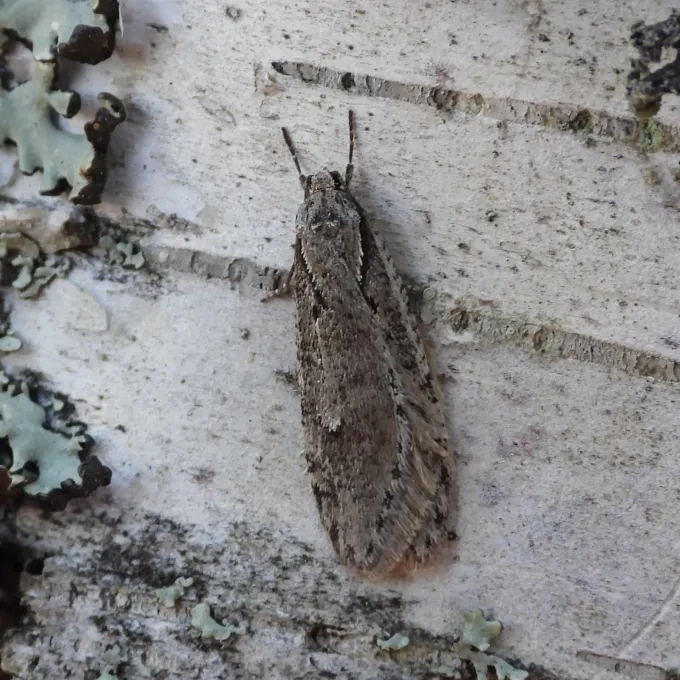
The hazel leaf moth (Semioscopis avellanella) belongs to the Depressariidae family. These are small moths with a wingspan reaching approximately 25 mm.
The forewings have an ash-grey or brownish color with fine dark speckles, providing excellent camouflage against the bark of host trees during the day.
The larvae, or caterpillars, change their appearance as they grow, usually maintaining a color profile that blends with the green leaves of the hazel plant.
The moth is recognized as an early-season pest, with adults emerging as soon as spring temperatures start to rise, making them active earlier than many other insects.
Pupation occurs within dense silken cocoons spun inside leaves or bark crevices, which are often difficult to spot during routine garden inspections.
What it damages
While hazel (Corylus avellana) is the primary host, this moth can also infest other deciduous trees like linden and birch when population levels are high.
The larvae are leaf-tiers; they use silk to bind leaves together, creating a safe chamber where they feed on leaf tissue without being exposed to predators.
Heavy infestation leads to severe skeletonization of the leaves, where only the veins remain, which significantly impairs the tree's ability to photosynthesize.
In hazelnut orchards, significant damage to the foliage can weaken the overall vigor of the trees, potentially affecting nut quality and yield in subsequent years.
Young trees are particularly vulnerable, as the loss of leaf surface can stunt their growth during the critical early stages of the growing season.
When it appears
Adult moths typically emerge in late March or early April, coinciding with the first warming trends of the spring season in many regions.
The larval stage is the most active and damaging phase, occurring primarily throughout May and June as they consume foliage to fuel their development.
By mid-summer, the larvae pupate, and the cycle enters a period of dormancy, with the insect waiting in its cocoon until the following spring.
Monitoring efforts should be focused on the period of bud burst, as this is when young caterpillars begin their initial feeding on emerging foliage.
Missing the early detection window often results in a more widespread infestation that is significantly harder to manage once the larvae are fully grown.
Signs of infestation
The most prominent sign of infestation is the appearance of rolled or tied leaves held together by fine, web-like silk threads, forming distinctive nest structures.
- Irregular holes eaten through the leaf tissue.
- Leaves folded or spiraled into tube-like shapes.
- Presence of larval frass (droppings) inside the tied leaves.
- Visible skeletonized patches on the leaf surface.
- Stunted or deformed terminal buds and new shoot growth.
Inspectors can confirm the presence of the pest by carefully unrolling the tied leaves to observe the larvae or the cast skins left behind after molting.
Control measures
Integrated pest management (IPM) is essential for controlling this moth, starting with cultural practices like clearing leaf litter and scraping loose bark during winter.
In small-scale or home gardens, physical removal of the silken nests by hand is highly effective and eliminates the need for chemical interventions.
Biological control agents, specifically products containing Bacillus thuringiensis, are highly effective when applied during the early larval development stage.
Chemical insecticides should be considered only as a last resort, using targeted applications to minimize impact on beneficial insects and pollinators in the orchard.
Always maintain a regular inspection schedule to identify "hot spots" early, allowing for localized treatments rather than blanket orchard sprays.
Taxonomy
- Latin name
- Semioscopis avellanella
- Order
- Lepidoptera (butterflies)
- Family
- Depressariidae
- EPPO code
- SMOSAV
Discussion
No discussions yet — be the first.